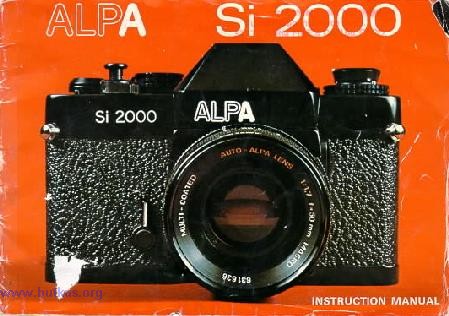
This camera manual library is for reference and historical purposes,
all rights reserved.
This page is copyright© by
, M. Butkus,
NJ.
This page may not be sold or distributed without the
expressed permission of the producer
I have no connection with any camera company
On-line camera manual library
This is the full text and images from the manual.
This may take 3 full minutes for all images to appear.
If they do not all appear. Try
clicking the browser "refresh" or "reload button" or right click on the
image, choose "view image" then go back. It should now appear.
To print, try printing only 3 or 4
pages at a time.
If you find this manual useful, how about a donation of $3 to: M.
Butkus, 29 Lake Ave., High Bridge, NJ 08829-1701
and send your e-mail address
so I can thank you.
Most other places would charge you $7.50 for a electronic copy or
$18.00 for a hard to read Xerox copy.
Back to main camera manual page
Problems opening PDF files or printing problems - click here

Type: 35mm Single Lens Reflex Camera with electronically controlled
exposure system, fully automatic aperture-priority type.
Picture size: 24mm x 36mm.
Film: 35mm cartricige film.
Lens mount: Pentax/Praktica mount.
Viewfinder visibility: 92% of negative size.
Mirror: Quick return system.
Shutter: Metal focal plane, vertical path, electromagnetically controlled.
Shutter speeds: Auto 2 sees - 1/2000 see (stepless). Manual
B,1 sec-1/2000 see, and "X".
Mechanical shutter operation
at "X" (1/90 see).
Exposure meter: TTL centre weighted measuring system employing
two Silicon blue cells.
Automatic exposure range
of EV 0-19 with ASA 100 (2 sees at f/1.4 to 1/2000 sec at f/16).
ASA range: 25 - 3200.
Film wind: Single stroke in an arc of 134° with 20° play.
Film counter: Automatically indicates number of exposures and resets to zero when the camera back is opened.
Self-timer: 6-10 seconds.
Exposure memory: Push button with Film rewind: Folding crank type.
Accessory shoe: Built in hot shoe.
Synchronization: X (X=1/90 sec)
Multiple exposure: Multiple exposure provision.
Power source: 6V silver oxide battery (Eveready No. 544
or equivalent). 4www.butkus.org
Viewfinder blind: Built in viewfinder blind to prevent extraneous
light from affecting the meter reading when the
Battery test: Indication by a green signal lamp.
Dimensions: (Body only) 145mm (W) x 97mm (H) x 54.5mm (D).
Weight: (Body only) 760 gr.
To install battery:
1. Using a coin. unlock the battery chamber cover by turning it counterclockwise.
2. Place the 6V silver oxide battery with the minus ( -) side facing
upwards as indicated by the symbol in the battery chamber (Fig. 1).
Note:
To test battery:
Test the battery when:
A new battery is installed.
LOADING THE CAMERA
Use 20 or 36-exposure 35mm film.
2. Keep the film rewind knob pulled all the way out, insert the film
cartridge into the film chamber with the protruding end towards the base
of the camera. Push in the film rewind knob (Fig. 7)
Note: Do not load or unload the camera in bright sunlight.
ADVANCING THE FILM
To make sure the film has been loaded properly, operate the film
advance lever through a full stroke (Fig. 9). Now turn the
rewind knob clockwise until resistance is felt. Do not force it. Keep observing
film rewind knob; it should turn counterclockwise every time the film is
advanced.
Operate the film advance lever and release shutter until figure ''1''
is opposite the pointer in the frame counter window. The camera is now
ready for the first exposure (Fig. 10).
Note: When the shutter release button lock lever is engaged,
the shutter cannot be Important:
THE FILM SPEED SETTING
The ASA/DIN speed of the film is indicated on the film box or in the
instruction sheet packed with the film. Select the desired ASA/DIN speed
by turning the ASA selection pin until the appropriate ASA number appears
in the ASA dial window,
SHUTTER SPEED SETTINGS
The ALPA Si 2000 camera is equipped with an electromagnetically controlled
shutter for either automatic or manual exposure control. To set the camera
for automatic shutter speed selection rotate the shutter speed dial until
the ''Auto'' mark is opposite the index line on the camera body (Fig.
13). To set it for manual exposure control, turn the shutter speed
dial until the desired shutter speed is lined up with the index mark on
the camera body.
THE APERTURE SETTINGS
The aperture is are set in the usual way by rotating the lens diaphragm
ring until the required F-stop is set against the red diamond index mark
on the lens barrel (Fig. 14,15). With the shutter speed dial set
at "Auto" the electronic metering system will set the corresponding~shutter
speed to ensure correct exposure of the film.
FOCUSING
Set the Auto/Manual control on the lens to the "Auto" position. (Fig.
16) Observing the subject through the viewfinder, turn the focusing
ring on the lens until the image in the microprism disc in the center of
the viewfinder appears crisp and clear
Scale focusing
The distance scale may also be used for focusing. Estimate or measure
the camera-to-subject distance in feet or meters, then set the focusing
ring to this figure (Fig. 19).
AUTOMATIC EXPOSURE
The meter on/off switch is incorporated in the winding mechanism. It
is therefore necessary to advance the film advance lever before proceeding.
Set the shutter speed dial to "Auto" (Fig. 20) and select the aperture
according to your purpose for shooting the picture. Focus the subject.
Depress the shutter release button as slowly and smoothly as possible When
the shutter release button is half way depressed, the exposure meter needle
will indicate the correct shutter speed figure according to the light value
which corresponds to the chosen aperture value (Fig. 21). Further
depression of the shutter release button will release the shutter at the
shutter speed indicated in the viewfinder.
Exposure Meter Needle
1. Over exposure:
Over exposure will be indicated by the meter needle moving into the
upper striped area of the viewfinder scale (Fig. 22). Should this
occur the lens aperture must be reduced until the needle enters the shutter
speed scale. If the needle will still not enter the scale a neutral density
filter must be used.
2. Correct exposure:
While the exposure meter needle stays within the scale (arrow marked)
correct exposure will result It will be found when handling the camera
that automatic shutter speed selection is a function of the aperture and
the ASA values chosen. As the lens aperture is altered the shutter speed
will alter accordingly. Therefore, if the camera selects a speed that is
considered unsuitable for the subject to be photographed, alter the aperture
until a suitable shutter Should the meter needle move below 1/30 sec. then the use of a tripod
is recommended, providing that a larger aperture cannot be set (Fig.
23).
3. Under exposure:
UNLOADING THE CAMERA
When the red figure "20" or "36" (20 or 36 exposures) appears against
the index mark in the frame counter window, the end of the film
has been reached.
Steps for Unloading the Camera:
1. Press in the rewind release button on the camera bottom (Fig.
25).
2. Lift up the rewind crank on the rowing knob (Fig. 26).
3. Turn the rewind crank in a clockwise direction (Fig. 26).
Tension will be felt as the film is being rewound into the cartridge. Stop
rewinding when the tension ceases. Open the camera back by pulling out
the rewind knob all the way and lift out the film cartridge (Fig. 27).
The rewind button on the camera bottom will snap back into position when
the film advance lever is next operated. Have the film processed without
delay.
CHANGING THE LENS
The ALLAi 2000 is equipped with a screw mount which accepts any interchangeable
lens with the Pentax/Practica screw mount. To remove the lens, keep turning
the lens counterlockwise until it is separated from the camera body (Fig
28, 29) .www.4.butkus.org
Note: Do not remove or replace the lens whilst camera is functioning.
THE EXPOSURE MEMORY BUTON
On normal use the ALPA Si 2000 will produce perfectly exposed photographs,
due to the automatic exposure system incorporated in the camera.
Steps for using the exposure memory: 2. Press the shutter release button half way and measure the light on
the main part of the subject you want to shoot, excluding all unnecessary
light from the side or background (Fig. 30, 31, 32). Then press
the exposure memory button which will instantly memorize the light value
on the subject (Fig. 33) and twist the memory button backward until
it is locked. When the memory button is locked, the green lamp in the viewfinder
will go on.
After the exposure return the memory button to its original position.
When the memory button is released the green lamp is turned off. (Fig.
34)
3. With the exposure memory button locked compose the subject in the
viewfinder as you desire (Fig. 35), and press the shutter release
button all the way to take the photograph.
EXPOSURE COMPENSATION
For special purposes such as multiple exposure, exposure compensation
can be accomplished by resetting the ASA/DIN dial. The following guide
will be found useful in determining the correct length of exposure (Fig.
38).
(1 ) white index 2/3 over exposure
(2) white index 1/:4 over exposure (Fig. 36)
(3) red index 1 x correct exposure
(4) white index 1/3 under exposure
(5) white index 2/3 under exposure (Fig. 37)
As an example if over exposure to the extent of x 2/3 is required, set
100 ASA to the red index (1). With this method it is possible to compensate
from 40 to 250 ASA (Fig. 38). After the exposure has been made the
ASA number must be returned to the red index mark.
MANUAL EXPOSURE
By moving the shutter speed dial off the ''Auto" setting manual shutter
speeds are set. There are two methods of selecting the correct exposure.
1. Set the required shutter speed on the dial. While depressing the
shutter release button observe the meter in the viewfinder. Rotate the
lens aperture ring until the needle aligns with the corresponding shutter
speed figure on the scale in the viewfinder (Fig. 39).
2. Set the required aperture on the lens. Slightly depress the release
button and observe which shutter speed is indicated in the viewfinder.
Set this speed on the shutter speed dial.
If for speccial purposes it is necessary to either under or over expose
the photograph, proceed by either of the previous methods. Then rotate
the lens aperture ring to bring the meter needle above the shutter speed
indicated in the viewfinder. This will produce over exposure.
The Manual shutter speeds can be used for:
1. A particular shutter speed that is required and beyond the coupling
range of the meter, e.g. 1 sec exposure at 3200 ASA.
2. Exposure compensation.
3. " B " ("Time" exposures longer than that possible in the Auto mode).
4. Flash synchronization ("X").
Mechanical shutter operation:
Since the "X" (1/90 see) position employs a mechanical shutter, it is
usable even when the battery is dead. Setting the shutter speed dial to
the''X" position whenever loading the camera with film or operating the
shutter in an unloaded camera will also save unnecessary battery drain.www.4.butkus.org
MULTIPLE EXPOSURE
When desired, the shutter can be cocked without transporting thefilm.
This feature enables making double or multiple exposures on a single frame
of film.
Take the first picture in the normal way. Before moving the film advance
lever, slide the multiple exposure switch to the left, as far as it will
go (Fig. 41). A red signal appears in the window indicating that
the film advance lever can be wound, but it will only cock the shutter
and not transport the film.
Depress the shutter release to make a second exposure on the same frame.
Operating the shutter release returns the multiple exposure knob automatically
to its original position to prevent accidental multiple exposures. If a
third exposure is desired on the same frame, just move the multiple exposure
knob to the left once more, operate the film advance lever to cock the
shutter, then depress shutter release. This procedure can be repeated to
obtain any number of exposures on the same frame of film.
DEPTH OF FIELD
Visible check in the viewfinder:
THE SELF TIMER
This device, when set, trips the shutter mechanism after a delay of
6-10 seconds. It is necessary if the photographer wishes to be in the picture,
and is useful for tripping the shutter at a slow shutter speed if a cable
release is not available.
To operate, move the self-timer lever counterclockwise as far as it
will go. Advance the film transport lever. Upon pressing the shutter release
button the self timer mechanism will start to operate. (Fig 45, 46).
If the self-timer is used in the " Auto " mode, turn the viewfinder blind
lever clockwise, closing the viewfinder system and thereby preventing extraneous
light from influencing the metering system (Fig. 47).www.4.butkus.org
It is advisable to use flash when the exposure meter indicates that
the light level is too low, such as indoors, at night time, or in daylight
where the subject is too dark to provide adequate exposure (Fig. 48,
49).
Electronic flash units as well as conventional flash units using flashbulbs
may be utilized. The ALPA Si 2000 has a hot shoe (accessory shoe with built-in
flash contact) together with standard.
(Webmaster: any standard flash will work with this camera.
They are found in department stores for $20 and up. They are "auto" flashes.
The higher priced flashes may have two or more "auto" settings. Just
set the flash to the auto setting, the camera to X and the F-stop to the
flash chart depending on the ASA of the film in the camera. The flash
will determine the distance and amount of flash needed. DO NOT use
another flash from another camera with extra pins on the bottom of the
flash shoe. You could damage the flash.)
P.C. outlet for "X" (Fig. 50)
Electronic and conventional flash units having a foot with built-in
contact may be used without a connecting cord. As the hot shoe has''X"
type synchronization, it can be used with electronic flash at''X" (1/90)
(Fig. 51) or at slower shutter speeds, the lens aperture is determined
by the calculation table indicated on flash units
USING INFRA-RED FILM
To use infra-red film an extra focusing adjustment must be made. After
focusing note the figure that is adjacent to the red diamond on the distance
scale then move that figure over to the red "R'' marked to the right side
of the red diamond. (Fig. 52) This adjustment is only required for black
and white infra-red~film. When using color infrared film, focus in the
normal way.
Your ALPA Si 2000 Single Lens Reflex Camera is a precision instrument.
Used with care, it will provide years of service.
camera is used away from
the eye.


3. Replace the battery compartment cover by turning fully clockwise
(Fig. 2).
Clean the battery with a dry cloth or paper before inserting and thereafter
at regular intervals. Make sure that the battery is inserted correctly,
i.e. check polarity.
The shutter will operate only
The camera is not used for a long period of time.
The camera is being used continuously for many hours.
To test the battery, set the shutter speed dial to the "Auto"
position (Fig. 3). Wind the film advance lever and
press the shutter release button half way. If the battery is in good condition,
the green lamp in the viewfinder frame will go on. When the green
lamp does not go on, replace the battery (Fig. 4, 5).
Note:
Every time a photograph is taken in the auto mode, the green lamp should
go on, indicating that the the battery is still in good condition. When
the indicator lamp fails to go on, replace the battery at once.
1. Pull out the film rewind knob until the camera back is released,
(Fig.
6) then swing the camera back fully open.
It may be found necessary to turn the knob slightly so that the rewind
shaft engages the film cartridge spool. Insert the trimmed end of the film
into the slot of the take up spool. Holding the film lightly down onto
the transport sprockets, operate the film advance lever. Having checked
that the upper and lower film perforations have engaged the transport sprockets,
close the camera back firmly (Fig. 8).
Set the shutter speed dial to the "X" position when making two blank
exposures to dispose of the first few inches of film which were exposed
during loading. After the film counter indicates you are ready to take
the first exposure, be sure to return the shutter speed dial to the "Auto''
position.
www.4.butkus.org
(Fig. 12) and then align the ASA/DIN number with the white index
line on the camera top cover by turning the ASA/DIN dial.
(Fig. 17,18). Once this point is reached it is advisable to
continue turning the ring through the area of sharpest focus and then back
again. This procedure ensures without doubt that the image is at its sharpest.


Under exposure will be indicated by the meter needle moving into the
lower striped area of the viewfinder shutter speed scale (Fig. 24).
To compensate open up the lens aperture until the needle moves back onto
the scale. Should the needle still not re-enter the scale additional lighting
or a flash unit must be used.


However some lighting conditions will occur that could misguide the
system. Subjects with very high contrast or strongly back-lit are examples
Such misguidance occurs with electronic shutter cameras since the exposure
system continuously follows the fluctuations of light intensity up until
the very instant that the
1. Focus the subject. Make sure that the shutter speed
dial is set at the ''Auto'' position.
Note: The exposure memory system will be erased by releasing the exposure
memory button before shooting. The memorization only functions by
simultaneous operation of the shutter release button and the exposure memory
button
Conversely if the needle is brought below the indicated shutter speed
then under exposure will result.
Caution: Get into the habit of immediately returning the shutter
speed dial to the "Auto" position after using the manual mode to avoid
possible future incorrect exposures (Fig. 40).
Depth of field designates the nearest and furthest limits of the area
that will be sharp in the picture in front of and beyond the subject. Depth
of field is controlled by the f/stop. The larger the lens opening (f/stop),
the shallower is the depth of field. The smaller the lens opening, the
greater the depth of field will become (Fig. 42, 43).
Set the lens at selected lens opening on the F-stop ring. Depress the
shutter release button half way and observe the subject through
viewfinder. This will enable you to preview the area of sharpness
in the picture before shooting.
Depth of field scale:
The depth of field scale indicates (after focusing) the approximate
area that will be sharp in the picture. Locate on the depth of field scale
the corresponding pair of f/stop figures. The distance between these two
f/stop figures on the focusing ring will be the area of sharpness in your
picture. (Fig. 44)
When using the self-timer the camera must of course be mounted on a
tripod, or a solid support of some kind.
(Webmaster: very few new flashes come with the old flash cord. This
is usually for off the camera flash units to help eliminate "red eye".)
(Webmaster: slower shutter speeds can bring in the background lighting
but could blur the image due to camera shake. A tripod is recommened)
Protect our camera from dirt, rain, dampness, and excessive heat. Avoid
touching the lens. To clean the lens wipe it gently with a soft, lintless
cloth or tissue. Do not use eyeglass tissues as they might damage the lens
coating.