and historical purposes, all rights reserved.
This page is copyright© by
 ,
M. Butkus, NJ.
,
M. Butkus, NJ.This page may not be sold or distributed without
the expressed permission of the producer
I have no connection with any camera company
This camera manual library is for reference
and
historical purposes, all rights reserved.
This page is copyright© by ,
M. Butkus, NJ.
This page may not be sold or distributed without
the expressed
permission of the producer
I have no connection with any camera company
On-line camera manual library
If you find this manual useful,
how about a donation of $3 to:
M.
Butkus, 29 Lake Ave.,
High Bridge, NJ 08829-1701
and send your e-mail address
so I can thank you.
Most other places would charge
you $7.50 for a electronic copy
or $18.00 for a hard to read Xerox copy.
This will help me to continue to host this site,
buy
new manuals, and pay their shipping costs.
It'll make you feel better, won't it ?
If you use Pay Pal, use the link below.
Use the above address for a
check, M.O. or cash.
https://www.PayPal.me/butkus
Venmo @mike-butkus-camera Ph. 2083
<<<
IF YOU
WOULD LIKE THIS OR ANY PDF FILE
PRINTED, BOUND AND MAILED TO YOU,
SEE THIS OUTSIDE COMPANY'S OFFER
>>>
Back to main camera manual page
Problems opening PDF files or
printing problems
- click here
CLICK HERE FOR VIKING 4.5 PDF
DIRECT FROM MANUAL
CLICK HERE TO Ansco Viking PDF VERSION OF 6.3
from file below - BETTER PRINTING
Your Ansco Viking takes 8 pictures this size (2 1/4 x 3
1/4) on a roll of Ansco 120 film.
YOUR ANSCO VIKING
Your Ansco Viking is a precision manufactured camera designed by experts to give excellent results with ease and simplicity of operation. The Viking 6.3 has a Vario shutter equipped with flash synchronization and many other features designed to aid you in getting the best results from your photography.
The Viking has an 105mm Agfa Agnar Anastigmatic lens, hard coated for higher light transmission, and color corrected. This high quality lens and shutter unit insures accurate exposures and crisp, sharp pictures in both black and white and color photography.
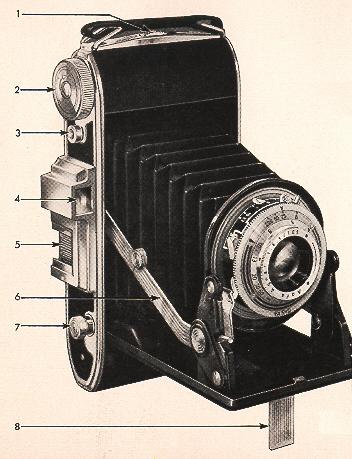 |
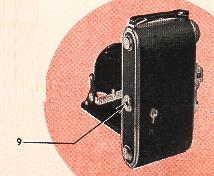
1. Camera back latch 2. Film winding knob 3. Platform release button 4. Viewfinder 5. Accessory clip 6. Side arm brackets 7. Shutter release button 8. Platform support 9. Tripod screw socket |
 |
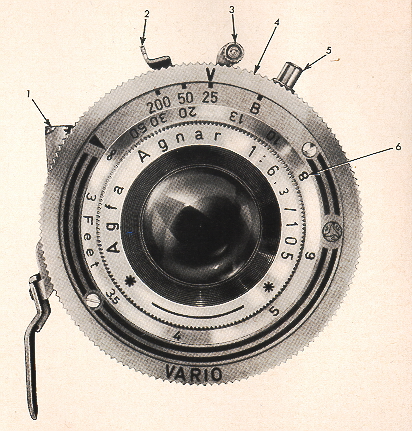 |
Lens Openings:
1. Cable Release Socket 2. Diaphragm Setting Lever 3. Shutter Winding Lever 4. Exposure Time Setting Ring 5. Flash Contact 6. Focusing Scale |
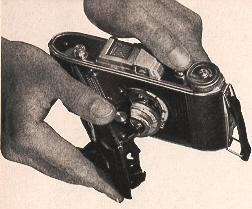 |
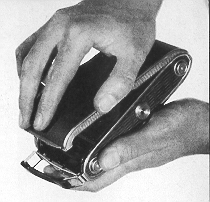
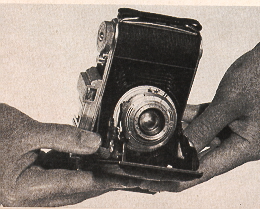
To open the camera, hold firmly as shown
in the picture at left. Press the platform release button. The bellows and
lens will spring forward and the platform lock
into position. Should the platform fail to lock, push downward on both sides
of the platform until it locks in place.
|
 |
Press down on the two side arm braces and press the platform up until it is completely closed and the "click" of the platform latch is heard. Repeat opening and closing the camera until these operations can be performed deftly and easily. |
Never force the camera at any time.
 |
The Viking camera is equipped with an optical type finder. By holding the camera to the eye the area that will appear in the picture can be seen. The eye level viewfinder is advantageous since it gives an image in the same perspective as when the subject is normally viewed. When taking pictures closer than 15' one should aim the camera slightly higher to include a little more area above the subject than is desired in the picture. |
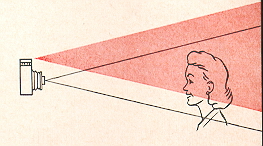 |
This is done to overcome a slight difference in view caused by the difference in location of the view finder and the lens. |
 |
The focusing scale will be found on the focusing ring of the lens barrel and can be identified by a series of figures running from 3' to co (infinity). The numbers in this series refer to the distance in feet from camera to the subject at which the lens is focused. For example: If the subject to be photographed is 15' away, revolve the focusing ring until the number 15 is opposite the index mark. Distances from the lens to all objects from 3' to 30' should be estimated as closely as possible owing to the limited depth of field. For distant subjects, the ring should be set at 00 (infinity), meaning as far as the eye can see. |
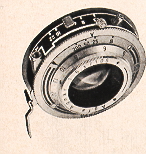 |
To use as a fixed focused non-adjustable camera, set the focusing scale at 10' or 30' (numbers in red), the lens diaphragm at the orange dot on the F stop scale, and the shutter at 1/50 of a second. With the camera set at 10', close-ups of from 8' to 15' will be in focus. At 30' everything from 15 to 00 (infinity) will be in focus. Sharper pictures of any particular subject will result, of course, if the lens is focused at the exact distance from the camera to the subject. |
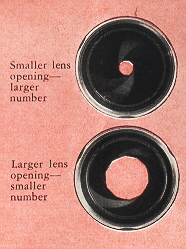
| The diaphragm is an adjustable opening between the components of the lens which controls the amount of light passing through the lens. The diaphragm is operated by a lever located on top of the lens mount which moves the iris leaves. The movement of these leaves can be observed by setting the camera at Bulb ((B),), holding the shutter open, and moving the lever back and forth; when doing this note that the smaller numbers indicate the larger lens openings, (i.e., f6.3 is the largest opening, f22 the smallest). |
|
 |
The shutter of a camera is the device that determines the length of the exposure when a picture is taken. Simply expressed, the shutter opens briefly allowing the light from the object to be photographed to pass through the lens and project an image on the film. The shutter can be set at mechanically regulated speeds from l/25th of a second to 1/200th of a second. Longer exposures can be made through the use of a Bulb (B) setting in which the shutter remains open as long as the shutter release button is depressed. It should be remembered that with Bulb exposures, and all exposures under 1/25th of a second, a tripod or similar firm support should be used. |
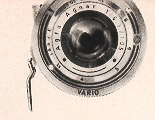
| The shutter of the Viking is regulated
by setting the exposure setting ring opposite the speed desired on the face
of the lens mount.
|
|
|
|
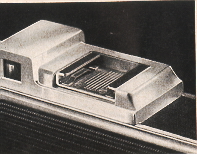
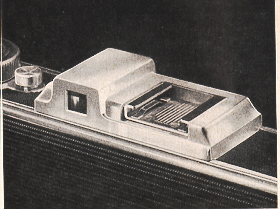
This handy clip may be used for
attaching a wide selection of standard camera accessories such as flash guns
and range finders.
|
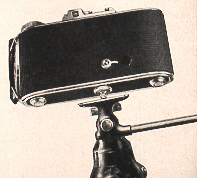
| The tripod socket (see right) is primarily used for attaching the camera to a tripod but in addition, some accessories (such as many types of flash units) are attached to the camera by this socket. |
|
|
|
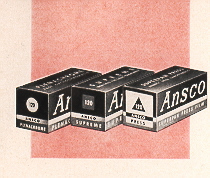
there is an Ansco Film for every picture |
Plenachrome -- the All Weather Film. A fast,
orthochromatic film for brilliant outdoor pictures in any
weather. Available in single rolls and 3 Roll Economy Packs.
Supreme -- A high speed panchromatic film for indoor or outdoor
photography under natural or artificial light.
Superpan Press -- An extremely high speed panchromatic film especially
designed for use under adverse light conditions as well as all normal types of
photography.
| Always load in subdued light.
To load the camera, first open the camera by moving the camera back latch in the direction of the arrow. The hinged back will then open with ease.
|
|
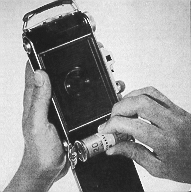 |
To load the film into the camera first swing out the spool carrier. Place the spool on the stationary pin of the spool carrier and then close the hinged side so that it engages the hole in the opposite end of the spool. Now return the spool carrier to its normal position. |
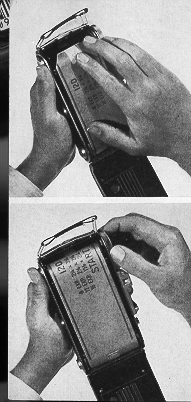 |
Break the seal and pull the colored paper backing across
the back, being sure that the black side of the paper faces the lens. Draw the
end of the paper over the top of the two metal rollers (never attempt to thread
the film under these rollers). Thread the pointed end of the paper into the slot
of the empty take-up spool.
Be sure to center the paper on the take-up spool so that it will wind evenly. Now give the winding knob one or two turns to bind the paper and give it a firm grip on the upper spool. Close the back of the camera by swinging it back into place until a "click" indicates that it is locked securely. Do not open back of camera again until film has been completely wound on take-up spool. Move the small lever on the camera back in a
counterclockwise direction to uncover the film winding window. Turn the
winding knob until the number 1 appears in this window (you will see a
pointing hand and four dots just before the number "1" appears).
|
| The proper exposure for any given picture varies considerably according to the light conditions and speed of the film being used. Light conditions vary with seasons, time of day and even geographical location. The Viking camera is equipped with a sufficiently versatile lens and shutter to allow pictures to be made under almost any type of lighting condition. Average exposures for favorable conditions outdoors are given in the tables below: |  |
| Light Conditions | 1/25 | 1/50 | 1/200 |
| Bright Sunlight | f22 | f l6 | f8 |
| Hazy Sunlight | fl6 | f11 | f6.3 |
| Bright Overcast | f l l | f8 | -- |
| Dull Overcast | f8 | f6.3 | -- |
 |
For pictures at night or indoors, flood lamps are usually used to provide the necessary light. A tripod or similar firm support must be used for exposures longer than 1/25 of a second to prevent movement of the camera. It is desirable to use a cable release for these exposures since it helps to prevent movement of the camera as shutter is tripped. The cable release screws into the socket at the right side of the lens mounting. |
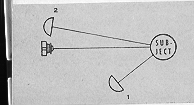
The recommended light sources are two No. 2 flood
lamps in good quality reflectors or two No. 2 reflector flood lamps with
Built-in reflectors. Lights should he placed according to the diagram: Main
light source (No. 1) should be directed downward at 45°. Fill-in lamp (No. 2)
should be close to the camera. Values are based on light colored walls or
surroundings. Darker colors require an increase of one or two lens stops.
*For Plenochrome and Supreme use the next larger lens opening
(smaller number).
flash exposures . . .
Your Viking has built-in flash synchronization. No other
synchronizer is necessary. Any flash gun with a 3mm continental type contact can
be used to take pictures indoors or at night. Just be sure the flash connector
is firmly attached to the flash contact ( Page 4, No. 5 ). Use this handy flash
guide for quick reference and easy flash exposures with Ansco Film.
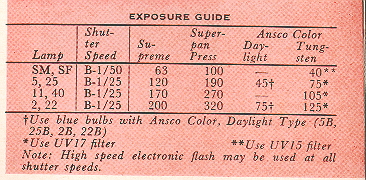 |
To find the exposure, divide the
distance from the flash lamp to the subject into the guide number; the
resulting figure will represent the lens opening required. Example: The
guide number for a number 5 bulb with Supreme Film is 120. The subject is 15
feet away therefore 120/5 = 8, use f/8. More complete guide number
information will be found on the instruction sheet packed with your Ansco
Film.
|
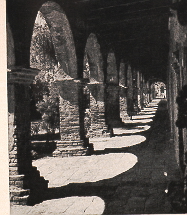 |
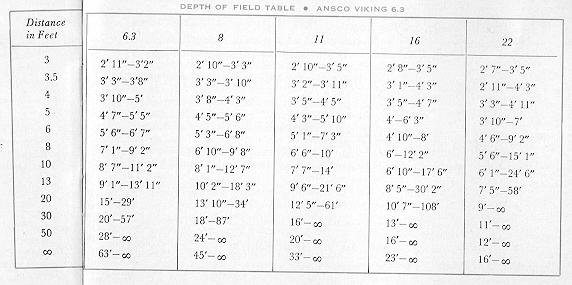
Depth of field is the range of l
distance in front of the camera that is in sharp focus. Greater depth of
field will result when smaller diaphragm openings are used. For example, with the camera focused at infinity ( 00 ) and the diaphragm set at f/6.3, everything from 63 feet to infinity will be sharp and in focus. When the camera is focused at infinity and the diaphragm set at f/16, everything from 23 feet to infinity will be in focus. |
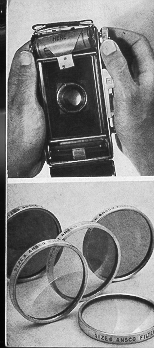 |
When the last picture has been taken, wind the film until you can no longer see the paper through the red window, then open the back of the camera. Pull out the film winding knob and remove the exposed film from the camera. Fold the pointed end of the colored paper under and seal the spool with the "exposed" sticker. You are ready now to process your film at home or take it to your Ansco dealer for processing. Remove the empty spool from the supply spool holder and place it in the take-up chamber so that it will be ready for the next roll of film. lens accessories
|
Ansco color film . . .
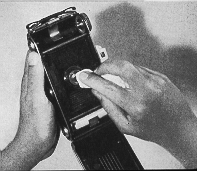 |
Your new Viking is a precision instrument and should be
treated with care. Do not allow it to lie in the sun or leave it in the glove
compartment of your car.
The outside and inside elements of your Viking lens should be carefully cleaned from time to time with a soft lens tissue or fine linen cloth. If small particles of dust or dirt gather inside your Viking, blow them out carefully. |
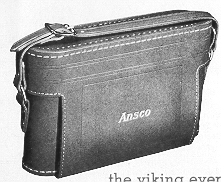 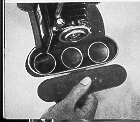 |
The use of a carrying case will help to protect your Ansco Viking from hard knocks, dust, rain and dampness. With the Viking Eveready Case, your camera is ready for instant use; just unsnap the button and front cover swings away. Inside the cover of the camera case is a convenient compartment with a snap lid for carrying lens filters. Ask your dealer for the Ansco Viking Eveready case, JN 450. |