Chinon Auto GLX
Focus free - DX Program
This camera manual library is for reference
and historical purposes, all rights reserved.
This page is copyright© by

,
M. Butkus, NJ. © 2001
This page may not be sold or distributed without
the expressed permission of the producer.
I have no connection with any camera company.
On-line camera manual library.
If you find this manual useful,
how about a donation of
$3 to:
M. Butkus, 29 Lake Ave.,
High Bridge, NJ 08829-1701
and send your e-mail
address
so I can thank you.
Most other places would charge
you $7.50 for
a electronic copy
or $18.00 for a hard to read Xerox copy.
This will help me to continue to host this site,
buy new manuals, and pay their shipping costs.
It'll make you feel better, won't it ?
Use the above address for a check, M.O. or cash.
If you use Pay Pal, use the link below.
Back to my main
Camera Manual page
Problems opening PDF files or
printing problems
- click here
<<< IF YOU WOULD LIKE THIS OR ANY PDF FILE
PRINTED, BOUND AND MAILED TO YOU,
SEE THIS OUTSIDE COMPANY'S OFFER >>>
CLICK HERE TO
Chinon Auto GLX PDF VERSION
MADE FROM HTML PAGE BELOW
CLICK HERE FOR
Chinon Auto GLX
DIRECTLY FROM MANUAL
TABLE OF CONTENTS
Nomenclature . . . . . 2
Specifications . . . . . . 8
Simplified Guide for Using Your Camera . . . . 12
Installing the Batteries ........... 14
How to Open the Lens Cover . . . . 16
Battery Testing ......... 18
Automatic Film Speed Setting . . . . 18
Automatic Film Loading ........ 20
Holding the Camera ............ 24
Viewfinder ......................... 26
Auto-Focus Shooting ............. 28
Focus Lock System ... . . . . 32
Film Rewinding ...... 34
Flash Photography ........... 36
How to Use the Hand Strap . . . . .. 40
Optional Carrying Case ..... 41
Care of the Camera ........... 42
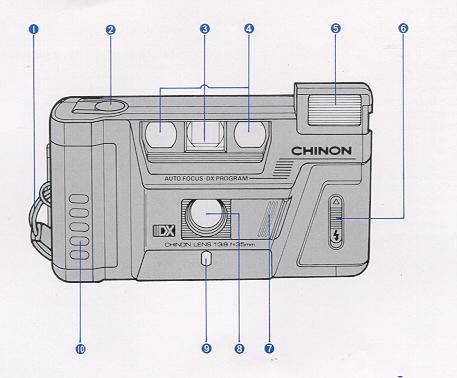 |
NOMENCLATURE
1. Hand strap
2. Shutter release button
3. Viewfinder
4. Auto focus window
5. Flash
6. Flash switch
7. Lens cover
8. Lens
9. Exposure metering window
10. Grip
|
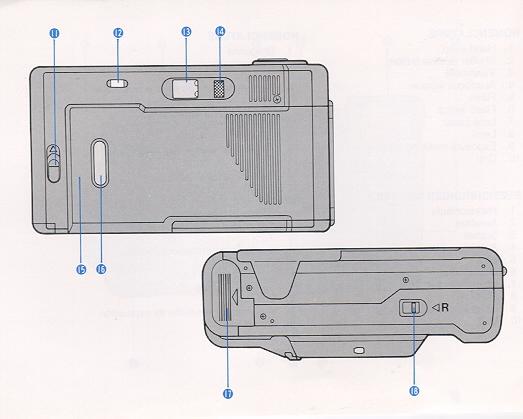 |
11. Back cover release button
12. Frame counter
13. Viewfinder eyepiece
14. Flash ready indicator
15. Back cover
16. Cartridge window
17. Battery compartment
18. Rewind switch
|
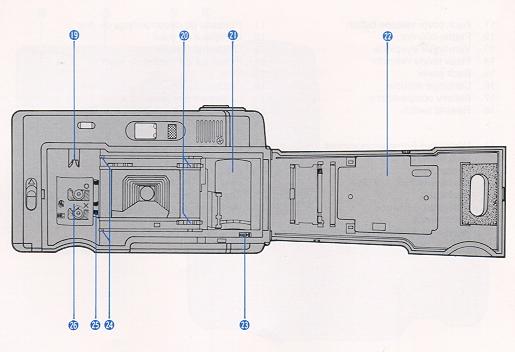 |
19. Film rewind shaft
20. Sprocket
21. Take-up spool
22. Film pressure plate
23. Film tip mark
24. Film guide
25. Automatic film speed seeing probe
26. Film chamber
|
SPECIFICATIONS
TYPE: Lens shutter type fully automatic 35 mm compact camera
PICTURE FORMAT: 24x36 mm
LENS: 35 mm F3.9, 3 elements in 3 groups
VIEWFINDER: Albedo type bright frame with AF frame, parallax marks, AF
lock indication LED (green) and under exposure warning/battery check LED (red)
SHUTTER: Programmed electronic shutter; 1/90 sec. (F3.9)-1/410 sec. (F8),
mechanical release, shutter locks when the lens cover is closed.
EXPOSURE METER: Programmed EE, CdS EV RANGE: EV10.5 - EV14.5 (ISO 100)
AUTOMATIC FILM SPEED SETTING: The film speed is automatically set when
using a DX-coded film of ISO 100/21°-1000/31°
.
Non-DX film will be set to ISO 100/21° .
FOCUSING: Infrared automatic focusing system with possible prefocus;
cancelable
FOCUSING RANGE: 1.3 meters (4.26 ft) to infinity FILM LOADING: Auto
loading system with built-in motor
FILM WIND: Automatic power winder for single frame advance
FILM REWIND: Automatic power rewinding; rewind actuated with rewind switch
AUTO REWIND STOP: Film rewinding automatically stops upon completion
EXPOSURE COUNTER: Indicates number of exposed frames and returns frame by
frame while rewinding, and resets to "S" when camera back is opened.
FLASH: Built-in flash, pop-up type flashmatic, Guide number 10 (ISO 100:
meters), Effective range of 1.3-3.5 meters (4.26-11.48 feet) at ISO 100,
Recycling time of approximately 5 seconds. Flash ready indicator built-in.
LENS COVER: Built-in, shutter locks with lens closed
OTHER FEATURES: Film type window and hand strap
POWER SOURCE: Two 1.5 V "M" size alkaline batteries (LR6)
DIMENSIONS: 129 (W) x 70 (H) x 45 (D) mm (5.08" x 2.76 x 1 .77 )
WEIGHT: 260 grams (9.17 oz)
SIMPLIFIED GUIDE FOR USING YOUR CAMERA
1. Installing Batteries (Fig. A)
2. Open Lens Cover (Fig. B)
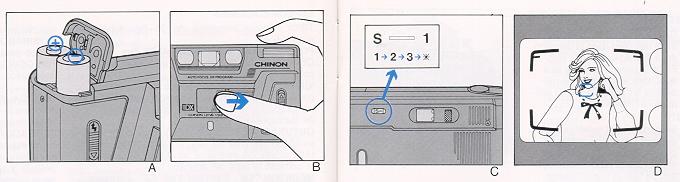
3. Automatic Film Loading (Release shutter 3 times) (Fig. C)
4. Be Sure to Direct AF Frame at Your Subject (Fig. D)
5. Release the Shutter (Fig. E)
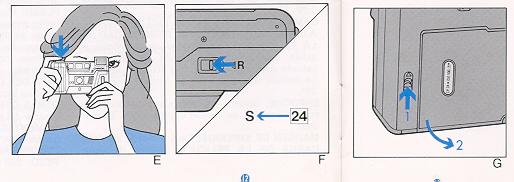
6. Automatic Film Rewinding (Fig. F)
7. Remove the Exposed Film (Fig. G)
INSTALLING THE BATTERIES
1. Slide the battery compartment cover in the direction of the arrow mark to
open the battery compartment cover (Fig. 1).
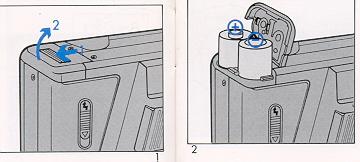
2. Place two 1.5 V "M" size alkaline batteries
(LR-6) into the battery compartment so as to correspond with the positive (+)
and negative (-) marks shown inside (Fig. 2).
NOTE: If you do not intend to use your camera for a long period of time,
remove the batteries and store them in a dry location. This will prevent the
possibility of battery leakage and damage to your camera. Do not use Ni-Cad
batteries Be sure to replace both batteries at the same time when the batteries
are too weak to operate the camera.
HOW TO OPEN THE LENS COVER
1. Slide the lens cover all the way to the right to ready the camera for
shooting. (Fig. 3)
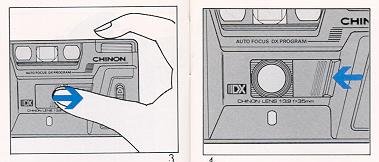
2. Slide it back in the opposite direction to close the lens cover (Fig. 4)
NOTE: When the lens cover is in the closed position, the shutter will be
blocked. The shutter cannot be released unless the lens cover is fully opened.
BATTERY TESTING
1. Cover the exposure metering window with your hand and press the shutter
release button halfway (Fig. 5).
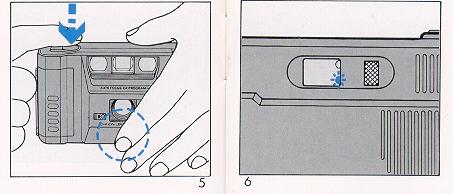
2. Make sure the under-exposure warning LED (red) light up (Fig. 6). If the
red LED fails to illuminate, the batteries are too weak and need to be replaced.
NOTE: As temperature decreases especially below 0° C (32° F) battery
performance declines. Keep batteries warmed under these conditions.
AUTOMATIC FILM SPEED SETTING
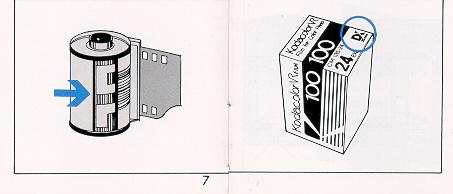
The film speed is automatically set when using a DX-coded film of ISO
100/21° -1000/31° (Fig. 7). Non-DX
film will be set to ISO 100/21° .
AUTOMATIC FILM LOADING
Always load and unload your camera in subdued light, and never in direct
sunlight.
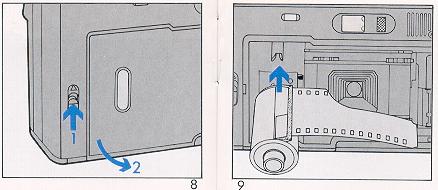
1. Slide up the back cover release button to open the back cover (Fig. 8).
2. Insert a film cartridge into the film chamber (Fig. 9).
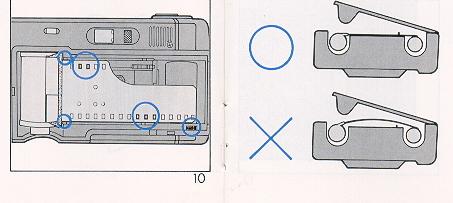
3. Align the trimmed end of the film on the take-up spool with the yellow
film tip mark. When loading film, make sure that the film lies flat between the
film guides. Engage the perforation of the film with the teeth of the sprocket
(Fig. 10). Close the back cover.
4. Open the lens cover and depress and release the shutter button three times
until the figure "1" appears in the frame counter (Fig. 11). The camera is now
properly loaded.
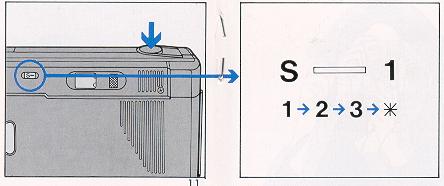
NOTE: If the film counter does not function, the film is not properly
advancing. Open the back cover and re-load the camera.
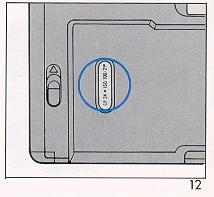
Cartridge Window This camera is equipped with a convenient Cartridge Window
so that you can check what type of film is in use
(Fig. 12).
HOLDING THE CAMERA
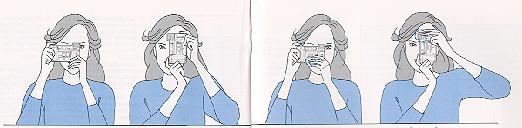
This is the way to hold your camera
Wrong way, do not block lens or electric eye!
VIEWFINDER
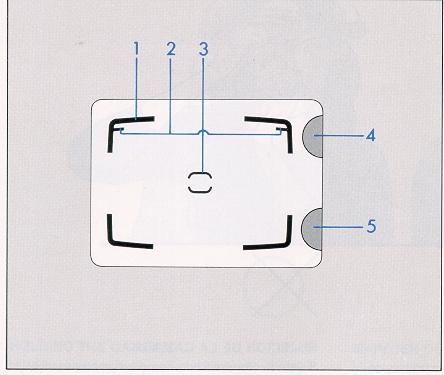
(1 ) Bright line frame
(2) Parallax marks
(3) Auto-focus frame
(4) AF lock indication LED (green)
(5) Under exposure warning/Battery check LED (red)
AUTO-FOCUS SHOOTING
1. Look through the viewfinder and compose the picture so that the main
subject is placed in the auto focus frame (3).

2. Gently press the shutter release button halfway. The camera automatically
focuses and the AF signal (green) will light.
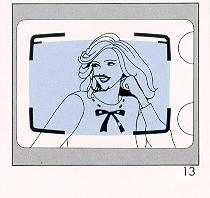
3. When taking a picture closer than 1.5 meters (5 feet), the image area is
indicated by the two parallax marks (2) in the top left and top right corners of
the viewfinder. Compose the photograph within the imaginary zone extending from
the corner of the parallax marks (Fig. 13).
NOTE: When a subject is positioned closer than 1.3 meters (4.26 feet), the
pictures will not be in focus.
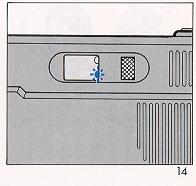
4. Press the shutter release button all the way. If the underexposure warning
LED (5) lights up, use the built-in flash (Fig. 14). See FLASH PHOTOGRAPHY.
NOTE: The following subjects will not be properly auto-focused: Shiny subjects
such as water surfaces or the exterior of a car body. Subjects viewed through a
glass window. Semi-reflective subjects.
FOCUS LOCK SYSTEM
This feature may be used to eliminate tricky focusing situations such as when
the main subject is located "off center" in the viewfinder.
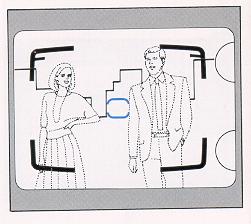
In such a situation, first focus on the main subject (by placing the subject
in the AF frame) and partially depress the shudder release button.
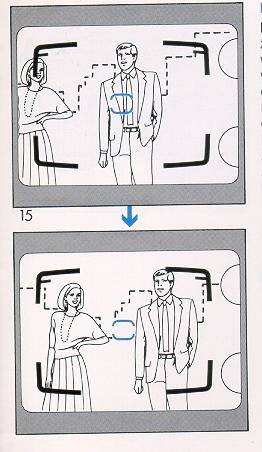
Hold the shutter release button in the halfway position and recompose the
subjects in the viewfinder and fully depress the shutter release to take the
picture (Fig. 15). This focus lock feature can be cancelled by removing your
finger from the release bunion.
FILM REWINDING
When the film in the camera is fully exposed, the motor stops and the shutter
release is blocked. Start rewinding at once.
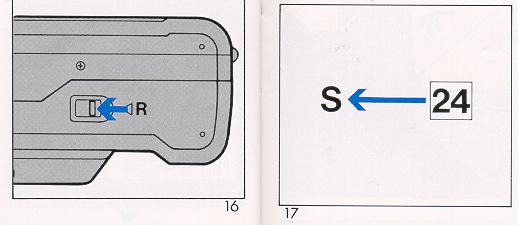
1. Slide the rewind switch in the direction of the arrow to rewind the film
(Fig. 16).
2. During rewinding, the frame number counts backward showing how many frames
are still remaining to be rewound.
3. When rewinding is over, "S" appears in the frame counter and the rewinding
is automatically stopped (Fig. 17). Open the back cover and remove the film.
NOTE: When auto rewinding takes a long time to complete, replace the
batteries with a fresh set.
FLASH PHOTOGRAPHY
Switch to flash photography if the under-exposure warning LED lights up while
pressing the shutter release
button halfway (Fig. 18).
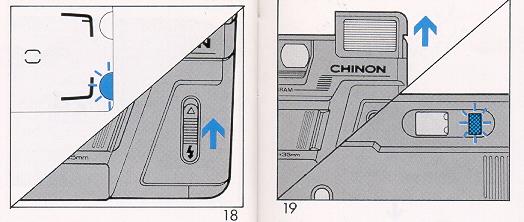
1. Slide the Flash Switch in the direction of the arrow to turn on the flash.
2. Make sure that the Flash Ready Indicator is illuminated before taking a
picture. (Fig. 19).

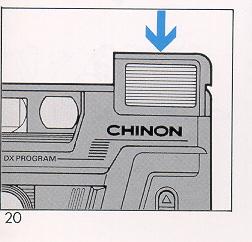
3. When the flash is no longer required, press the flash head down until it
locks (Fig. 20). This turns off the flash unit and positions it for storage.
Daylight Flash Photography
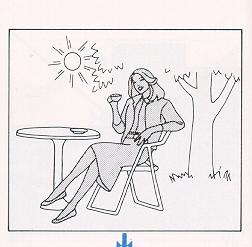
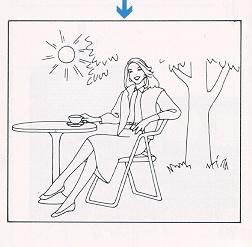
If the main subject has less light falling on it than the surrounding area
and background, underexposure of the main subject will result. In such
situations, use the flash even in daylight.
Effective Flash Distance
| ISO 100 |
1.3 - 3.5 M |
4.3 - 11 ft. |
| ISO 200 |
1.3 - 5 M |
4.3 - 16 ft. |
| ISO 400 |
1.3 - 6 M |
4.3 - 20 ft |
| ISO 1000 |
2.8 - 6.1 M |
9 - 20 ft. |
NOTE: -- If you release the shutter before the Flash Ready Indicator glows,
the exposure will not be correct.
CARE OF THE CAMERA
Your camera is a precision instrument. When used with care it will provide
years of trouble-free service. Protect your camera from dirt, rain, dampness and
excessive heat. Avoid touching the lens. To clean the lens, wipe it gently with
a soft lintless cloth or tissue. Do not use eyeglass tissues as they might
damage the lens coating. Do not disassemble and touch the inside of the camera
as possible high voltage in the flash circuitry can be dangerous.