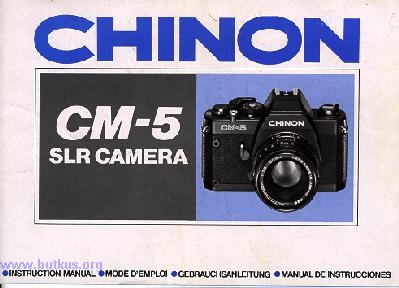
For reference use on many Chinon manual focus
and metering cameras
using the 3 LED metering system
This is the full text and images from the manual.
This may take 3 full minutes for all images to appear. If they do
not all appear. Try clicking the browser "refresh" or "reload button".
This camera manual library is for reference and historical purposes,
all rights reserved.
This page is copyright by
, M. Butkus,
N.J.
This page may not be sold or distributed without the
expressed permission of the producer
I have no connection with Chinon Co., Japan
If you find this manual useful, how about a donation of $3 to: M.
Butkus, 29 Lake Ave., High Bridge, NJ 08829-1071
and send me your e-mail
address so I can thank you.
Most other places would charge you $7.50 for a electronic copy or
$18.00 for a hard to read Xerox copy.
To main Chinon/Ricoh manual site
TABLE OF CONTENTS
DETERMINING CORRECT EXPOSURE - 30
USING THE ELECTRONIC FLASH - 38
CHINON POWER WINDER (PW-545/610) - 44
AUTO FOCUS 50 MM MC F1.7 LENS - 46
AUTO FOCUS 35-70 MM F3.3-4.5 LENS - 47
INFO BACK IMPRINTING UNIT - 48
INFO BACK-2 IMPRINTING UNIT - 48
OPTIONAL ACCESSORIES FOR CHINON CM-5 - 52
1. Shoulder strap eyelet
2. Frame Counter
3. Shutter release button/exposure meter switch
4. Film advance lever
5. Shutter speed dial
6. Film speed window (ASA/DIN)
7. Hot Shoe4.butkus.org
8. Film rewind knob/back cover opener
9. Body grip setting holes
10. Self-timer lever
11. Lens lock release lever
12. Aperture ring
13. Depth of field scale
14. Focusing ring
15. Film chamber
16. Exposure indicator LED's/battery check lamp
17. Viewfinder eyepiece
18. Sprocket teeth
19. Take-up spool
20. Film pressure plate
21. Film chamber cover
22. Power winder coupler
23. Rewind knob
24. Film guide rail
25. Film rail
26. Tripod socket
27. Shutter
28. Battery compartment cover
29. Power winder electronic contacts
Type: 35 mm SLR compact camera with LED type light measuring system.
Picture Format: 24 x 36 mm.
Lens Mount: Chinon Universal Bayonet Mount. (Pentax K-mount)
Mirror: Large, Quick return, shockless system.
Shutter: Seiko MFC metal focal plane shutter.
Shutter Speeds: 1 sec. - 1 /1000 sec., "B".
Viewfinder: Fixed eye-level pentaprism, central split image with microprism collar and ground glass.
Viewfinder Magnification: 0.87 x (@ 50 mm, infinity).
Viewfinder Visibility: 92%.
Exposure Meter: TTL, Center weighted full aperture system employing
one silicon blue photo cell,
3 steps exposure indicator with 3 LEDs.
Exposure Range: EV + 2 (F/1.9,1 sec.) to EV + 18 (F/16, 1/1000 sec.)—ASA100 F/1.9 lens.
Meter ON/OFF Switch: Meter switch is activated when shutter release button is pressed, meter remains on for several seconds after finger is lifted off release button.
ASA Range: 25 - 1600 (DIN 15 - 33) with safety lock.
Film Advance: Single stroke in an arc of 130° with 25° stand off.
Aim Counter: Automatically indicates number of exposures and
resets to "S" when camera back is
opened.
Film Rewind: Folding crank type.
Accessory Shoe: Hot Shoe type with X sync.
Self-Timer: Built-in.
Synchronization: Strobe Sync. at 1/60 sec.
Power Winder Contacts: Power winder electronic contacts are built
in for a single frame picture
advance.
Power Source: Two 1.5 V Alkaline batteries (LR44 A76) or two 1.5
V silver oxide batteries
(SR44, S76, G-13). 4www.butkus.org
Battery Test: Built-in with LED indicator.
Accessories: Multi-coated lenses, Auto electronic flashes, carrying case, and many more.
Body Dimensions: 135.5 (W) x 86.0 (H) x 50.5 (D) mm. (5.33" x 3.78~ x 1.99~)
Body Weight: 455 grams (16.05 oz).
LENS MOUNTING
Your CHINON CM-5 is equipped with a CHINON bayonet mount which accepts
all interchangeable lenses with the bayonet mount. To attach the lens,
match the red dot on the camera body with the red dot on the lens (Fig.
1). Then insert the lens into the camera body and turn it clockwise until
the lens locks with a click. To remove the lens from the camera body, depress
and hold the lens lock release lever on the camera body, turn the lens
counterclockwise as far as it will go, and lift it up from the Body (Fig.
2).4.butkus.org
BATTERY TESTING
Test the batteries when; — a new battery is installed — the camera
has not been used for a long period of time — the camera is being used
continuously for many hours. To test the batteries, press the shutter release
button slightly. If the batteries are in good condition, one of three LED's
located at the left side of the viewfinder frame will illuminate (Fig.
8). If a LED fails to illuminate, the batteries are too weak and need to
be replaced, they are incorrectly inserted, or the speed selector is set to "B" position.4.butkus.org
FILM LOADING
Your Chinon CM-5 camera can be used with any kind of 35 mm film.
2. Then, insert a film cartridge into the film chamber with the protruding end facing the bottom of the camera (Fig. 10).
3. Push in the film rewind knob and slightly turn the knob in either direction until it catches the film cartridge spool.
4. Insert the trimmed end of the film into a slot of the multi-slotted take-up spool.
5. Turn the shutter speed selector to any setting and advance the film while holding the film lightly down on to the transport.
9. Do not force or further rewind the film.
10. Advance the film and release the shutter three times (Fig. 12). The rewind knob should rotate counterclockwise when the film is advanced and the "1" marking should appear in the frame counter window (Fig. 13).
FRAME COUNTER
Make sure the film has been loaded properly. Operate the film advance
lever through a full stroke. When the film end is reached the film advance
lever may stop before the lever is fully turned. Do not force the lever.
Stop winding at once and rewind the film. Refer to "Unloading Exposed Film".
ASA/DIN SETTING
Rotate the shutter speed dial to the left or right to select a suitable shutter
speed from the band of "B", 1 to 1/1000 sec.
APERTURE SETTING
F stop Selection: The following may be used as a guide to determine
the lens F stop when you are using the camera;4.butkus.org
· Sunny day outside: F/8 - F/16
· Cloudy day outside: F/4 - F/5.6
· Inside (without flash): F/1.9—F/2.8
FOCUSING
Your Chinon CM-5 camera has a Through The Lens (TTL) exposure metering
system. Also called an open aperture measuring system. determine the correct
exposure, To operate the film advance lever, observing the subject through
the viewfinder in the center of microprism area. Depress the shutter release
button until the exposure indicator lamp (LED) located on the left side
of the viewfinder frame illuminates (Fig. 23). Should the green lamp (LED)
not illuminate, you must turn either the shutter speed dial or the lens
aperture ring until the green lamp illuminates. By *The Exposure Indicator: Your Chinon CM-5 camera has three exposure
indicator lamps (LED) located at the left side of the viewfinder frame.
These three lamps control the condition of exposure of the camera. The
conditions of exposure can be confirmed in the following three ways;
A: Over Exposure
B: Correct Exposure
C: Under Exposure
When rotating the shutter speed dial or the lens aperture ring, you
must operate them slowly since the exposure indicator lamps are very sensitive.
Generally you should select a shutter speed first then operate the lens
aperture ring until the proper exposure is obtained. A tripod should be
used for shutters speed longer than 1/30 sec.
NOTE: The exposure indicator lamp does not illuminate when the
shutter speed dial is set at "B" position. The meter switch is activated
when the shutter release button is pressed and the meter remains on for
several seconds after your finger is lifted off the release button.
UNLOADING EXPOSED FILM
USING THE ELECTRONIC FLASH
Depth of field designates the nearest and furthest limits of the area
that will be sharp in the picture in front of and beyond the subject. Depth
of field is controlled by the f/stop. The larger the lens opening, the
shallower is the depth of field. The smaller the lens opening, the grease,
the depth of field becomes (Fig. 29 & 30).
SELF-TIMER
When using CM-5 in conjunction with power winders 545 and 610, only
the single frame advance will function with both units. Furthermore, the
power winders will only advance the film when the camera's shutter release
is depressed and released. The shutter release button on the power winder's
built-in grip is nonfunctional when used with CM-5. (Fig. 33). NOTE: 1.
Caution should be used not to set the C/S dial in the "C" position. 2.
Care should be taken to avoid depressing the shutter release on the power
winder grip when depressing the camera's shutter release as the power winder
will not advance the film when the button is kept depressed. 3. Do not
attempt to use the remote control socket when the power winder is used
in conjunction with CM-5. 4. Do not use the self-timer when the Power winder
is in use.
Auto Focus 50MM
MC F/1.7 Lens
Chinon
35-70mm Auto Focus F 3.3 - F 4.4 Zoom. Operation
same as 50mm AF lens. Built in power on/off switch. When the
subject is too close to AF (less then 1 meter) the camera will give a continuous
audible signal, stating manual focusing is required. [Mike: even more impossible
to find. Pins on the lens couple to the CG-5 and CE-5 camera body]
Chinon
Infoback Imprinting Unit DB-010: Accessory data back features
electronic input of up to 30 characters (alpha or numeric) of information
onto your negative or slide, via a compact 36 button digital control panel.
Built in memory features will continuously imprint the same message or
can change the information as you like.
Chinon
Info Back-2 Digital Data-Imprinting Unit DP-520: Deluxe accessory
data back. Same features as Info Back (DB-010) plus LCD readout via built-in
monitor window.
Chinon
Auto Date Quartz Digital Data Imprinting Unit (AD-S10)
Your CM-5 camera accepts infrared film. To use infra-red film an extra
focusing adjustment must be made. After focusing note the figure that is
adjacent to red diamond on the distance scale (Fig. 34), then move that
figure over to the infra-red mark engraved on the lens. This adjustment
is only required for black and white infra-red film. When using color infra-red
film, focus in the normal way. NOTE: Read the instructions carefully packed
with the infra-red film for further information.
Standard Lenses
45 mm f/2.8, 50 mm f/1.9
50 mm f/1.7
multicoated
50 mm V1.7 AF
50 mm f/1.4 multicoated
Wide-Angle Lenses
28 mm f/2.8 multicoated
35 mm f/2.8
multicoated
Telephoto Lenses
135 mm f/2.8 multicoated
200 mm f/3.5 multicoated
300 mm f/5.6
multicoated
500 mm f/8 reflex Ape
35-70 mm f/3.3-4.5 AF Zoom
35-100 mm f/3.5-4.3 MC Macro
80-200 mm f/4.5 MC Macro
70-210 mm f/3.8 MC Macro
100-300 mm F5.6 MC Macro
Accessories
PW-545 & PW-610
Info Back DB-010
Info Back-2 DP-520
Auto Date AD-510
CHINON Auto S-180 flash
CHINON Auto S-240 flash
CHINON Auto S-280 flash
CHINON Auto S-360 Flash
Synchro-eye for flash
(Slave Unit)
Wireless Remote Control set for Power Winder
Deluxe Carrying case
Neck Strap
Filter (UV, Y2, ND4X, PL)
Rubber Eyepiece
Eyepiece Adaptor (-3, +1, +3)
Angle Finder
2 clips lens cap
1.5 V Alkaline Batteries
(3 pcs in one sat)
Rubber Lens hood
Auto Extension Ring
Bellows
Mini Copy Stand
Table Tripod
Cable Release (13 inch) (any brand will do)
Remote Control Unit
Spare ring for Mini Copy Stand
Lens Mount Cap
Body Cap
Your Chinon CM-5 camera is a precision instrument. Used with care, it
will provide years of service. Protect your camera from dirt, rain,
dampness, and excessive heat. Avoid touching the lens. To clean
the lens, wipe it gently with a soft lintless cloth or lens tissue.
Do not use eyeglass tissue as they might damage the lens coating.
Your Chinon CM-5 is equipped with a frame counter which displays the
number of exposures made and resets automatically upon opening the camera
back. When the camera back is opened the counter shows "S" indicating the
start of the picture taking process. When a film is loaded according to
the procedure previously described, the counter displays "1 " indicating
that the camera is ready for the first exposure Every time the film advance
lever is turned the counter will proceed one stop
The ASA/DIN speed of the film is specified on the box or in the instruction
sheet packed with the film. Set the ASA/DIN speed by lining UP and rotating
the shutter speed dial to be appeared in the film speed window. Be sure to check the ASA number whenever you put new film into the camera (Fig. 16).
(Fig. 17).
The aperture is set in the usual way by rotating the lens diaphragm
ring until the desired F stop is set against the green index mark on the
lens barrel. For further explanation see "Determining Correct Exposure"
(Fig. 18 & 19).
Your Chinon CM-5 has three built-in focusing aids. The center of the
viewfinder is the split image with microprism collar which is surrounded
by ground glass. When the camera is in focus, the image of these focusing
aids become sharpest. While observing the subject through the viewfinder,
turn the lens focus ring until the upper and lower split-image match up
to form a uniform image (Fig. 20). This split image focusing is particularly
helpful when the subject is dominated by vertical lines. The microprism
is also helpful. When it is out of focus, the image on the microprism will
be composed of collection of asterisks (Fig. 21). These sparkling asterisks
will disappear when the focus is properly set. You can double check the
focus setting by the image on the ground glass. You can also focus indirectly.
Actually measure or estimate the distance to the subject and set the lens
focus ring to the appropriate setting (Fig. 22).
RED GREEN RED
When the film in the camera is fully exposed, the film advance lever
will stop. Do not attempt to force the lever any further. Rewind the film
and replace with a new film. Push in the rewind button at the bottom of
the camera (Fig. 24). Unfold the rewind crank of the rewind knob and turn
the rewind crank clockwise (Fig. 25). You will feel friction as the film
is rewound. Suddenly, when the film is rewound completely, the friction
decrease and the rewind crank will turn with ease. Pull up the rewind knob
to open the camera back (Fig. 26). When the camera back is opened, the
frame counter will automatically reset to the "S" position. The rewind
button on the bottom of the camera will pop out upon the next advancement of the film
advance lever. Your exposed film should be processed without delay.4.butkus.org
It is advisable to use a flash when the exposure indicators detect
that the light level is too low, such as indoors, at night time, or in
daylight when the subject is too dark to provide adequate exposure. Electronic
flash units as well as conventional flash units using flash bulbs may be
utilized. Your CM-5 has a hot shoe (Accessory shoe with built-in flash
contact) for "X" synchronization (Fig. 27). Electronic flash units having
a foot with built-in contact may be used without connection cord. As the
hot shoe has "X" type synchronization it can be used with electronic flash
at 1/60 sec. or at slower shutter speeds (Fig. 28.) The lens aperture is
determined by the calculation table indicated on the flash unit. Specially
designed and developed automatic flash units are available for your Chinon
CM-5 as optional accessories. This highly advanced electronic flash system
permits carefree flash photography for you.
Depth of Field Scale: The depth of field scale indicates (after focusing)
the approximate area that will be sharp in the picture. Locate on the depth
of field scale the corresponding pair of f/stop figures. The distance between
these two f/ stop figures on the focusing ring will be the area of sharpness
in your picture (Fig. 31).
The self-timer when set, trips the shutter mechanism after a delay
of 7 - 12 seconds. This feature is useful should the photographer wish
to be included in the picture, and is also useful for taking pictures at
slow shutter speeds when a cable release is not available. When using the
self-timer, the camera must be mounted on a tripod, or a solid support
of some kind. To operate, move the self-timer lever counterclockwise as
far as it will go. Advance the film transport lever. Upon pressing upward
on the self-timer lever with your finger, the self-timer mechanism will
start to operate (Fig. 32). NOTE: Do not depress the shutter release button,
since the self-timer mechanism will not operate and the shutter will be
released instantly. NOTE: Do not advance the film advance lever while
the self-timer is in operation, otherwise damage to the camera's internal
mechanism could occur.4.butkus.org
Focuses even in total darkness. Stepless operation even from 1M
to infinity. Aperture range from F 1.7 to F 22. Audible signal beeps
when subject is in focus. [Mike: very impossible to find, works by
pressing side button]
Accessories date back featuring