and historical purposes, all rights reserved.
This page is copyright© by
 , M. Butkus, NJ.
This page may not be sold or distributed without
the expressed permission of the producer
I have no connection with any camera company.
This camera manual library is for referenc
and historical purposes, all rights reserved.
This page is copyright© by , M. Butkus, NJ.
This page may not be sold or distributed without
the expressed permission of the producer
I have no connection with any camera company.
On-line camera manual library
If you find this manual useful,
how about a donation of
$3 to:
M. Butkus, 29 Lake Ave.,
High Bridge, NJ 08829-1701
and send your e-mail
address
so I can thank you.
Most other places would charge
you $7.50 for
a electronic copy
or $18.00 for a hard to read Xerox copy.
Back to main camera manual page
CLICK HERE TO PDF FILE
DIRECT SCAN FROM MANUAL
Genesis IV English - Mode D'Emploi
Genesis IV Bedienungsanleitung
Genesis IV Manual de Instrucciones
Click here for
Chinon Genesis IV PDF version
made from file below - easier printing
This manuals is a mixture of the Genesis III and any different images from the IV manual.
Image numbers may jump but none are missing.
ENGLISH
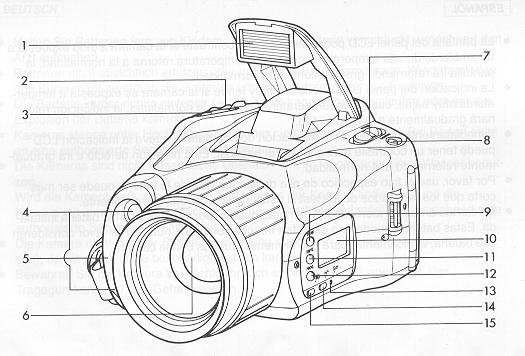
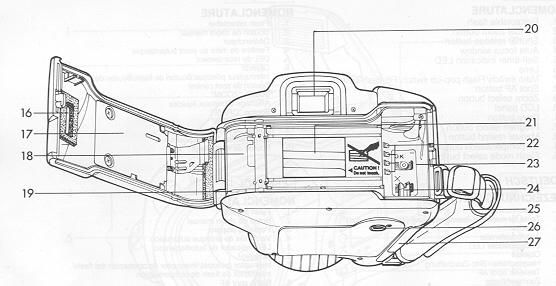
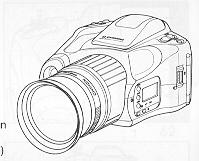
| NOMENCLATURE1. Retractable flash 2. Manual zoom button 3. Shutter release button 4. Auto focus window 5. Self-timer indication LED 6. Lens 7. Main switch/Flash pop-up switch/Fill-flash switch 8. Spot AF button 9. Zoom select button 10. LCD panel 11. Drive button 12. Program select button 13. Manual rewind button |
14. EV compensation button 15. Flash mode select button 16. Film window 17. Film pressure plate 18. Take-up mark 19. Film tip mark 20. Viewfinder eyepiece 21. Quick return mirror 22. Automatic film speed setting contacts 23. Film chamber 24. Film rewind shaft 25. Hand strap 26. Tripod socket 27. Battery compartment cover |
SPECIFICATIONS
|
MAIN FEATURES:
-35 mm TTL type zoom camera -38-135 mm zoom lens -Multi Auto Zoom Program -Dual Mode AF -Triple Program AE -Fully motorized film transport -Built-in sensor flash w/Red-eye reduction -Exposure compensation -Tele converter mode -Wide angle converter mode FILM TYPE: 135-size film PICTURE SIZE: 24x36 mm LENS: Focal length: f/38 mm- 135 mm Lens construction: 13 elements in 10 groups Macro capability: Possible (Macro Focusing distance 1:4.5) Zooming operation: 4 modes: a) Programmed Auto Zoom, b) Manual Power Zoom, c) Tele Converter Zoom, d) Wide angle Converter Zoom Auto zoom cancellation: Possible by Manual Zoom Button FINDER: Type: TTL finder Finder screen: Fine matte screen Magnification: 0.8x (50 mm inf.) Coverage: 90% in horizontal and vertical Diopter: -1.0 diop. Finder indications: Multi AF OK signal, Spot AF OK signal, Near distance warning, Slow shutter speed warning, Bulb mode signal, Flash sync. signal, Flash recharging signal Finder mirror: Motorized quick return mirror Type: Dual Mode AF combines TTL phase-differential detection AF and Multi AF Focus lock/Cancellation: Possible Shooting range: 0.85 m (33.5") to infinity Spot AF: Possible SHUTTER: Type: Electromagnetic focal plane shutter Type of shutter release: Electromagnetic release Shutter speed range: 1-1/1 200 sec. plus Bulb Shutter release: Focusing priority EXPOSURE METER: Type: TTL metering system Exposure control: 5 modes: a) Normal Program AK, b) Action Program AK, c) Creative Program AK, d) Slow Sync Program AK, e) Flash Program AE Photo cell: SPD (divided) Exposure range:Wide: EV4-EV19 (ISO 100); Tele: EV5 EV20 (ISO 100) Film speed sensing: DX film sensing for ISO 25-3200 (ISO 25 setting for non DX films) Exposure compensation: Built-in (+/-2.0 EV w/0.5 EV increments) Flash program shutter speed: 1/38-1/100 sec. TRANSPORTATION: Film loading: Automatic loading First frame setting: Automatic setting Film winding: Motorized winding Film rewinding: Motorized rewinding Rewinding actuation: Automatic Rewinding stop: Automatic Rewind button: Built-in for midroll rewinding Frame counter: On LCD panel Shooting mode: 2 modes: Single/Continuous (1.5 frame/sec) Flash GN: G No. 14 (ISO/100 meter) Effective range: Wide: 0.85-5.9 m (33.5~-19.4'), Tele: 0.85 4.1 m (33.5"--13 4') Recycle time: Approx. 4.0 sec. Off flash: Yes Slow synch: Yes Pre-flash: Yes OTHER FEATURES: Power source: Lithium battery pack 6V Film door window: Built-in Tripod screw: Built-in: U-1/4~ Self-timer: Built-in with LED indication, cancellable Multiple exposure: Built-in LCD PANEL INDICATIONS: Flash: Fill/Off/Pre-flash/Hash charging Photography: Multiple Exposure/SeH-timer/Continuous Shooting Exposure: Normal/Action/Creative Program Zoom Mode: Auto Zoom/Tele/Wide Converter Other: Exposure compensation, battery check Auto power shut off: Built-in for 60 sec. Strap: Attachable Dimension: 140 (W)x86 (H)x126.5 (D) mm (5.5x3.9x4,9") Weight: 745 9 (26.07 ounces) |
Simplified Guide
A. Battery Installation
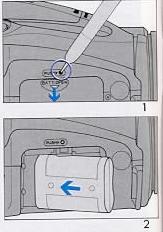 |
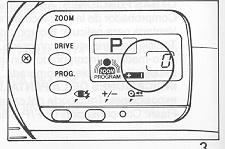
1 ) Insert a pointed object such as a ball-point pen into the battery cover release hole on the side of the camera and slide it in the direction indicated by the arrow to open the battery compartment. (Fig. 1 ) 2) Place the battery correctly in the battery compartment in accordance with the marks inside and close the cover. Use a 6 V lithium battery of the "2CR-5" type. (Fig. 2) B. Battery Check Sliding the Main switch to the first position turns the camera ON. Then, sliding the Main switch to the end pops the flash up. After the flash has popped up and the finger is released from the Main switch, the Main switch will automatically slide back to the first click position. (Fig. 3) |
 |
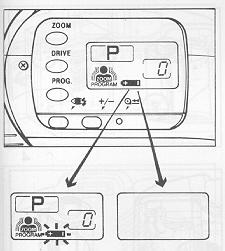
When any of the following occurs, it means that the battery condition is too low for continued use and the battery should be replaced with a new one. --The battery check mark is blinking. --The battery check mark is blinking and the shutter is locked. --Nothing appears on the LCD panel. |
 |
Battery life: Approximately 24, 24-exposure rolls, using 50% flash. (CHINON) Laboratory testing) When a new battery is correctly installed and the LCD indication is still not displayed correctly, remove the battery and reinstall it again. A memory back up system memorizes the frame counter as well as the film speed for a short time even without a battery. However, it is recommended to replace the battery as quickly as possible.
|
C. Setting the Film Speed
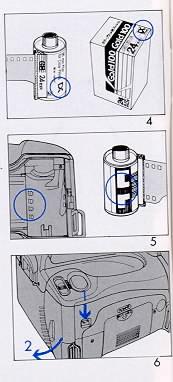 |
Using films with DX coding is recommended. In this case, the proper film speed will be set by the camera automatically Film can be used with ratings from ISO 25 to 3200. (Fig. 4)
Note: For films without DX coding, the camera is set automatically at ISO 25. Only use non DX film with an ISO 25 rating. However, if non-Dx films with ratings of ISO 50 or 100 are used, the camera can be adjusted for them by using the built-in exposure compensation system (See page 50 in the Applied Use section for exposure compensation instructions). Please keep the camera's DX contact points and the DX information panels on the film cartridges clean. (Fig. 5) |
D. Loading a Film: Automatic Film Loading
The film should be carefully loaded into the camera, without being subjected to direct sunlight.
1 ) Turn the Main Power Switch to the "OFF" position.
2) Open the back cover by pushing the back cover release button in the direction of the arrow. (Fig. 6)
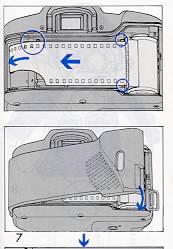 |
3) Insert the film cartridge and pull out the film so that the trimmed end lines up with the film tip mark. The length of film pulled out shouldn't be either too short or too long against the position of the film tip mark. If it was pulled out too much, adjust it by rewinding the film back into the film cartridge so that the trimmed end lines up with the film tip mark. Make sure that the film lies flat between the film guides.
4) Close the back cover. (Fig. 7) The film will be advanced automatically to the first frame. Turn the Main Power Switch to the "ON" position and make sure the counter on the LCD panel shows "1". Note:
|
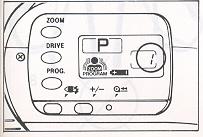 |
* With non-DX films or ISO 25 DX films, if the "0" remains lighted on the LCD panel after the back cover has been closed, it also means that the film has not been loaded correctly Open up the back cover and insert the film correctly again.
* Always set the Main Power Switch to "OFF" while loading the film.
* The focal plane shutter system is a reliable, yet delicate component of the Genesis IV. Never scratch or touch the shutter curtains. Extreme care should be taken,
especially when you load a film cartridge into the camera.
E. Holding the Camera
|
|
|
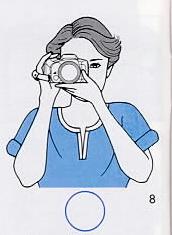
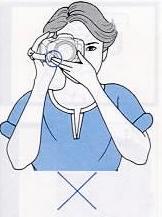
Hold the camera in such a way that your elbow is securely touching your body to ensure camera steadiness and to avoid the possibility of camera shake. (Fig. 8) Hold the camera so that your fingers, the carrying strap etc. will not cover any part of the flash unit, lens, or the AF measuring windows. |
Gently press the shutter release button. When the telephoto lens is in use, be particularly careful to avoid any camera movement.
When the camera is not in use, always return the Main Power Switch to the "OFF" position.
F. Viewfinder Information
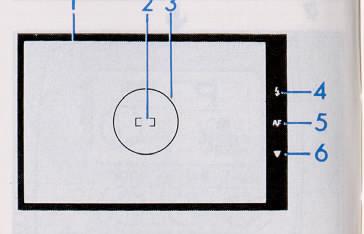 |
1 ) Viewfinder frame 2) Autofocus frame The TTL AF mode and the central spot of the Multi AF focus areas. 3) Evaluative metering central measuring area. 4) Flash Ready Signal When the flash is fully charged, this light will glow steadily. While the flash is recharging, the same light will blink until the flash recharging is completed. |
5) AF OK signal
When blinking, this indicator warns that the camera-to-subject distance is too close for proper focus. The camera shutter cannot be released in either the single or continuous shooting modes if this condition occurs.
6) Slow Shutter Speed Warning
When blinking, this indicator warns that the automatically selected shutter speed is too slow for non flash photography or slow flash sync photography. When it glows steadily, the bulb exposure mode will be utilized upon releasing the shutter. The flash will fire, even in the bulb mode, if the flash is in the open position. In both instances, a tripod is recommended to avoid blurred pictures.
G. LCD Panel Display
|
|
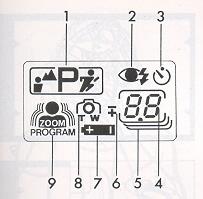
1) Image Program Mode/Program AE indication 2) Prewash Mode 3) Self-timer Mode 4) Frame Counter 5) Continuous Shooting Mode |
6) Exposure Compensation Indication 7) Battery Check Mark 8) Tele Converter Mode/Wide Angle Converter Mode 9) Auto Composing Mode
|
H. Auto focus Photography
The camera incorporates an auto focusing system combining both a TTL Passive AF and an Infrared Active Multi AF systems: the Dual Mode Auto focusing System. Depending upon the subject situation, the optimum AF system will be automatically selected for pin-point auto focusing accuracy.
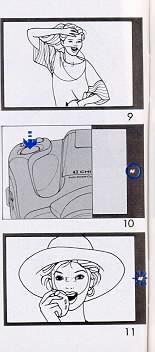 |
1 ) Position the camera so that the subject is set within the auto focus frame of the viewfinder. (Fig. 9) 2) Press the release button gently. The focus distance will be measured and set automatically. Once the focus has been completed, the "AF OK" mark in the viewfinder will light up and the subject in the viewfinder will be visible in sharp detail. This is a visual confirmation that the subject will be correctly focused in the picture. (Fig. 10) 3) When the camera-to-subject distance is too close, the AF OK mark in the viewfinder frame will blink and the shutter release will be locked. In this case, position the camera further away from the subject and focus again. (Fig. 11 ) |
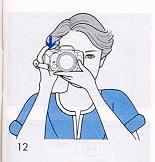 |
4) Once the AF OK mark is lighted and focus is visibly confirmed by the viewfinder, press the shutter release button all the way down to take the photograph. (Fig. 12) |
Note:
Since the TTL viewfinder enables a visible focusing confirmation, when your main subject is not sharply in focus in the viewfinder, press the shutter release button halfway again for refocusing.
Never push or turn the lens as the camera's micro computer always detects and memorizes the exact position of lens focusing each time the focusing is completed. If the lens is accidentally pushed or turned, turn off the camera by sliding the Main Power Switch to "OFF" to initialize the camera's memory before shooting again.
If the camera-to-subject distance is closer than 85 cm (33.5 inches), the AF OK mark will blink and the shutter release will be locked. The camera should then be positioned further away from the subject so that the picture can be taken.
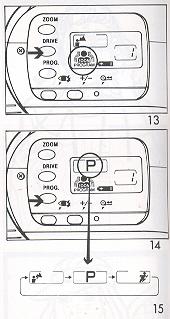 |
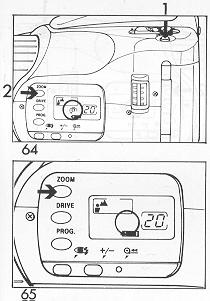
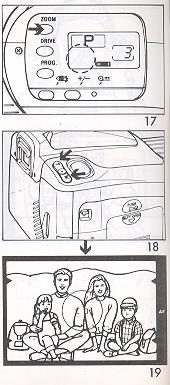
I. Multi Image Program Shooting (for basic snap shooting) The camera utilizes a Multi Image Program shooting mode. By selecting either the Standard Image Program Mode, Sport/Portrait Image Program Mode or the Landscape Image Program Mode, depending upon the subject situation, an optimum composing angle will be automatically selected along with an optimum programmed exposure setting. 3) Look through the viewfinder and point the camera at the main subject and gently press the shutter release button halfway. The camera will then automatically compose the picture by zooming the lens as well as precisely setting the focus. (Fig. 16) |
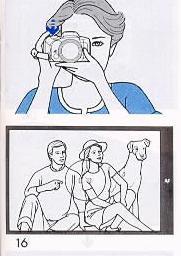 |
Note:
* For more details on Multi Image Program shooting, see the applied use section.
* Never push or turn the lens as the camera's micro computer always detects and memorizes the exact position of the lens each time the focusing is completed. If the lens is accidentally pushed or turned, turn off the camera by sliding the Main Power Switch to "OFF" to initialize the camera's memory before shooting again.
* The LCD indication will automatically disappear after 60 seconds upon completion of picture taking. Pressing either the shutter release button (half way), Zoom Select button, Drive button, Program AE select button, Manual Zoom button or Flash button will automatically reset the zoom lens to the Wide Angle Position (38 mm) and the LCD indication will be activated again.
* Selected shooting mode will be inputted into the camera's memory and retained for the next shooting opportunity even after the Main switch is turned OFF.
 |
J. Shooting with Manual Power Zooming When you wish to control the picture composition yourself, set the camera for the Manual Power Zooming mode.
|
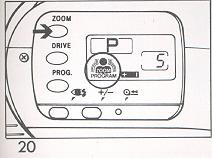 |
Note: * The when the Manual Power Zoom Mode is selected, unless it is changed back to the Multi Image Program Composing Mode by pressing the Zoom button, it shall remain in effect for the next shooting occasion even after the Main switch is turned OFF. * When you wish to change from the Manual Zoom mode to the Multi Image Program Composing Mode, press the Zoom button so that the Auto Composing Mode symbol |
* Turning the Main Power Switch to the "OFF" position and then back "ON" will also change the Manual Power Zoom mode to the Auto Composing Mode mode.
* The LCD indication will automatically disappear after 60 seconds upon completion of picture taking. Pressing either the shutter release button (half way), Zoom Select but ton, Drive button, Program AE Select button, Manual Zoom button or Flash button will automatically reset the zoom lens to the Wide Angle Position (38 mm) and the LCD indication will be activated again.
* When the camera is set for the Manual Power Zoom Mode, the following three different types of Auto Exposure Programs can be selected by pressing the Program AE select button.
1. "P" Normal Program AE The normal Program AE mode is ideal for general picture taking. Shutter speed and aperture changes are adjusted according to the varying light level at an equal rate. It will maintain a fast enough shutter speed to avoid camera shake while an adequate depth of field will also be implemented to assure razor sharp pictures.
2.  Action Program AE
The Action Program AE is designed for portrait or spot/action pictures. In this mode, the camera will select a wider aperture and the faster available shutter speed to freeze the motion and reduce camera shake.
3.  " * Creative Program AE
The Creative Program AE is ideal for scenery picture taking because in this mode, the camera is programmed to select a smaller aperture to provide greater depth of field.
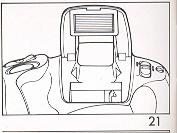 |
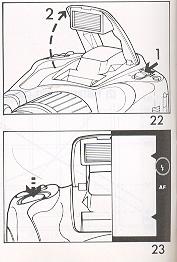
The camera utilizes an Automatic Sensor Flash system which is designed to measure ambient light intensity and then activate and fire the built-in flash when needed. The sensor flash of the camera works automatically only when the flash is in the open position. (Fig. 21 ) 1 ) Slide across the flash button to pop up to the flash into its operating position. (Fig. 22) 2) Gently press the shutter release button half way. If the flash is necessary, the " 3) If the " 4) If the " Note: The flash can be charged even if the shutter release button is fully depressed. In this case, immediately upon completion of the flash charging, the shutter will be released. Therefore, to avoid accidental exposures, it is recommended that the shutter release button not be fully depressed during flash charging. |
 |
|
 |
Flash effective range.
| Film speed | ISO 100 | ISO 400 |
| Tele | 0.85-4.0 m | 0.85-8.0 m |
| 33.5"-12.3' | 33.5"-26.2' | |
| Wide | 0.85 - 5.1 m | 0.85-10.0 m |
| 33.5"-15.7' | 33.5"-32.8' |
L. Automatic Film Rewinding
 |
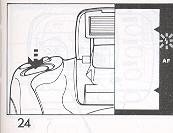
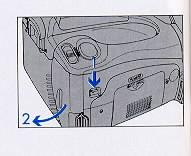
1 ) When the entire film cassette has been used, the film will automatically start to rewind within two to three seconds. 2) While the film is rewinding, the counter will count backwards. When the film is entirely rewound, the rewind motor will stop automatically.
|
 |
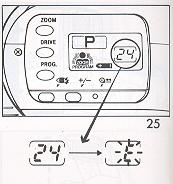
3) Check the frame counter on the LCD panel to make certain that the film counter shows "E" before opening the back cover. (Fig. 25) |
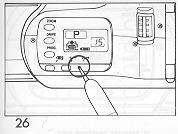 |
(Rewinding a partially exposed roll of film.) If a film must be removed before it has been completely used, press the manual rewind button |
Note: After the film is rewound, if the frame counter still does not return to "E" but a number is blinking, press the manual rewind button again.
Applied Use
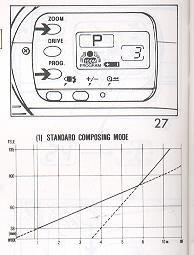 |
A. Multi Image Program Composition Shooting According to your photographic purpose and the desired image effect, select either the Standard Program Mode, Sport/Portrait Program mode or Landscape Program mode. The camera will automatically compose the picture and select an optimum exposure setting. (1) Standard Composing Mode This mode is ideal for general picture taking. When this mode is chosen, the lens focal length will be automatically controlled so that the main subject or subjects will always be within the picture area. Since the standard program AE will always accompany this composing mode, it will maintain a fast enough shutter speed to avoid camera shake while an adequate depth of field will also be implemented to assure razor sharp pictures.
|
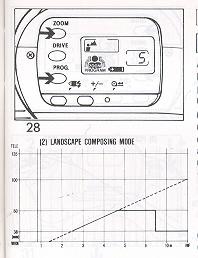 |
· Set the camera for the desired Multi Image Program Mode by pressing the Zoom Mode button until the "do" mark appears on the LCD panel. Press the Program AE Select Button until the "P" mark appears on the LCD panel. Partially depress the shutter release and the camera will automatically control the lens zooming and exposure for general shooting occasions (snap shot photography). (Fig. 27) (2) Landscape/Group Program Mode This mode is ideal for scenery since the picture will be composed with wider focal length selections with an automatic exposure setting that provides greater depth of field. It is also ideal for pictures of people in groups since the camera will adjust the image size to include everyone in the gathering. |
· Set the camera for the desired Multi Image Program Mode by pressing the Zoom Mode button so that the  mark appears on the LCD panel. Press the Program AE Select Button until the
  mark appears on LCD panel. Partially depress the shutter release and the camera will automatically control the lens zooming and exposure for landscape or group photographs. (Fig. 28)
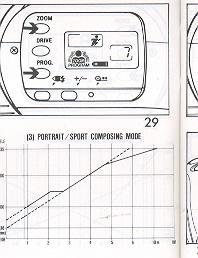 |
(3) Sport/Portrait Program Mode+Auto Close-up This mode is designed for portrait or sports/action pictures. In this mode, the camera will select an optimum lens focal length and exposure setting emphasizing a greater telephoto magnification along with a wider aperture and faster shutter speeds to better frame a portrait image but also to increase the potential to freeze the motion and reduce camera shake.·
Set the camera for the desired Multi Image Program Mode by pressing the Zoom Mode button until the |
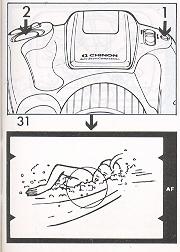 |
(3-1) Automatic Close-up Photography In the Sport/Portrait Image Program Mode, when the subject is within 0.85 to 1 meter (33 5" - 39 4") from the camera, the Auto Close-up mode will be activated. 1 ) Set the camera for the Sport/Portrait Image Program mode. (Fig. 30) 2) Press and hold the TTL SPOT AF button. Look into the viewfinder and point the camera at the subject. Gently press the shutter release button halfway to actuate the focus. If the camera-to-subject distance is within the 0.85-1 meter (33.5 - 39.4") range, the camera will automatically set the focal length for extreme telephoto (110 mm) to emphasize the close-up effect. (Fig. 31) Note: If the subject is not in the close-up distance range (0.85-1 meter, 33.5"~39.4"), the lens focal length will not be set at the extreme telephoto (135 mm) position. |
Zooming adjustment for Multi Image Program Mode
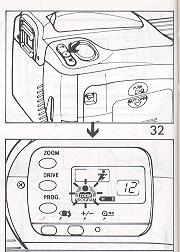 |
You can override the automatic composing feature set by the camera's Multi Image Program Mode by using the Manual Zoom Button as follows: Note: If the center of the Manual Zoom Button is not depressed prior to using the manual override zooming feature, manual override zooming adjustment will not be possible unless above steps (1 & 2) are taken again. |
B. Memory Function
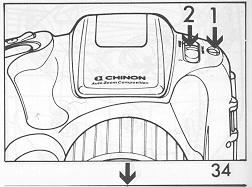 |
The following shooting modes and functions will be memorized and held even if the Main switch is turned-off. In other words, once a preferred shooting mode is selected, these shooting modes will remain unchanged until a new setting is chosen.
Frame Counter |
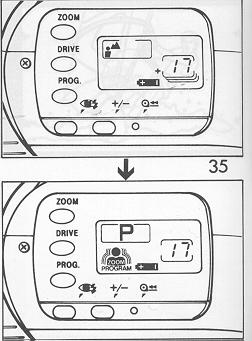 |
Clearing the Memory When you wish to clear the memory to return to the normal shooting mode, turn the Main Power Switch "ON" while the SPOT AF button is pressed. Now, the camera will return to the normal shooting mode as follows (Fig. 34, 35):
|
C. Auto Focus Modes
(1) Dual Mode Auto focusing
The camera incorporates a Dual Mode Auto focusing System which combines both TTL passive AF and Infrared Active AF Systems into one system. This system eliminates the inherent disadvantages of each AF system to permit virtually any subject to be properly focused under the widest possible variety of lighting conditions. Depending upon the subject situation and the lens focal length in use, the camera will automatically select an optimum AF system from either the Multi AF or TTL Passive AF systems.
<Multi AF>
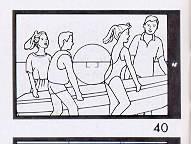
The Multi AF system utilizes triple infrared beams which provide a wider focusing area instead of a single, central beam of a conventional infrared AF system. Therefore the Multi AF system eliminates the need for a focus lock even if the subject would be positioned off-center. In the Multi AF mode, the actual focusing area will be wider than the AF frame in the viewfinder. (Fig. 40)
 |
 |
<TTL Passive AF System>
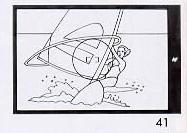
The TTL Passive AF System is ideal for telephoto pictures that require increased focusing accuracy. In the TTL Passive AF System, the focusing area is precisely what the AF frame in the viewfinder covers. (Fig. 41 )
Note:
Although the camera automatically selects the optimum AF system for each subject situation and shooting condition, if the viewfinder image on the main subject does not appear to be sharp upon completion of focusing, focus again by pointing the AF frame precisely on the main subject.
(2) Spot AF Mode
In the Spot AF Mode, the focusing area will be precisely what the AF frame in the viewfinder covers.
1 ) Point the AF frame in the viewfinder directly on the main subject. (Fig. 42)
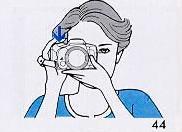
2) Press and hold the Spot AF button and gently press the shutter release button halfway. (Fig. 43)
3) "The AF OK" LED in the viewfinder will light up in red and the focusing will be locked on the main subject. Once the focusing is locked on the main subject, the focusing will be locked as long as the shutter release button is halfway pressed, even if your finger is lifted from the Spot AF button.
4) Gently press the shutter release button fully to take a picture. (Fig. 44)
Note:
When the "AF OK" LED blinks, it means the camera-to-subject distance is too close. The camera should then be positioned further away from the main subject to allow focusing to be completed.
Center-weighted Spot AE metering will only be effected if the picture is taken while the Spot AF Button is pressed.
 |
 |
(3) Focus Lock (Prefocus) and Cancellation
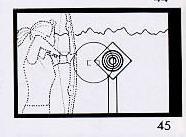
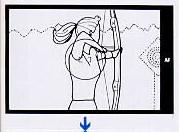
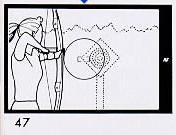
When the main subject is located "off-center" in the viewfinder, or when it is difficult to focus on the subject, the focus lock is invaluable. (Fig. 45)
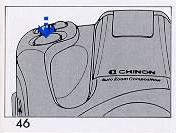
1 ) Look into the viewfinder and point the auto focus frame on the center of the subject that is to be in focus. Gently press the shutter release button and confirm that the "AF OK" LED in the viewfinder lights up. (Fig. 46)
2) Without losing tension on the shutter release button, recompose the picture in the viewfinder and then take the photograph by pressing the shutter release button all the way down. (Fig. 47)
Note:
The focus lock feature can be canceled by removing your finger from the shutter release button. Thus, you can repeat this technique any number of times without having to take a picture.
The focus lock functions with both the Dual Mode AF and Spot AF modes.
 |
 |
 |
D. Flash Photography
(1) Automatic Sensor Flash Mode
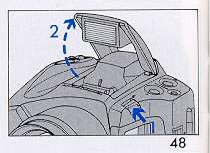
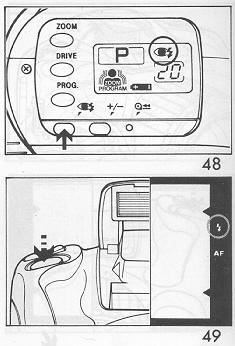
1 ) Press the flash button so that the flash will be properly positioned for automatic flash photography. A built-in sensor will fire the flash only when necessary.
(Fig. 48)
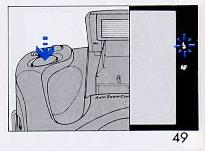
2) Gently press the shutter release button halfway to confirm that the flash ready light "  " in the viewfinder lights up. If the flash ready light does not light up, that means the flash is not necessary for a properly exposed picture. The flash will not be fired when the picture is taken. If the flash ready light blinks, it indicates that the flash is charging. During the flash charging period of approximately 4 seconds, the shutter cannot be released. Wait until the flash ready light glows constantly and then take a flash picture by gently pressing the shutter release button all the way down. (Fig. 49)
(2) Off-flash Mode
Although the camera will fire the flash automatically in accordance with the brightness of the surrounding lighting conditions (when the flash is in its operating position), there are times when it might be preferable to take a picture without the flash to capture a special mood. Off-flash photography is achieved with the following procedures.
 |
 |
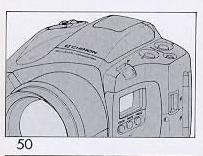
1 ) Gently press the flash down until it is returned to its storage position in the top of the camera. When the Main Power Switch is slid to "ON", the Off-flash mode will be activated. (Fig. 50)
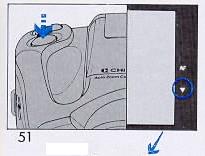
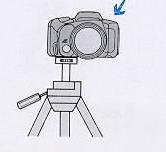
2) Gently press the shutter release button halfway If the Slow Shutter Speed Warning LED " ~ " blinks in the viewfinder, it warns that the shutter speed is possibly too slow for handheld picture taking. Hold the camera as securely as possible or use a tripod in order to avoid camera shake and subsequently blurred pictures. If the Slow Shutter Speed Warning LED " " glows constantly while pressing the shutter release button halfway, it means that a bulb exposure will be taken. In this case, a tripod must be used. (Fig. 51 )
 |
 |
 |
(3) Pre-flash Mode
 |
An annoying "red-eye" effect sometimes occurs with flash photographs. In this mode, the chance of getting the red-eye effect will be reduced. 3) Gently press the Shutter Release Button fully to take the photograph. |
Note: In this mode, to reduce the chance of the "red-eye" effect, the pre-flash fires before the actual flash firing and shutter release. Therefore, do not move the camera until the actual flash firing and shutter release sequence is completed.
The effect of the red-eye reduction will vary depending upon the picture shooting conditions as well as the eye color of the people who are being photographed
(4) Fill-in Flash Mode/Slow Flash Synchronization
|
|
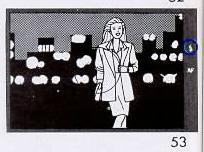
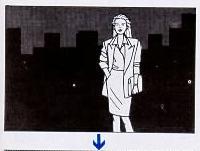
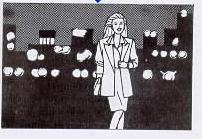
Under some available light conditions (deep shade or back-lit situations) a picture may result where the subject is too dark. The use of the flash for daylight flash will enhance the picture tremendously under these conditions. When this mode is used, depending upon subject brightness, the shutter speed may vary from 1/100 see to 1 second or even slower in the Bulb mode. This slow flash synchronization enables beautiful night scenes to be depicted while having the foreground subject flawlessly exposed by the fill-in flash. |
|
|
1 ) The Fill-in flash Mode can be used by pressing the Flash button. While holding the Flash button down, compose the picture and gently press the shutter release button halfway. (Fig. 50) |
|
|
2) When the Flash Ready LED ( 5, ) in the viewfinder glows constantly, a Fill-in flash photograph can be taken by pressing the shutter release button all the way down. If the Flash Ready LED ( 5, ) blinks, it means the flash is charging. Wait until the Flash Ready LED glows constantly (approximately 4 seconds). The shutter can then be tripped to take a Fill-in flash photograph. (Fig. 53) | |
|
|
|
Note: The use of a tripod is recommended for taking a Fill-in flash photograph in low light conditions to avoid possible camera shake since the shutter speed may go down to 1 second or even slower in the Bulb mode. |
E. Automatic F111-In Fiash/Back Light Control Systems
 |
The camera has both an automatic Fill-in flash and an automatic Back Light Control system. When the main subject has less light falling upon it than the surrounding area, the subject may be underexposed or silhouetted. In such a case, the camera will automatically adjust the exposure by activating the automatic Back Light Control or the automatic Fill-in flash so that the main subject will be more favorably exposed. |
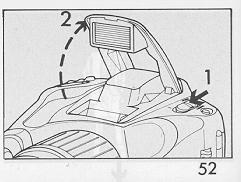
1 ) Slide the Main switch all the way forward so that the flash will be properly positioned for flash photography. (Fig. 52)
2) Press the Shutter Release Button fully to take a picture. Depending on the lighting situation on the subject, the camera will automatically compensate for the exposure by using the automatic Back Light Control or firing the flash (Automatic Fill-in flash) when necessary.
Note: If the flash is in its operating position, the flash ready light ( ) in the viewfinder will illuminate if the camera desires to use the flash to compensate for the back lit situation. Even when the flash is closed, the flash ready light " " in the viewfinder will illuminate if the camera's computer wishes to use the flash to compensate for a back lit condition.
In this case, pop up the flash and then take the photograph so that the automatic fill-in flash will be activated.
The automatic Fill-in flash will not be activated, even in a back lit situation if the size of the main subject is either too small or too large. In that case, use of the manual fill-in flash is recommended.
F. Self-timer
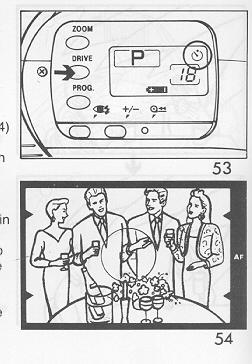 |
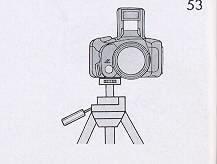
The Self-timer feature allows the photographer to be in the picture. 1 ) Place the camera on a tripod or other firm support. 2) Press the Drive Mode button so that the self-timer symbol mark " 6) " appears on the LCD panel. (Fig. 53) 3) Look into the viewfinder and position the AF frame on the center of the subject. (Fig. 54) 4) Press the shutter release button completely to start the self-timer operation. The self timer indication LED on the front of the camera will light up and the picture will be taken in approximately 10 seconds. The self-timer indication LED will initially glow and then will blink for two seconds just before the picture is taken. |
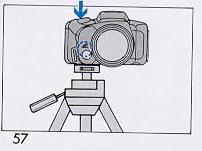 |
The Self-timer shooting mode will be canceled if the self-timer has not been used within 60 seconds. To cancel the Self-timer during its "count down", press the Drive Mode button once. To cancel the Self-timer Mode before the "count down" has started, press the Drive Mode button twice to return to the Normal Shooting Mode. |
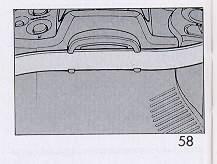 |
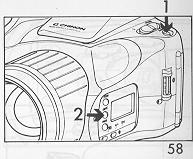
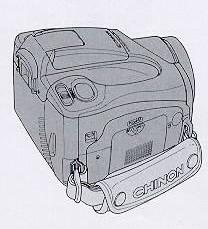
When taking a picture of yourself, it is recommended to compose the picture manually by using the power zoom. Otherwise, the Auto Composing Mode system will adjust the picture composition without you in the picture taking area and the optimum composing angle may not be selected. For self-timer photography or when the picture will be taken with your eye away from the viewfinder eyepiece, slip the neck strap into the slots alongside the viewfinder eyepiece to prevent extraneous light from entering into the camera through the eyepiece and effecting the exposure. (Fig. 58) |
G. Continuous Shooting Mode
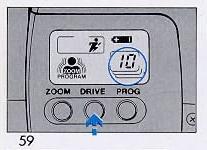 |
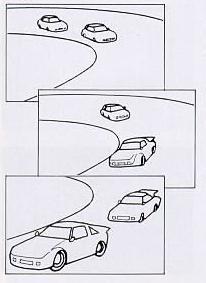
The camera has a sequential shooting capability which allows you to shoot continuously as long as the Shutter Release Button is kept fully depressed. 1 ) Press the Drive Mode Button twice so that the Continuous Shooting Mode indication "
|
2) Press the shutter release button fully to start taking pictures. Continuous shooting will take place as long as the Shutter Release Button is completely depressed.
 |
Note:
In the Auto Composing Mode, the shutter will be released upon the completion of the automatic picture composition process prior to each shutter release. In the Sensor Flash Mode, the shutter will be released upon the completion of the flash recycling, if necessary.
|
H. Unlimited Multiple Exposure Mode
The camera incorporates a multiple exposure system for unlimited images on one frame.
The film will not advance automatically after taking a picture when this mode is selected.
1 ) While pressing the Spot AF Button, press the Drive Mode Button so that the counter frame on the LCD panel will begin blinking. The Multiple Exposure Mode is then activated. (Fig. 60)
2) Press the Shutter Release Button fully to take each picture. During this mode, the film will not advance and the frame counter will remain unchanged.
 |
 |
 |
Note:
To cancel the Multiple Exposure Mode, press the Drive Mode Button or turn the Main Power Switch to the "OFF" position.
Prior to developing and printing the film, the photo finisher should be advised that multiple exposures have been taken. Otherwise, the negative (s) may not be printed or printed improperly.
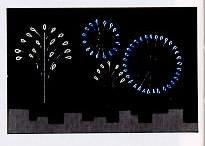
The Multiple Exposure technique is suitable for capturing fireworks displays or night scenes, or when using the flash in a dark area. In daylight, it may result in overexposed negatives.
I. EV Compensation
The EV Compensation allows the photographer to expose pictures either darker or lighter in tone as opposed to the fully automatic exposures that the camera would take without any manual direction from the photographer. In addition, it also effectively corrects exposure settings when shooting against back lighted or spotlighted conditions (With DX films).
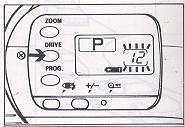
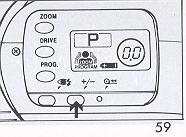
1) Push the EV Compensation Button (+/-) so that (0.0) appears on the LCD panel. (Fig. 59)
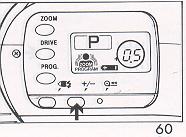
2) Select a preferred EV Compensation index by pushing the EV Compensation Button. Each time you press this button, the value of the EV Compensation will change as follows: 0.0~ +0.5 ~ +1.0 ~ +1.5 ~ +2.0 ~ --2.0 ~ --1.5 ~--1.0 ~--0.5~0.0 each change will be indicated on the LCD panel as the buttons pressed. (Fig. 60)
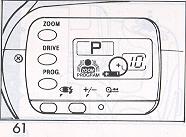
3) Once the preferred EV Compensation value is reached, press any button other than the EV Compensation Button or leave the camera alone for approximately 5 seconds. The LCD indication will revert to the normal display indications. An absolute value (+ or -) will appear on the panel to signify that the EV Compensation is in use. (Fig. 61)
 |
 |
 |
Note:
* Once the EV Compensation is set, it will not be canceled even if the shutter is released or the Main Power Switch is fumed "OFF. For cancellation, press the EV Compensation Button until the LCD panel indicates "0.0". The EV Compensation will then be canceled.
* During film rewinding and/or film loading, the EV Compensation setting will be automatically canceled and the camera will revert back to the "0.0" setting.
* The EV Compensation will not be effected during routine battery changes due to the memory back up system.
* The EV Compensation must be reset, if needed, after each new roll of a film is loaded.
J. Bulb Photography
In either the Off-flash mode or the Fill-in flash modes in low lighting conditions beyond the normal AE range, the camera will automatically switch itself to the Bulb mode. This setting is extremely advantageous for night photography
1) Select either the Off-flash Mode by returning the flash into its retracted position or the Fill-in flash Mode by holding the flash button depressed.
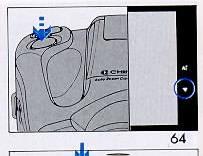
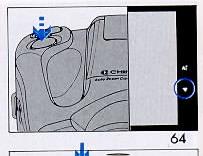
2) Press the Shutter Release Button halfway and confirm that the "  " mark in the viewfinder lights up. (Fig. 64)
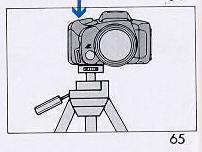
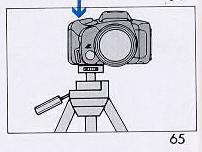
3) Press the Shutter Release Button completely but very gently to take the photograph. The shutter will stay open as long as the Shutter Release Button is fully depressed. (Fig. 65)
 |
 |
Note:
J. Bulb Photography
In either the Off-flash mode or the Fill-in flash modes in low lighting conditions beyond the normal AE range, the camera will automatically switch itself to the Bulb mode. This setting is extremely advantageous for night photography
1) Select either the Off-flash Mode by returning the flash into its retracted position or the Fill-in flash Mode by holding the flash button depressed.
2) Press the Shutter Release Button halfway and confirm that the " ~ " mark in the viewfinder lights up. (Fig. 64)
3) Press the Shutter Release Button completely but very gently to take the Photograph. The shutter will stay open as long as the Shutter Release Button is fully depressed. (Fig. 65)
 |
 |
Note:
a. Optional Tele Converter (1.4x) with Tele Converter Mode
|
|
CHINON offers an optional Tele Converter for the camera which will extend the telephoto focal length to 154 mm. For picture taking with the optional teleconverter, it is recommended to set the camera for the "Tele Converter mode" for fool-proof picture taking. Neglecting to do this may result in pictures with a "PORTHOLE" effect since the zoom could extend to wide angle, causing comer and edge vignetting. 1 ) Turn the Main Power Switch to "OFF". Hold the filter ring around the camera's lens and attach the Tele converter on to the filter ring by threading it on. (Fig. 63)
|
|
|
2) Turn the Main Power Switch to "ON". Press and hold the Spot AF Button down and the press the Zoom Mode button. The Tele Converter Mode mark "  " appears on the LCD panel to signify that the Tele Converter Mode is now set for picture taking. (Fig. 64) " appears on the LCD panel to signify that the Tele Converter Mode is now set for picture taking. (Fig. 64)
3) Compose the picture by pressing the Power Zoom Buttons (Tele or Wide) and then take the picture. 4) To cancel the Tele Converter Mode, press the Zoom Mode Button and confirm that the Tele Converter Mode mark " |
Note:
* In the Tele Converter Mode, the lens will automatically be set to teh extreme tele photo positon and lens zooming will not be possible..
* The camera will not focus property if a picture is taken in the Tele Converter Mode without attaching the Tele Converter. When taking a picture without the Tele Converter in place, always cancel the Tele Converter Mode.
* Once the Tele Converter Mode is selected, it cannot be canceled even if the Main Power Switch is fumed "OFF. Cancellation can only be made by pressing the Zoom
b. Optional Wide Angle Converter (0.8x) with Wide Angle Converter Mode
 |
CHINON offers also an optional Wide Angle Converter Lens for the camera which will extend the wide angle focal length to 30 mm. For picture taking with the optional Wide Angle Converter Lens, it is recommended to set the camera for the Wide Angle Converter |
Mode to assure accurate focusing.
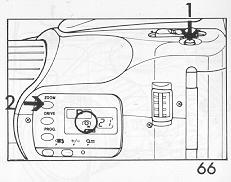
1 ) Turn the Main Switch to "ON". Press and hold the Spot AF Button and then press the Zoom Mode button twice. The Wide Angle Converter Mode mark " rim" appears on the LCD panel to signify that the Wide Angle Converter Mode is now set for picture taking. (Fig. 66)
2) Hold the filter ring around the camera's lens and attach the Wide Angle Converter Lens on to the filter ring by threading it on.
3) Turn the Main Switch to "OFF" and then "ON" again to initialize the camera's focusing memory. By depressing the Manual Zoom Button, set the camera for an extreme wide angle focal length.
4) Take the picture by gently depressing the Shutter Release Button all the way.
5) To cancel the Wide Angle Converter Lens Mode, press the Zoom Mode Button and confirm that the Wide Angle Converter Mode mark " Ad" disappears frown the LCD panel.
Note: When the Wide Angle Converter Lens is attached to the camera and a picture is taken of a subject which is positioned closer than 1.3 meter (4.26') from the camera, the corners and edges of the picture may be vignetted. Once the Wide Angle Converter Lens Mode is selected, it cannot be cancelled even if the Main Switch is turned "OFF". Cancellation can only be accomplished by pressing the Zoom Mode Button.
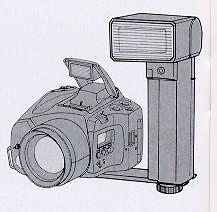
c. External Flash Unit
The external flash unit (Auto GS-320) can be used to extend the effective flash range of the camera when using ISO 100 or 400 negative films. Using the Auto GS-320 flash is recommended when the subject is beyond the effective flash range of the camera's built-in sensor flash. The Auto GS-320 flash unit will also permit bounce flash photography.
1) Attach the Auto GS-320 to the camera and turn the slave switch to the flash "ON" position.
2) Press the Flash Switch on the camera to position the camera's flash for sensor flash photography.
3) For ISO 100 negative film, select the A1 automatic position (A2 for ISO 400 films).
4) Set the camera for the Manual Power Zooming Mode and compose the picture by using the Power Zoom Buttons
(Tele or Wide).
 |
 |
5) Once the picture composition is completed. set the zoom head of the flash unit according to the following table.
6) You are ready to take a flash picture with the Auto GS-320. For more details, please refer to the instructions supplied with the Auto GS-320 flash unit.
Note:
Unless the camera's built-in sensor flash is in its operating position, the Auto GS-320 will not operate since the flash can only be fired by the built-in slave unit of the Auto GS-320 and the flash light of the sensor flash of the camera.
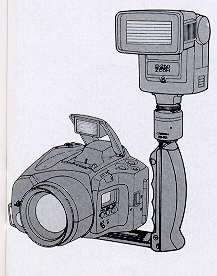
c. Using the Optional Slave Unit SE-620
With the optional slave unit (SE-620), a hot shoe type automatic flash unit having an F-number setting can be used as an external flash unit with the camera. The effective flash range can be calculated with the following formula.
Effective range = Guide number. F/F=4.4 and 5.6 for 38 mm and 110 mm zoom lens settings, respectively.
d. Filter and Hood
 |
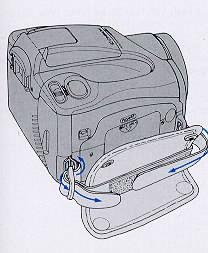 |
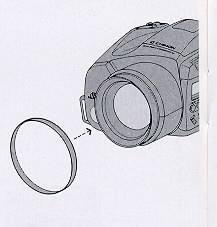
1 ) Filters of 58 mm diameter can be attached to the camera's filter ring. When you wish to use a Polarizing filter with the camera, always select a circular type PL filter. Using special effect filters such as a close-up lens may result in out of focus pictures or picture vignetting. With these special effects filters, always focus with the Spot AF button and take pictures after the focusing is visibly confirmed through the view finder.
 |
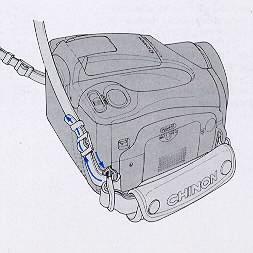 |
2) A 58 mm lens hood may be mounted on the camera but it may obstruct the Multi AF infrared beams thereby effecting the focus. When using a lens hood, always use the Spot AF button for focusing.
(AUTO DATE)
(1) YEAR/MONTH/DAY, DAY/HOUR/MINUTES SETTINGS
(A) Year/month/day setting
Example: 24 December, 1990
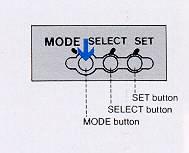
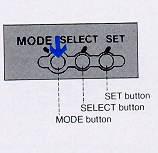
1. With a ball point pen or similar object (fingernail), press the MODE button for year/ month/day setting.
2. With a ball point pen or similar object (fingernail), press the SELECT button to locate the "year" position. Blinking number will appear.
 |
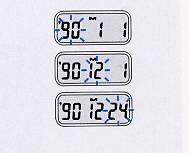 |
3. With a ball point pen or similar object (fingernail), press the SET button to set "90". Press the SELECT button to locate the "month" position above whose number "M" (month) indication always appears and whose number appears blinking. Then, press the SET button until "12" appears.
4. Press the SELECT button to locate the "day" position. The blinking "day" indicating number will appear. Then, press the SET button until "24" appears.
NOTE:
'Every time you press the SET button, the number shown on the display window proceeds consecutively. When you press and hold the SET button for more than a second, the numbers will change continuously.
 |
 |
(B) Hour/minute setting
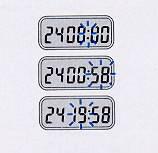
Example: 19:58 (PM 7:58)
1. With a ball point pen or similar object (fingernail), press the MODE button for day/ hour/minute setting.
2. With a ball point pen or similar object (fingernail), press the SELECT button until a blinking "!" appears. Press the SET button to start "00" second.
3. Press the SELECT button to locate the blinking "minute" position. Press the SET button to set "58".
4. Press the SELECT button to locate the blinking "hour" position. Press the SET button to set "19".
(2) DATA IMPRINTING
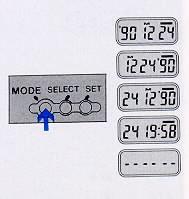
When the above procedure (1) is completed, select, by depression of the MODE button, the year/month/day, month/day/year, day/month/year mode, day/hour/minute mode or non imprinting mode that is desired.
NOTE:
1. When replacing the battery, do so as quickly as possible. If the Auto Date back is left without a battery for two to three hours, the time and date readings may be incorrect even after a replacement battery has been installed.
2. If an incorrect LCD indication appears after the installation of a new battery, reinstall the battery in the battery compartment or "reset" it by releasing the shutter.
3. Always check for the correct time and date indications after replacing the battery.
IMPORTANT
1. To clean the unit, use a dry cloth without any cleaning agent
2. Do not depress the buttons with any too-sharp object such as a knife.
3. Rough handling may result in damage to the unit.
4. Keep the lithium battery out of the reach of children.
LCD Information
1. Use the unit at temperatures between -10°C and +50°C for normal operation of the liquid crystal.
2. Do not expose the unit to the direct rays of the sun for a long time since the LCD may turn black at temperatures above 60°C (140°F).
3. Performance of the LCD declines as the temperature becomes low.
Care of the Camera
This camera is a precision photographic instrument. When used with care it will provide years of trouble-free service. Protect your camera from dirt, rain, dampness and excessive heat. Avoid touching the lens. To clean the lens, wipe it gently with a soft lintless cloth or tissue. Do not use eyeglass tissues as they might damage the lens coating. Do not open and touch the inside of the camera as possible high voltage in the flash circuitry can be dangerous. When the camera will not be in use for a long period of time, turn off the Main Power Switch and store in a well ventilated, cool, dry place. Due to the sensitive characteristics of the micro computer built into the camera, the camera may not operate properly even when a fresh battery is installed. It is not a malfunction. If this should occur, turn the Main Power Switch "ON" and "OFF" or reinstall the battery again.
Because we continually strive to improve our products, we may change specifications without prior notice
 indication.
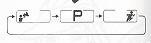 Press the Program AE select button until the LCD panel indicates P . (Fig. 15)
 located on the side panel. Use a ball-point pen or a similar object which is not too sharp. Use only a light touch to initiate the partial film rewinding. Too much pressure could cause internal damage to your camera. Rewinding will begin automatically. (Fig. 26 )
 appears on the L.C.D. panel. (Fig. 48)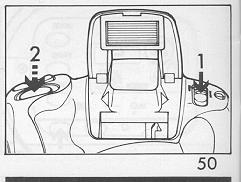
 " will appear on the LCD panel. (you are not concerned with the frame number but the repetition look of the frame. (Fig. 59)