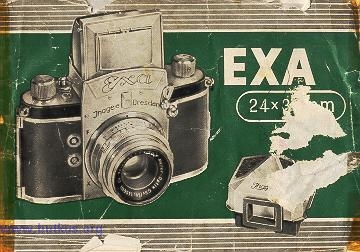
EXA 24X35mm
IHAGEE CAMERA WORKS
Posted 7-18-'03

HTML Translations - German - Italian - French - Spanish - Others
These links will not translate any PDF files


This camera manual library is for reference and historical purposes, all rights reserved.
This page is copyright © by , M. Butkus, NJ.
This page may not be sold or distributed without the expressed permission of the producer
I have no connection with any camera company

On-line camera manual library
This is the full text and images from the manual.  This may take 3 full minutes for all images to appear.
If they do not all appear.  Try clicking the browser "refresh" or "reload button" or right click on the image, choose "view image" then go back.  It should now appear.
To print, try printing only 3 or 4 pages at a time.

Back to main on-line manual page

If you find this manual useful, how about a donation of $3 to: M. Butkus, 29 Lake Ave., High Bridge, NJ 08829-1701
and send your e-mail address so I can thank you.

Most other places would charge you $7.50 for a electronic copy or $18.00 for a hard to read Xerox copy.

This will allow me to continue to buy new manuals and pay their shipping costs.  It'll make you feel better, won't it?  
If you use Pay Pal, use the link below. Use the above address for a check, M.O. or cash.


CLICK HERE TO REMOVE COLORED BACKGROUND

CLICK HERE FOR SECOND SECTION

(the other image is missing)

1 = camera back catch

2 = film chamber for feeder cartridge (unexposed film)

D = cassette guide with film roller

3 =film chamber for take-up spool or take-up cartridge

4 = film transport knob

5 = take-up spool for exposed film

6 = film rewinding knob

7 = pivot of film rewinding knob No. 6

8 = image frame

9 = film guide

10 = film transport sprockets

l I = hinged camera bade

13 = film pressure plate

14 = shutter speed lever

15 = exposure counter

16 = rewind button (Push button before rewinding film!)

17 = reversing lever

18 = reflex finder-hood


19 --: back wall of finder-hood with frame-finder rear sight

20 = protecting cover for hinged focusing magnifier

21 = button for folding magnifier up and down

22 = finder-hood catch

23 --- lens

24 = lens bayonet catch

25 = distance ring

26 = stop ring

27 = shutter release knob

27a= movable release lock

28 = milled knob for interchange of finder-hood and Special Prism

29 = contact nipple "F" regular flash

30 = contact nipple "X" electronic and regular flash

31 = red mark on camera

32 = red mark on lens

33 = Special Prism (delivered as accessory

35 = Loops for carrying

There may be slight deviations between the camera models and the illustrations in this booklet


The 35 mm EXA
is yours now and we wish you good luck with it. The camera will give you much pleasure, for it is handy, easy to operate, and ready for use at a moment's notice. So it is well suited to be your constant companion.
We would advise you, however, to read this instruction booklet attentively before setting out to make photographs with your new camera. Having acquired sufficient experience in correctly manipulating all parts that eventually lead to taking pictures, you will obtain better results in every case and avoid damaging the camera mechanism.
You are, no doubt, well aware of the unique advantages of the EXA which is a single-lens reflex camera. In its interior there is a small mirror which reflects the image taken by the lens on to the ground-glass focusing screen. For that reason the future picture is always strictly the same as the reflex image. This image permits critical focusing and composition of the picture on the ground-glass screen to an unexcelled degree of precision.
We hope and wish you will obtain excellent results with the EXA and are at your disposal for all questions concerning your camera.4.butkus.org

Before loading the camera
it is advisable to get thoroughly acquainted with the camera without film. To begin with, one should train oneself to master all the movements: to release the shutter, to open and shut the camera, to use the finder-hood, to compose and focus the picture, always handling the camera as though it where loaded with film. It is only when a complete mastery of the camera has been achieved that it should be loaded with film. To start with, the use of an old exposed film is recommended.

A. How to open and shut the camera back
Press camera back catch (1) to the Left (111. 3), and open hinged back (11) completely. When closing the camera, care must be taken that the camera back engages correctly in the groove on the body of the camera. Press back (11) lightly towards camera body until the catch (1) snaps into position.


B. How to open and shut the finder-hood
When the catch (22) is pressed inward, the finder-hood automatically opens into working position llll. 4). A detailed description of the various possibilities which it offers for composition and observation of the image, will be found in section E of this booklet. For the present let us stress the most important feet only: The ground-glass image is always strictly the same as the future photograph. That is the reason why the ground-glass image is the decisive factor for all operations which lead to taking a picture: composition, choice of frame, critical focusing, stopping down. The degree of brightness of the ground-glass image even permits of determining the exposure time fairly accurately. - If there is no image visible in the finder-hood, wind the film transport knob 14) once in the direction of the arrow as far as it will go.4.butkus.org

Before shutting the finder-hood make sure that the focusing magnifier is in its neutral (vertical) position (Section E). Then, beginning at either side, fold down the side walls, the back wall (19), and finally the front part until it snaps into position (111. 5b)


C. Shutter and film transport
The EXA camera possesses a very simple and sturdy shutter. In order to observe how it works, open the back of the unloaded camera or remove the lens (see Section D). With the release of the shutter for exposure the mirror swings upwards into a position parallel with the focusing screen so that no stray light can get into the camera. Therefore no image is visible when a picture has been taken and the shutter has not been wound up again. The shutter speeds are set by means of the lever (14), it does not matter, weather this is done before or after winding up the shutter. The mark on the lever must come to lie against the mark of the speed required (Ill. 6). 6). The figures engraved on the camera top plate indicate fractions of seconds, so that e. g. 25 stands for l/25 sec. Release by pressing the shutter release knob (27) gently (111.7). A cable release can be screwed into the release button screw thread. The movable release lock (27a) acts as a guard against unintentional tripping of the shutter (important for storing and carrying the camera).  The locking lever has to be swung up in order to disengage the release knob. If the speed-setting lever (14) is set to "B", the shutter will open upon pressure on the release knob (27) and remain so as long as the knob (27) is pressed.

 It will close as soon as the pressure ceases. For "T" setting (after pressure on the release knob (27) the shutter will remain open, until a second pressure will close it again) a special cable release is available. Long exposure times can be easily measured by counting the seconds or checked by a watch. In this case it is absolutely necessary to use a tripod (tripod bush in camera base) or to place the camera on a stable support (a table, a wall, etc.). Handheld instantaneous exposures, however, are unconditionally possible. After exposure wind the film transport knob (4) in the direction of the arrow` as far as it will go. With this action the shutter is wound up, the film advanced one frame, the mirror swung into focusing position (the reflex image is visible again), and the exposure counter (15) advanced one mark.4.butkus.org

Film advance and shutter winder being coupled, double exposure of one section of film is impossible.

D. How to focus the EXA
The lens (23) of the EXA is interchangeable, but the camera should always be kept with the lens or it will be spoilt by dust. The front element of the lens should be protected by a lens cover which must be taken off before making an exposure. To remove the lens press the lens catch (24) lightly towards the lens (Ill. 8) 8) and, holding the lens by the back ring, turn it to the left, until the red mark on the camera (31) comes to lie opposite the red dot on the lens (32), and the lens can be lifted from the camera body. To insert a lens this procedure is reversed: Insert lens (23) into the bayonet mount so that the red mark on the lens (31) comes to lie against the red mark on the camera body (32). Now the lens is turned to the right until it is heard to slip into the catch (24) on the camera.

 
The best way to arrive at critical sharpness is to turn the distance ring (25) to and fro until the main subject appears absolutely sharp on the focusing screen in the finder hood. The figure on the distance ring (25) that comes to lie opposite the red mark, indicates to which distance the lens is set (lens-to-subject distance) (111. 9-11).The diaphragm is adjusted by turning the knurled stop ring (26) until the stop required is opposite the red mark. The figures on the ring indicate the effective lens opening, i. e

low figures (2.9, 4, etc.) = large aperture
= short exposure time

high figures (22, 16, etc.) = small aperture
= long exposure time

 When increasing (or decreasing) the lens aperture, (or longer) exposure time is required, namely for one stop double (or half) the normal exposure time; e. g. if the normal exposure is 1/50 sec. for an aperture of f/8, it will be 1/25 sec. for f/11 or 1/100 sec. for f/5.6. A reduction of lens aperture (higher figures) produces an increase in depth of field, that is to say, also points some distance in front of and behind the main subject focused at appear to be sharp. For further details see the following table. For instance: lens set at 5 m, stop 8: extent of depth of field from 3.02 m to 15.08 m, but lens set at 5 m, stop 4: extent of depth of field from 3.76 m to 7.47 m.

The lenses of the EXA have the distance ring (25) behind the front stop ring (26)(111.9-11). The depth of field scale engraved in the back ring of the lens mount tells practically the same as the table.
 
The aperture figures diverge from either side of the red index mark. The index lines on the left hand side indicate the distance in meters from which sufficient sharpness can be expected, those on the right hand side the distance in meters up to which sharpness can be expected (= range of depth of field). The respective distances are opposite the figures of the aperture chosen. If the aperture figure on the right hand side comes to lie to the right of the infinity sign (00) sharpness will extend to infinity. Taking Illustration 9 as an example: lens set at 5 m., stop 8: range of sharpness form about 3 m to nearly 15m.4.butkus.org

EXA Depth of Field

The Meritar (111.11) lens for the EXA has recently become available with pre-set iris diaphragm as an optional extra. These lenses may be recognized by the ad adjustable stop ring R. Having decided the aperture to use for your picture, press back the knurled stop ring towards the camera body. Now turn the normal iris ring until the required stop number is set against the red mark and release the stop ring which will spring back to its original position.

For critical focusing use the lens at full aperture and immediately before releasing the shutter turn the diaphragm ring up to the stop, an operation which is carried out by "feel" alone and without the necessity to move the camera from the sighting position.

CLICK HERE FOR SECOND SECTION