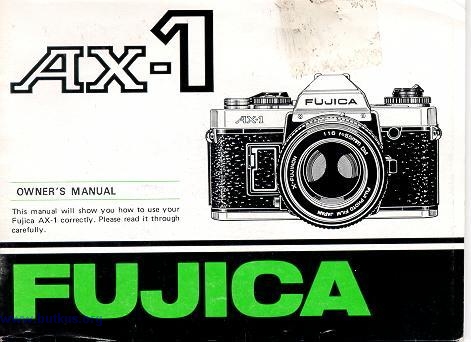
Fujica AX-1
On-line owners manual

This camera manual library is for reference and historical purposes, all rights reserved.
This page is copyright by   M. Butkus, NJ.
This page may not be sold or distributed without the expressed permission of the producer
On-line camera manual library
This is the full text and images from the manual.  This may take 3 full minutes for all images to appear.
If they do not all appear.  Try clicking the browser "refresh" or "reload button" or right click on the image, choose "view image" then go back.  It should now appear.
To print, try printing only 3 or 4 pages at a time.

If you find this manual useful, how about a donation of $3 to: M. Butkus, 29 Lake Ave., High Bridge, NJ 08829.
This will allow me to continue to buy new manuals and pay their shipping costs.  It'll make you feel better, won't it? 
If you use Pay Pal, use the link below. Use the above address for a check, M.O. or cash.

 Back to my main Chinon information page

CLICK HERE TO CONTINUE TO PDF MANUAL - Better printing

Go to part II  AX-1

If you need more specific information on Fujica cameras.... try this U.K. site


CONTENTS

Special features .... . . . 4

Names of parts .................... 5

Getting ready to take pictures  . . . . . . 8

1 Attaching the strap and putting the camera in its case ......8

2. Mounting and dismounting the lens . . . . .9

3 Loading and checking the battery . .10

4. Loading the film ..............13

5. Setting the film speed selector . .17

6. Aiming the camera . . .18


Taking automatic exposure pictures

1. Shutter speed selector settings .19

2. View finder information . . . .20

3. Procedure for taking automatic exposure pictures.......21

4. Focusing the lens .......23

5. Rewinding the film ......25

Camera functions............. 1. Light metering range .. .........27

2. AE lock (exposure memory} .......27

3. Stopped-down automatic exposure . . .28

4. Exposure compensation ......32

5. Multiple exposure .........34
 

Camera care . . . . 57

Specifications

This compact, lightweight, aperture-preferred AE camera has a built-in microcomputer, product of the latest in electronic engineering, to insure high-precision automatic exposure in candlelight to sunlight.


Five LED shutter-speed indicators in the viewfinder let you set exposure in an instant so that you won't miss those once-in-a-lifetime shots. Three-way (split-image, microprism, ground-glass screen) focusing lets you focus any type of subject quickly and sharply.4.butkus.org

Soft-touch electromagnetic shutter release permits even the first-time user to shoot without camera shake; Auto Winder X (optional accessory) lets you shoot continuously at 2 fps; unique, high-precision electronically controlled self-timer emits a penetrating beep beep to keep you alert until the shutter trips.


A wide assortment of "system accessories" including the unique Fujica Auto Strobe 300X (G. No. 30), Fujica Auto Strobe AZ (G. No. 17) and Fujica Photo Recorder for printing data on the film, expands you; picture-taking scope well beyond present horizons.


Fujica X "short turn" (65° ) lens mount permits quick lens changing and accepts the entire line of new X-Fujinon interchangeable lenses from wide-angle to telephoto as well as other lenses to take full advantage of the SLR system.


1. Attaching the strap

* Slide back the strap end hoop as shown.

* Hold the clamp between your fingers as shown and pull out the metal clip.

* The clamp may be tight when it's new. If you find it difficult to pull out the clip, open the clamp with
    your fingers and pull it outs

*  Hook the clip to the camera's Strap Eyelet and push the clamp forward to lock the clip.

*  slide back the strap-end hoop tightly against the clamp.


Putting the camera in its case

Put the camera in its case and secure the cam to the strap with the flaps provided on both sides of the case by closing the snaps. Next, put on the case cover,

To take the camera out of its case, repeat (5) in reverse.

2. MOUNTING AND DISMOUNTING THE LENS

Position the red dot on the lens rear opposite the red dot on the Lens Mount, then push the Lens in and turn it 65° to the right (clockwise). It will lock into position with a click.

While pressing in the Lens Lock toward the camera body, turn the Lens to the left (counter-clockwise} as far as it will go, then pull it out toward the front.

Using the Rubber Lens Hood
 

3. LOADING AND CHECKING THE BATTERY
When shooting against the light, fit the accessory Rubber Lens Hood on to the lens to prevent flare and ghost caused by the light falling directly on the lens surface.

Choosing the Right Battery You can use any one of the following batteries b' be sure to use a new battery. 6-volt silver oxide battery: (JIS4G13, Eveready (UCAR) No. 544, Mallory PX28). 6-volt alkaline manganese battery: (Eveready No. 537).
 

1) Remove the Battery Compartment Cover by pushing the Cover Lock in toward the Lens with your fingernail and lifting it up.

2) Insert the battery, plus (+) and minus ( - ) ends correctly, as shown in the Battery Compartment.

3) The battery will load easier if you insert the minus ( - ) end first.

4)  To unload, press down and pull out the plus (+) end of the battery with your fingernail.

5) Replace the Battery Compartment Cover by sliding in the inner edge and pressing the cover down.

Note:
1. One new battery will normally last about 6 months.

2. Before loading, wipe both ends of the battery clean with a dry piece of cloth.

3. If you are not taking pictures for a long while, remove the battery before putting the camera away.


Make it a habit to check the battery before you start taking pictures. You won't get - properly exposed pictures if the battery is worn out because your Fujica AX-1's shutter is electronically operated regardless of the exposure mode employed.

1) Set the Shutter Speed Selector to AE.

2) While looking through the Viewfinder, press the Shutter Release halfway down.
 

1) If any one of the shutter-speed-indicator LEDs in the Viewfinder left side blinks (about 4 times a second), it's time to change the battery. (The LEDs will not turn on if the battery is completely exhausted.)

2) Be careful, however, because if the top or bottom shutter-speed-indicator LED blinks at the rate of about 8 times a second, it means the shutter speed needs changing because the light is either too bright or too dim for correct exposure.

Notes:
1. If you are taking your camera on a vacation trip, be sure to bring a spare battery along.

2. When shooting in cold weather, check the battery frequently because low temperature will dampen battery performance.

4. LOAD THE FILM

Use cartridge-packed 35mm roll film (135 type) Always load and unload film in subdued light

1) Open the Camera Back by pulling the Film Rewind Knob all the way out. (It will not open unless the knob is fully pulled out.

2) Drop the film cartridge into the Film Chamber with the spool head (protruding portion of the cartridge pointing to the camera bottom, then push the Film Rewind Knob down to its original position.4.butkus.org

3) Pull out the film tip and insert it deeply into the slot of the Take-up Spool, but make sure it doesn't go through the spool hub.


4) Wind the film with a stroke or two of the Film Advance Lever and make sure the Sprocket Teeth catch the film perforations.


5) Erect the Film Rewind Crank and turn it in the direction of the arrow to take up any slack in the film, make sure the film is properly positioned between the guide rails, then close the Camera Back.


6) While watching the Exposure Counter, wind the film with the Film Advance Lever and press down the Shutter Release. Repeat until the second white dot from the letter "S" (first white dot from the red "O") appears in the center of the Exposure Counter. The film has now been positioned for the first shot.

* The film is advancing properly if the Film Rewind Knob turns while the Film Advance Lever is winding.

* The white dots between the numbers in the Exposure Counter represent odd numbers.

7) Film identification The Film Confirmation Window in the camera back will tell you at a glance whether there is film in the camera or not. If you have Fuji film in your camera, it will also tell you the film type and the number of exposures it will yield.


The procedure is the same as that described in (I) to 3) . To wind the film, close the Camera Back, switch the auto winder switch to SINGLE or CONT. and press down the Shutter Release.

* If the film does not advance, turn off the auto winder and switch it once again to SINGLE or CONT.

* For further information read the Auto Winder instruction manual.


After loading the film, be sure to set the Film Speed Selector beaches your pictures will not be properly exposed if it is not set for the speed of the film loaded in the camera. The speed of the film you are using is printed on the film box.

1) While pressing in the Film Speed Selector Lock (a white button at the side of the Film Speed Selector, turn the selector dial and set it for the speed of the film you are using, that is, if you are using an ASA 100 film, set the number 100 opposite the Film Speed Setting Mark.

* The marks labeled +1 and -1 on each side of the Film Speed Setting mark are used for making exposure compensation.  Be sure to use the center mark for setting the Film Speed Selector.

2) The lines etched between the numbers on the Film Speed Selector represent the ASA speeds shown in the illustration above.

3) The corresponding ASA and DIN film speeds are as follows:
 

ASA  25 32 40 50 64 80 100 200 250 320 400 800
DIN 16 16 17 18 19 20 21 24 25 26 27 30

6. AIMING THE CAMERA

1)  Hold the camera with your left hand as shown, press the left elbow against the side of your chest, relax your right hand and press the Shutter Release gently down.

2)  When shooting with the camera held vertically, try to keep it extra steady because it will be less stable in that position,

3)  The film is advanced with the right thumb and the Shutter Release is depressed with the right for finger.

Taking automatic exposure pictures

1. SHUTTER SPEED SELECTOR SETTINGS
Your Fujica AX-1 is an aperture-preferred automatic exposure camera. You just set the aperture and the camera will take care of the shutter speed.  Even the first-time beginner can take perfectly exposed pictures with it every


Notes:
1. To switch from AE to 60X or B. turn the Shutter Speed Selector while pressing in the Shutter Speed Selector Lock. (You cannot turn it unless the Lock is in depressed position).

2. Remember, your Fujica AX-1 has a built in "exposure memory" (AE lock), that is, the shutter speed obtained by depressing the Shutter Release halfway down will remain locked and the LED indicator in the Viewfinder will not change position unless you take your finger off the Shutter Release even if there are changes in subject brightness and aperture value (#e paragraph entitled "AK lock" on page 28.

Using the B (Bulb) setting
To take pictures requiring long exposures of 1-second or more, set the Shutter Speed Selector to "B". The shutter will remain open for as long as the Shutter Release is held depressed so that you can trip the shutter when you want to.

2. VIEWFINDER INFORMATION


Note: Your Fujica AX-1 USES a fully automatic electronic shutter. The shutter speed indicated in the viewfinder represents an approximate value.4.butkus.org


1) Set the Shutter Speed Selector to AE.
2) Use any aperture you want; that is, if your camera lens is an X-Fujinon 1:2.2 55 mm, set the Aperture Ring to any one of the f-numbers from F2.2 to 16.


3) Look through the Viewfinder and press the Shutter Release halfway down. An LED will turn on to show you the meter-selected shutter speed that will combine with the aperture you selected to provide correct exposure.  For example, if the aperture you selected is F5.6 and the camera-selected shutter speed is 1/125 sec., the LED opposite the paired numbers 250 and 125 will turn on.

Note: The shutter speed numbers are paired. In the cam shown here, the coupled shutter speed can be either 1/250 or 1/125 second.

4) Over and underexposure warning
If the aperture you selected is not compatible with the camera's shutter speed range, that is, if it is too large and needs a shutter speed that is faster than 1/1000 sec., the red LED opposite the paired numbers 1000/500 will turn on and blink (8 times a second to warn you that your picture will be overexposed; and if it is too small and needs a shutter speed that is slower than 1 /2-sec., the red LED opposite the paired numbers 2/4 will
turn on and blink (also 8 times a second to warn you that your picture will be underexposed.

5. Guarding against camera shake
If you are taking a dimly-lit subject, the camera may provide a shutter speed that is slower than 1/30 sec. for the aperture you selected, in which Cam you win have to guard against camera shake by mounting the camera on a tripod or using something firm to support it such as a table or the top of a chair.

4) FOCUSING THE LENS

*  Eyesight adjustment lens The far- or near-sighted can use an eyesight adjustment lens
    (+2, +0.5, -2.5, -4 diop., optional accessory). It will let you focus the lens without glasses.

In the center of the viewfinder of your Fujica AX-1, you will see a split-image spot, a microprism collar around it which, in turn, is surrounded by a ground glass screen. Any one of them can be used for focusing the lens.

FOCUSING WITH THE SPLIT IMAGE CENTER
1) Look through the Viewfinder, center the part of the subject on which you want to focus the lens in the split-image center and turn the Distance Ring.

2) Your subject is in sharp focus when the upper and lower segments of the image in the split image center fall in line. This method of focusing is best for taking pictures of subjects that are formed mainly of straight lines such as buildings, towers ate


FOCUSING WITH THE MICROPRISM COLLAR
1) Look at your subject through the microprism collar and turn the Distance Ring.

2) Your subject is in sharp focus when it appears smooth and clear. This method of focusing is recommended for portrait work.

Focusing with the Ground-glass Screen
Look at your subject through the ground-glass screen and turn the Distance Ring. Your subject is in sharp focus when it appears sharp and clear. This method is recommended for focusing the lens quickly and for copying work.

Estimate the distance from camera to subject with your eye and set the Distance Ring to that distance (white numbers = meters, green numbers = feet).

This method is best for taking quick snapshots.  However, if you are using a large aperture or are taking close-ups, or if you are shooting with a telephoto lens, be sure to focus the lens precisely,

5. REWINDING THE FILM
After exposing a roll of film, wind it back into its cartridge and take it to your photo finisher as soon as possible.


*   If you are at the end of a roll and the Film Advance Lever feels tight as you are winding it, do not force it.  Just return it to its normal position and rewind the film into its cartridge.

1) Press in the Rewind Button (provided on the camera top.4.butkus.org

Note: Before pressing in the Rewind Button, pull out the Film Advance Lever by a stand-off angle of the lever, or the Rewind Button may disengage and the film may not be rewound.

Erect the Rewind Crank and turn it in the direction of the arrow. You will feel a sudden release of tension when the film has been rewound into its cartridge.

2) Open the Camera Back by pulling the Rewind Knob all the way out and unload the film. (The Camera Back will not open unless the Rewind Knob is fully pulled out.

* Be sure to open the Camera Back only after' you have rewound the film back into it! cartridge.

CAMERA FUNCTIONS
1. LIGHT METER RANGE

Click here for the image of the Light Meter Ranges

The table shows your camera's light metering range with films of various speeds. Since the range at ASA 100 is from EV 2—EV 18, the range with an F2.2 lens is from EV3 1/3 (at F2.2, 2 sec.\ to EV 18 let F16, 1/1000-sec. It applies to the camera's built-in exposure meter's measurements for aperture-preferred and stopped-down automatic exposure.

2. AE LOCK (EXPOSURE MEMORY)
The exposure settings of your Fujica AX-1 can be locked with the AE lock.4.butkus.org

1) When the Shutter Release is pressed halfway down, the shutter speed (indicated by a red LED) coupled to the preset aperture to accommodate the brightness of the subject will remain locked until you take your finger off the Shutter Release. This is referred to as AE Lock (locking the AE or automatic exposure..

2) The AE lock is useful for making automatic exposure compensation in back lighted situations. To compensate for back lighted portraits, you just bring the camera up close to your subject, press the Shutter Release halfway down and hold it there, then step back and shoot. (don't take your finger off the Shutter Release until you trip the shutter).

Note: As long as the Shutter Release is pressed halfway down, the shutter speed indicating LED will not change position even if the Aperture Ring is turned. If you want to Us a different aperture, take your finger off the Shutter Release, reset the Aperture Ring and check the shutter speed again through the Viewfinder  .

3. STOPPED DOWN AUTOMATIC EXPOSURE

You will have to use stopped-down automatic exposure when shooting with a Praktica screw-mount Fujinon lens (mounted with Mount Adapter X-S), an ultra-telephoto lens, through an automatic extension bellows, a microscope (with Microscope Adapter X) or a Macrocinecopy, or with the lens mounted in reverse (with Reverse Adapter X).  And to prevent light from entering through the finder and fouling up your exposure setting, you will have to use the accessory eyecup or eyepiece cap.


1) Set the Shutter Speed Selector to AE.
2) Set the Aperture Ring to the desired value.
3) Press in the Preview Button and, while holding it there, look through the Viewfinder and press the Shutter Release halfway down to make sure that neither the overexposure nor the underexposure warning signal is blinking.


4) Take your picture by pressing the Shutter Release gently down,

Note: Be sure to press in the Preview Button before you press the Shutter Release halfway down because your picture will not turn out properly exposed if you do it the other way around.


Shooting through a microscope or macrocinecopy


1)  Set the Shutter Speed Selector to AE
2)  Look through the Viewfinder and press the Shutter Release halfway down to make sure that neither the overexposure nor the underexposure warning signal is blinking.
3) Take your picture by pressing the Shutter Release gently down.

Stopped-down automatic exposure
Shooting whit a Ultra-telephoto lens, with a lens mounted in reverse,
and through an auto Extension Bellows


1)  Set the Shutter Speed Selector to AE
2)  Set the Aperture Ring to the desired value.
3)  Look through the Viewfinder and press the Shutter Release halfway down to make sure that neither the overexposure nor the underexposure warning signal is blinking.
4)  Take your picture by pressing the Shutter Release gently down.
 

4. Exposure compensation
Under normal conditions your pictures will be properly exposed without exposure compensation, but if you are shooting under special lighting conditions (against the light, etc.}, or if you are taking intentional high key pictures (overexposed pictures) or intentional low key pictures (underexposed pictures), or if you are taking pictures under the conditions shown in the accompanying chart, exposure compensation is mandatory.

The procedures for making exposure compensation are as follows:


Just press in the Film Speed Selector Lock, move the film speed setting to the mark labeled +1 or -1 and take your picture. (Be sure to move it back to its original position after making your exposure.)
 

Exposure Compensation Chart


5. MULTIPLE EXPOSURE
Multiple exposure is used to create special picture effects by superimposing the same scene or another scene several times on the same frame. It is easy to do with your Fujica AX-1.4.butkus.org


1)  Take your first picture.

2)  While pressing down the Rewind Button, wind the film with the Film Advance Lever. (The film will remain stationary, the shutter will cock, and the Exposure Counter will remain where it is.)

3)  After winding the Film Advance Lever, take your second picture. You can repeat (2) and (3) as many times as you want.

Notes:
1. Multiple exposure is normally made by photographing the darker subjects first.

2 It cannot be made with an Auto Winder X coupled to the camera.

3. For best results, use a tripod.


Go to part II  AX-1