and historical purposes, all rights reserved.
This page is copyright© by
 ,
M. Butkus, NJ.
,
M. Butkus, NJ.
This page may not be sold or distributed without
the expressed permission of the producer
On-line camera manual library
This camera manual library is for reference
and historical
purposes, all rights reserved.
This page is copyright© by ,
M. Butkus, NJ.
This page may not be sold or distributed without
the expressed
permission of the producer
On-line camera manual library
If you find this manual useful,
how about a donation of
$3 to:
M. Butkus, 29 Lake Ave.,
High Bridge, NJ 08829-1701
and send your e-mail
address
so I can thank you.
Most other places would charge
you $7.50 for
a electronic copy
or $18.00 for a hard to read Xerox copy.
Back to my main Camera Manual page
CLICK HERE
FOR Fujica Flash S PDF MANUAL
MADE FROM
THIS PAGE
CONTENTS
SPECIFICATIONS ....
ATTACHING THE HAND STRAP
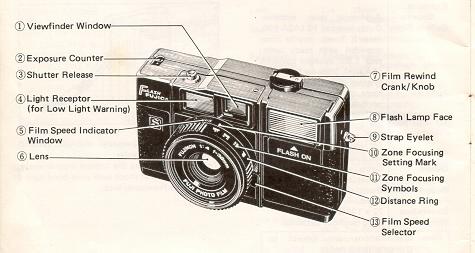
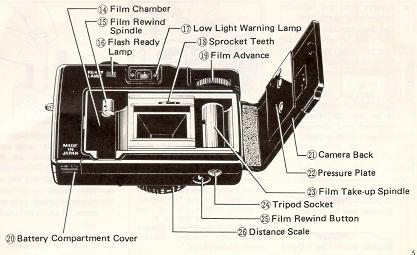
NAMES OF PARTS ........
LOADING THE BATTERIES . .
LOADING THE FILM .......
SETTING THE FILM SPEED
SELECTOR ...............
FOCUSING THE LENS ......
COMPOSING AND TAKING
YOUR PICTURE, .......
TAKING FLASH PICTURES. . .
END OF THE FILM ........
CAMERA CARE
Lens: 1:4, 38mm, 3-component, 3-element, coated.
Shutter: Mechanical, 1/1 25-sec. fixed speed; X synchronization.
Exposure Control: Aperture switch over.
(1) Outdoor non flash photography
F8 when
set for ASA 100
F16 when
set for ASA400
(2) Flash photography
Aperture
automatically sets to F 4 for both ASA 100 and 400 films when flash is popped
up.
Focusing: Four-zone focusing, zone focusing symbols visible through viewfinder.
Viewfinder: Direct vision; 0.5 plus magnification; 85% field of view; -1 plus or minus 1 diop.; low-light warning (LED).
Film Advance: Wheel in camera back, provision for double-exposure prevention,
Film Rewind: Rewind button and crank,
Exposure Counter: Automatic reset, additive.
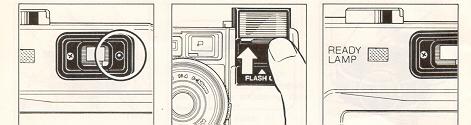
Built-in Flash: Guide number 10 {ASA 100 meter); 7 sec. recycle time; provided with ready lamp; two 1.5V penlight batteries (AA size); Slide-up flash head {manual slide-up); flash switch turns on and aperture opens up fully when flash head is pushed up; flash switch turn' off, aperture returns to normal, and ready lamp turns off when flash head is pressed down.
Other: Cable release socket; strap eyelet; tripod socket.
Body Finish: Black; simulated-leather front.
Dimension: 72x121 x54mm
Weight: 270g (without batteries)
Note: Specifications are subject to change without notice.
Clip the Hand strap (included with your camera) on the Hand strap Eyelet.
To prevent dropping the camera inadvertently, carry it about and shoot with
your hand passed through the Hand strap loop.
LOADING THE BATTERIES
* Always load the batteries before loading the film.* Use two penlight batteries [AA-size). Alkaline-manganese batteries (Mallory MN1500 or Eveready E-91 ) are recommended because they last long.
* Do not use rechargeable type nickel-cadmium batteries because they can overload and damage the camera's built-in flash.
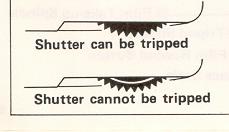
Before putting the camera away in its case, turn the Film Advance Wheel a
little so that you can see the white line on it.
This will lock the Shutter Release and prevent wasting battery
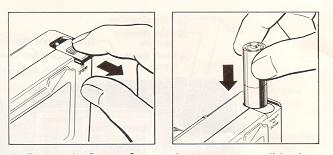
1. Remove the Battery Compartment Cover by pushing it out toward the camera back.
· Wipe both ends of the batteries clean with a dry piece of cloth before loading.
· Use a pair of the same brand of batteries and always change the pair at the same time.
· If you are not using the camera for some time, remove the batteries before
putting it away because battery leakage can damage it.
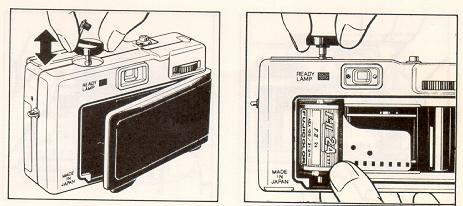
1. Open the Back Cover by pulling the Film Rewind Knob for Crank) all the way out.
· Always load the film in subdued light,
2. Insert the film cartridge in the Film Chamber then push the Film Rewind knob back to its origins Position.
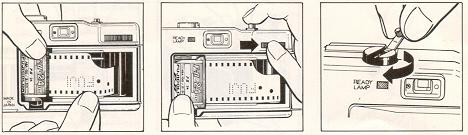
· Make sure the film perforations engage the Sprocket Teeth.
4. Turn the Film Advance and depress the Shutter Release. Repeat this cycle once or twice to make sure the film will wind. then close the Back Cover.
5. Take up the film slack by erecting and turning the Rewind Crank slowly in the direction of the arrow, then fold the crank back to it's original position.
6. While watching the Exposure Counter, turn the Film Advance and press down the Shutter Release. Repeat until the number "1" appears in the Counter. {The film is now in position for the first shot.)
· The film is properly loaded if
the Rewind Knob turns to the left while the Film Advance is being turned.
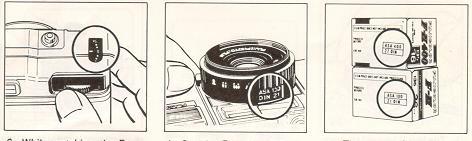
1. Set the Film Speed Selector to "100" if you are using an ASA 100 film and to "400" if you are using an ASA 400 film.
· Make sure the Film Speed Selector is set fully to the right or to the left.
FOCUSING THE LENS
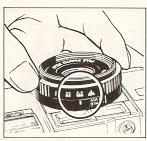
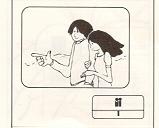
(Person) About 1 meter (3.3 ft.) (good for taking close-up portraits)
(Two persons) About 1.5 meters (5 ft.) {good for taking close range
pictures of people)
(Group of people) About 3 meters (10 ft.) (good for taking
medium distance pictures of a group of people)
(Mountain) Beyond 3 meters 110 ft.) (good for taking distant
scenes)
2. Focusing can also be done with the distance scale engraved on the bottom side of the Distance Ring.
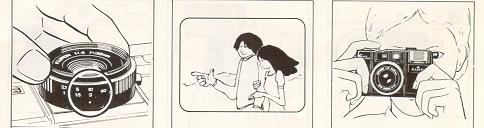
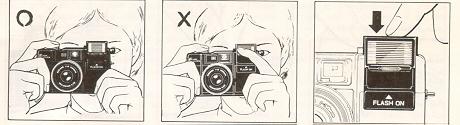
Look through the Viewfinder and press the Shutter Release halfway down. If a red LED light (low-light signal) turns on in the right edge of the Viewfinder, use the camera's built in flash to take your picture.
3. Focus the lens, compose your picture, and press down the Shutter Release. The flash will discharge when the shutter is tripped to give you a perfectly exposed picture.
· Avoid putting your fingers in
front of the Flash Lamp Face.
4. The camera's built-in flash will let you take pictures from the following
distances:
| ASA 100 film | 1 - 3 meters
(13.3 - 10 feet) |
| ASA 400 film | 1.5 - 5 meters
(15 - 16 feet) |
After You are through exposing a roll of film {check the Exposure Counter to make sure it shows the number "24" if the film in the camera is a 24-exposure roll), rewind it into its cartridge and unload it as follows:
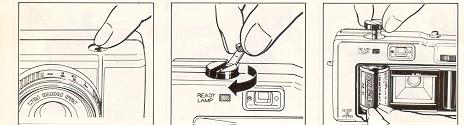
2. Open the Back Cover by pulling the Rewind Crank all the way out and un load the film cartridge
· Take the exposed film to your photo finisher as soon as possible.
2. Keep your fingers off the lens glass, viewfinder window, eyepiece glass and light receptor window. These glass surfaces are cleaned with FUJI Lens Cleaning Fluid and FUJI Lens Cleaning Paper.
3. If you are not taking pictures for some time, remove the batteries and keep the camera and batteries where it is cool, dry and free of dust, preferably in separate, ridded cans together with some sort of desiccant, such as silica gel.
4. During the hot summer months, do not leave your camera in the car, on the beach, or in damp places for a long period. In winter, especially in the mountains and at ski resorts, do not let your camera get too cold.
5. To protect your camera lens, put the lens cap on each time you finish shooting.
6. Your camera is a high-precision instrument. Do not wet it or drop it on
the floor. In case it becomes wet with rain, wipe off all moisture with a piece
of dry cloth.
7. In case of mechanical or other trouble, take your camera to your
repairer. Do not try to repair it yourself unless you are an expert because it
contains a high voltage circuit for setting off the flash.
8. If you are not using the camera flash for a long time, set it off periodically to prevent the condenser from deteriorating.