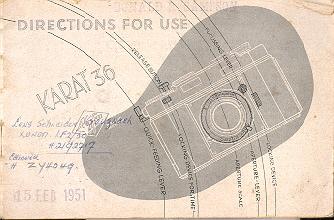
This camera manual library is for reference and historical purposes, all
rights reserved.
This page is copyright© by
M. Butkus, NJ.
This page may not be sold or distributed without the expressed
permission of the producer
I have no connection with any camera company
On-line camera manual library
This is the full text and images from the manual. This
may take 3 full minutes for all images to appear.
If you find this manual useful, how about a donation of $3 to: M. Butkus,
29 Lake Ave., High Bridge, NJ 08829-1701
and send your e-mail address so I can
thank you.
Most other places would charge you $7.50 for a electronic copy or $18.00 for
a hard to read Xerox copy.
TO ALL FRIENDS OF THE KARAT,
Thus we may be permitted to address you, for if you are reading this booklet, you are sure to have joined the happy
circle of lucky people who own a Karat 36. We should like first of all to congratulate you on the wise choice you have made of
a perfect miniature camera.
Your selection, we are certain, was determined not only by the camera's attractive appearance, but also by its quality and
efficiency, and not least by the confidence justified by every product of the Agfa Camera Works.
The vast experience of our factory has gone to produce in the Karat 36 a miniature camera of a perfect type which will satisfy
all requirements. Thanks to its collapsible rapid-feeding lever that sets the shutter and ensures speed in setting and releasing
it again, the Karat 36 has become the ideal camera for all amateur and professional photographers and for all. press work.4.butkus.org
The idea behind the construction of this camera was to produce an absolutely fool-proof camera, simple in its mechanism
and easy to handle. But never forget that you have in your hands a first-class optical instrument of precision construction and
that careful treatment is no more than its due.
We would, therefore, request you to read these directions carefully. They have been kept as helpful and short as possible.
Practice the operations in the illustrated part, first without a film in the camera. You will then be able to
manipulate your camera quickly and steadily in all circumstances. Get accustomed to switch the rapid-feeding lever with an
even, firm jerk. This will enable you to achieve maximum speed in making exposures.
Practice focusing too. After a short
time you will find that you have no difficulty in focusing even tiny objects quickly and satisfactorily.
Never use force! Protect your camera from dust and never expose it too long or unnecessarily to sunlight. Avoid touching the
lenses with your hands, to clean the outer surface of the front lens and the window of the view-finder, use only a clean, soft
linen rag.
Strictly speaking, all this advice goes without saying But keep it in mind and this excellent miniature camera will give you
constant delight. You will be amply repaid by your results, whether in the fascinating field of black and white art or in the
wonderland of color photography.
A close study of the illustrated pages following these hints will make you familiar with the mechanism and show you how to
handle the camera. You will find other details worth knowing in the second part of the booklet.
AGFA CAMERA WERK, MUNCHEN
![]() |
||
| To open the camera, move locking slide outwards and swing the camera back open. Firm pressure on the camera back will help to release the locking slide.4.butkus.org | Raise the hinged film guide. Turn the milled disc of the winding-spool, until the slit for inserting the film, on which the carrying tooth is visible, is on top. | Pull out re-winding knob of counter spool as tar as it will go and press it back again, after having inserted a miniature film cartridge, turning the knob slightly till the
cartridge spool is engaged. |
| The Karat 36 is fed with the standard miniature film cartridge, It will not take the special 12-exposure "Karat Cartridge" of the Karat 12 model. | ||
![]() |
||
| Insert flap of film in slit of spool up to second film perforation with which the carrying tooth must engage correctly. Turn milled disc of spool until the film is tightly stretched. The film must be pulled out of the cartridge in its full width by about 1/2" and must lie within the edges of the film channel. Then lower hinged film guide, | Close camera firmly, but without force. Before closing the camera make sure that hinged film guide is lowered. | Turn film counter disc clockwise to "A" by pressing finger on small milled knob |
![]() |
||
| Press the brace-lock device which makes the lens board spring forward into position for taking pictures. At low temperature lens board may need a gentle pull.
Important! It is only in this postion that the rapid-feeding lever can be operated. |
With thumb or forefinger turn rapid-feeding lever as tar as it will go. (Simultaneous film transport and shutter cocking). Don't obstruct knob of re-winding spool which turns with the lever. Double exposures as well as ,,blanks" are prevented by special blocking device.4.butkus.org | Press the release button down steadily and completely with the upper joint of the forefinger, putting the top of the finger firmly on the camera. Repeat above operation. The counting device now points to a mark before "1". |
![]() |
||
| Set lever for lens aperture at the desired number of aperture scale. | Set exposure time by turning the milled ring with exposure times engraved on it to the triangular mark. In order to save the shutter, always set time of exposure before setting shutter. | For time exposures set shutter at ,,B". Pressure on the release button opens the shutter which closes when the button is set loose. To use a cable release, unscrew
flat cap on release button. For long-time exposures, lock depressed release button by means of lever
"T". Important: Lever "T" must otherwise always be in horizontal position. |
![]() |
||
| In order to focus, bring range view finder close to eye and direct camera towards object. Take knob of focusing lever between tips of middle and ring finger of your left hand to operate lever. | If the object lies beyond the distance set, its image appears in the viewfinder as divided horizontally into two halves that do not fit. | Adjust by focusing lever until I the two halves fit to form an undivided image. This is a sign that the camera is at the right focal distance which can be verified by looking at the scale in feet on the valuation ring seen from above in the small window on the lens board. |
![]() |
||
| Set rapid-feeding lever once more, the counter disc now shows the number 1 and the first exposure can be made. Camera must be kept level. Hold it steady with both hands. Before making exposure check aperture and exposure time once more. |
When taking upright pictures, the little finger of the left hand holds back the lid of the Ever-ready case. There are three things to remember: a. aperture and exposure time must be set b. film must be moved forward which automatically sets shutter, c. lens must be focused and shutter. released. |
To close camera, push back brace-lock and press down lens board on both sides. |
![]() |
||
| When the picture counting disc shows the number "36" the film has advanced for the last exposure. | To re-wind film pull out milled re-winding knob halfway, to facilitate manipulation. | Keep locking-knob "R" on bottom of camera depressed and turn re-winding knob in the direction of the arrow, until the film is wound up. This is indicated by the fact that re-winding knob can be turned, even if locking-knob is released. |
![]() |
||
| Open back of camera by releasing locking-slide. Firm pressure on the camera back will help to release the locking slide. | Take out film cartridge after re-winding knob has been pulled out to its full length. Close camera. Never forget to lower hinged film-guide, as otherwise the camera will not close. | Wrap up exposed film cartridge immediately in foil-lined paper or the like, so as to protect it from light, and mark it as exposed film. Secure camera in Ever-ready case by screw at bottom. |
FURTHER IMPORTANT HINTS AND TECHNICAL DATA
Up till now, dear Karat friend, you have been listening to a lightning lecture on the mechanical handling of the Karat 36. In the
following paragraphs we wish to give you additional important hints of a general kind which we urgently recommend to your
occasional study.
GENERAL REMARKS
The right film is the customary 35 mm Standard Miniature Film Cartridge for black and white or color pictures, size 24 x 36
mm. The "Karat Cartridge" specially made for the Karat 12 camera cannot be used.
Dented cartridges cause obstructions! So don't use cartridges in which the film is jammed so that it does not come out smoothly.
It
is advisable to insert the cartridge in diffused light.
By operating the rapid-feeding lever, the film is moved at one jerk for the length of a picture, and at the same time the
Compur shutter is set. Operate rapid-feeding lever only with opened camera (position for exposure)! Simultaneously with
the operation of the rapid-feeding lever, the re-winding knob turns (this is the sure sign that the film is being fed properly).
See, therefore, that this knob is not inadvertently impeded while film is being fed. A locking device prevents the annoyance of
double exposure or unexposed film.
OPTICAL EQUIPMENT
The Karat 36 is made in three types, with the Xenon f/2.0, the Heligon f/2.0 and the Xenar f/2.8. Focal length for all types is
50 mm.
It is scarcely necessary to say anything about the quality and efficiency of these lenses which are known and appreciated all
over the world. They are special lenses for miniature cameras, minutely calculated constructions in which the most exacting
demands on optical equipment - for instance in color photography - have been taken into consideration.
The coating of the lenses consists of an inconceivably fine layer on the lens surface. On the one hand, this protects and
enhances the great transmissive capacity of our lenses, as reflection losses which can never be entirely avoided are greatly
reduced, on the other hand it eliminates the disturbing reflexes (flare spots and "ghosts") that are apt to appear on many
pictures and on the most interesting ones in particular, namely in exposures against the light.
It is, therefore, understandable that such exquisitely fine optical instruments should need most careful treatment. Avoid
touching the lenses with the hand and immediately remove any dirt or finger marks which are by no means as harmless on
such highly polished lenses as is commonly supposed. In cleaning, use only a suitable piece of chamois leather or soft linen
which must be absolutely free from dirt, oil or dust. Wind the cleansing material round your finger or over a small, pointed
wooden rod. Never use an instrument with a sharp edge or made of metal.
It stands to reason that lenses with the anti-reflex coating require still greater care. Remember that the coating has only a
thickness of about 1/1000 mm. This does not mean that the coating is particularly susceptible to injury, but it is just as easliy
damaged by wrong treatment as is the highly polished lens.4.butkus.org
Bear in mind that when temperature changes are abrupt clouded lenses will only become clear again when the whole camera
has accommodated itself to the new temperature.
Never try to take the lens asunder.
THE COMPUR-RAPID-SHUTTER
The shutter of the Karat 36 allows exposures of 1, 1/2, l/5, 1/10, 1/25, l/50, 1/100, 1/250 and l/500 second. The numbers engraved on
the shutter ring stand for fractions of seconds, for instance: 2 = 1/2 sec., 50 =
1/50 sec. etc.
As a rule the speed of exposure desired should be set before cocking the shutter by means of the rapid-feeding lever. For the
same reason, namely in order to save the exceedingly delicate mechanism of the shutter, the camera should always be
stored with its shutter unset. Make it a habit to set the shutter only immediately before making an exposure.
For time-exposures the camera should be set on a tripod or at least on a firm support. In such cases it is advisable to use a
cable release which is screwed into the nipple of the shutter release after the flat cap has been removed.4.butkus.org
The lever "T" that serves to arrest the release button when making long-time exposures must always be swung back to its
horizontal position after the exposure has been made. Before closing the camera, make sure this lever is in the correct
position. Never try to close the camera when the lever is upright.
LENS STOPS
The aperture scale on the Xenon and Heligon types comprises the following apertures; 2 2.8 4 5.6 8 11 and 16; in the case
of the Xenar the apertures can be set in the same gradation from 2.8 to 16.
The lens stops serve as a control of speed and depth of field. Therefore remember:
low aperture numbers, e.g. 2.8 = high speed, but small depth of field,
high aperture numbers, e.g. 16 = less speed, but large depth of field.
The aperture scale has been so graded that between one aperture number and the next higher one, the speed of the lens is
reduced by half.4.butkus.org
DEPTH OF FIELD
The short focus lenses employed in the Karat 36 have a particularly good depth of field Study of the depth of field problem
cannot be too strongly recommended. Familiaiity with it will increase your self-reliance, extend your possibilities and enable
you to enjoy to the full all the advantages of your camera.
You know already that with a large lens aperture (low aperture number) the -depth of field is smaller than with a high aperture
number. It is also important to know that for close-ups the depth of the focus zone is smaller in extent than for distant views.
Set yourself some tasks with different zones of sharpness and distances and solve them with the aid of the depth-of-field-table You will soon master the law of depth of field and the right use of the table without being a mathematician.
The depth-of-field-ring on top of the Karat 36 is another valuable help always available. It is easy to handle. The stationary
inner disc has engraved on it the distance numbers from 3 feet to CD (infinity), the movable knurled outer ring shows the
aperture numbers corresponding with the zones of sharpness. These zones are narrowest with low aperture numbers and
widen progressively with the higher aperture numbers, according to the law that with a small aperture number, the zone of
sharpness is narrow and widens with a higher aperture number.
If, for instance, by turning the knurled outer ring, the aperture number 16 is set at number 4 (feet) of the inner disc, the zone
corresponding to aperture indicates the respective zone of sharpness between the two limit marks, that is from about 3.5 to 5 feet. Now if you set the lens of the
Karat 36 at aperture 16 and a distance of 4 feet you will obtain a picture in which everything lying within the range of 3.5 to 5
feet will be sharply defined.
Conversely, by means of the depth-of-field-ring, the aperture number necessary to obtain a desired zone of sharpness can be
ascertained.
The two point focusing method is a most convenient way for sticking to two distinct zones of sharpness On the aperture scale
between 8 and 11 a red point is visible, while on the distance scale the numbers 10 and 30 are marked in red. Now set the
aperture lever at the red point and the distance scale-- according to whether the picture is to be a close-up or a distant
view-- at the red number 10 or 30.
You will then get the following zones of sharpness:
distance set at 10 feet = from 7 ft. 4 1/2 in. to 15 ft. 6 1/2 in.
distance set at 30 feet = from 14 ft. 5 in. to oo (infinity).
For most snapshots two-point focusing will suffice.
THE RANGE VIEW FINDER
The range view finder of the Karat 36 is a combination of view finder and coupled range finder, providing accurate focusing from 3 feet to co (infinity). Its use is considerably facilitated by focus sing for broad-view pictures on
the vertical lines of the object focused, while for upright pictures, it is preferable to keep to the horizontal lines.
The sharp image seen in the view finder shows on a reduced scale the exact field covered by the camera. In close-ups however, there is a slight deviation, the so-called parallax, which can be easily adjusted after a little
experience, and it practically only occurs as a disturbance in pictures taken within a range of 3 to 6 feet. It is compensated by slightly lowering the center of the image in the view finder which can be done by simply tilting the
camera up in the direction of the view finder.
When the camera is held in vertical position the same divergency appears as a lateral deviation which is adjusted likewise by slightly swinging the camera sideways in direction to the view finder.
TAKING CARE OF THE CAMERA
Regular care lengthens the life of your camera. It should at least be examined and freed from dust frequently. Before inserting the film, remember always to remove from the interior of the cartridge any cartridge-dust and film-splints that may have accumulated.
MISCELLANEOUS
The rectangular socket on top of the camera is for holding accessories.
SHUTTER LOCKED INADVERTENTLY
Should the-shutter have been released by an inadvertent touch on the release mechanism of the lens-board, the result is a complete stop or jam, i. e. neither the feeding lever nor the release can be operated To remedy this,
set the focusing scale at 3 feet, so that the cocking mechanism on top of lens board becomes accessible and you can easily press it with your finger tip Thus the shutter is set again and can now be released by the body
release in the normal way.
ORDER NO. - KARAT 36
2017/30 Xenar 1:2.8 coated lens, F = 50 mm, Compur-Rapid shutter
2017/35 Xenon 1:2.0 coated lens, F = 50 mm, Compur-Rapid shutter
2017/37 Heligon 1:2.0 coated lens, F = 50 mm, Compur-Rapid shutter
Flash Contact
The Karat 36 is provided with a 1/8 - in. (3-mm.) nipple to which a flashbulb release cable may be attached. Automatic synchronizing
ensures that the flash coincides with the exposure. As a great variety of flashbulbs is available on the world market, all of them
having different delay- and flashing-periods, it is recommended, when using a flashbulb, to set the shutter for 1/25 second.
| Click here for COMPARATIVE TABLE OF FILM SENSITIVITY | DEPTH OF FIELD TABLE 3 TO 6 FEET |