Konica
Autoreflex T

This camera manual library is for reference and historical purposes, all rights reserved.
This page is copyright by , M. Butkus, NJ.
This page may not be sold or distributed without the expressed permission of the producer
On-line camera manual library
This is the full text and images from the manual.  This may take 3 full minutes for all images to appear.
If they do not all appear.  Try clicking the browser "refresh" or "reload button" or right click on the image, choose "view image" then go back.  It should now appear.
To print, try printing only 3 or 4 pages at a time.

If you find this manual useful, how about a donation of $3 to: M. Butkus, 29 Lake Ave., High Bridge, NJ 08829-1701 
This will allow me to continue to buy new manuals and pay their shipping costs.  
It'll make you feel better, won't it? 


If you use Pay Pal, use the link below. Use the above address for a check, M.O. or cash.

 Back to my main Chinon information page

Click here for PDF version - better pinting

Problems opening PDF files or printing problems - click here

Go to second section of Autoreflex T     Go to third section of Autoreflex T

FEATURES OF KONICA AUTOREFLEX T

1. Incorporates a fully automatic exposure control system which makes possible high levels of EE (Electric-Eye) photography.

2. Equipped with a variable TTL (Through-The-Lens) system which measures light in the most ideal manner depending on the coverage angle of an interchangeable lens.

3. The viewfinder is bright and the light metering system is of the full lens opening type. The lens may be stopped down for light metering, wherever necessary.

4. Incorporates a polymechanical viewfinder which makes it possible to check all data for photographing at an instant.

5. Color Dynamic Coating which gives fully display to excellent effects.

6. A system camera which makes possible multipurpose photographing with an ample series of interchangeable lenses and accessories.4.butkus.org


CONTENTS

Basic Manipulation for EE Photographing ......... 6

Major Specifications of KONICA Autoreflex T .......  9

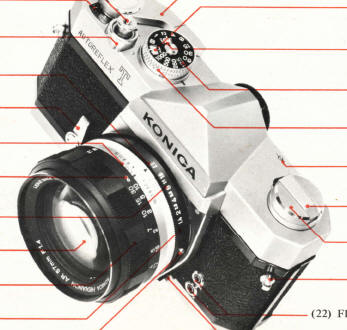
Name of Each Part .....................  10

Loading of Mercury Battery Cells

      (Meter Switch/Check of Batteries)

Film Loading

    (Set Film Speed)

Shutter

Aperture

Metering Systems of TTL Meter . . .

Looking at Meter inside Viewfinder .

Electric-Eye Photography

(Manual Picture-Taking)

Training of Camera . .,

Focusing . . . .. . . .

Depth of Field .....

Use of Self-Timer . .

Film Rewind ...............

Synchroflash Photography ......

B (Bulb) Exposure . .

Lens Interchange . . .

Photographing in Stopped-down Metering System

HEXANON Interchangeable Lenses .......

Accessories . . . .. . . . . . .. ...

Maintenance of Camera and Lens . .


BASIC MANIPULATION FOR EE PHOTOGRAPHING

1. Insert mercury batteries and put ON the meter switch.

2. Insert film and set the film sensitivity speed.

3. Set your camera to the EE mark.

4. Determine a shutter speed. (1/125 sec. for outdoor shooting and l!30 sec. for indoor

5. Focus and frame.

6. Check the exposure.

7. Depress the shutter button to take a picture.

8. After a roll of film has completely be taken rewind the film.4.butkus.org
 

MAJOR SPECIFICATIONS OF KONICA AUTOREFLEX T

Type: 35mm SLR equipped with focal plane shutter and TTL-EE system.
Film: 35mm film in cartridge, 20 or 36 exposure.
Picture Size: 24 x 36mm. (1" x 1-1/2").
Standard Lens: HEXANON AR 57mm f/1.2 (6-group and 7-element), AR 57mm f/1.4 (5-group and 6 element),  AR 57mm f/1.8 (5-group and 6 element). Equipped with EE lock and closest taking distance 1-1/2R (0.45m),    Color Dynamic Coating.
Mount: KONICA Mount 11 of bayonet type, diameter 47mm, flange back 40 .5mm.
  Aperture Device: Fully automatic EE aperture, smallest aperture f/16. Equipped with a manual aperture device for checking depth of field.

Shutter: Up-and-down running metal focal plane High Synchro shutter "Copal Square S" with speeds of B 1 to 1/1000 sec. Speed scale calibrated in equally graduated 1: 2 progression, single-spindle, non revolving dial, built-in self-timer, M and X synchro. M, FP and MF coupled to all speeds with M and electronic light to 1/125 sec. with X.

Viewfinder: Eye-level viewfinder using pentaprism. Fresnel lens also used. Built-in rangefinder focusing lens with Micro Dia Prism of real-image dispersion alignment type. Polymechanical Viewfinder in which shutter speed scale, aperture scale, meter needle, exposure warning marks, mark indicating f-number at full lens opening, manual indicator mark, index point for stopped-down metering and battery check mark are all visible.

Exposure Adjustment: Variable TTL system using 2 super high sensitive compound CdS cells. Fully automatic EE aperture lens (light metering at full opening): preference given to shutter determination for EE picture-taking. For manual picture taking in automatically controlled correct aperture system, film speed, shutter speed, correct aperture coupled to f-number at full lens opening are read. Manual pre-set aperture lens (stopped-down metering): shutter speed, film speed and aperture are set to index points (zero method). Two 1.3V mercury batteries used as electric source, battery switch and check device.

EE Coupling Range: EVI. 5 (f/1.2 with 1/2 sec.) EV18 (f/16 with 1/1000 sec.) with ASA 100 for f/1.2 lens.

Film Sensitivity Range: ASA 25 to 1600, DIN 15 to 33.

Film Loading: KONICA EL Type (patented Konireel Used).

Film Wind: Film wound with top lever in one action (cocking in are of 162° with 30° play), double exposure prevention.

Film Counter: Automatic return type indicating number of pictures exposed.

Film Rewind: Crank type. Rewind button automatically returns.

Dimensions and Weight:  With f/1.2: 5-3/4"(w)x3-3/4"(h)x3-3/4"(t), 43ozs.
With f/1.4: 5-3/4"(w)x3-3/4"(h)x3-1/2"(t), 36ozs.
With f/1.8: 5-3/4',(w)x3-3/4"(h)x3-1/2"(t), 34ozs.
Without lens: 5-3/4"(w)x3-3/4"(h)xl-1/4"(t), 26ozs.


The KONICA Autoreflex T's TTL meter takes two 1.3V mercury battery cells as its electric source. Wipe the separately enclosed mercury battery cells with a piece of dry and clean cloth and put them into the mercury battery chamber.

(Webmaster: this is a mercury battery, not available for sale in the U.S.  Check my web page for Mercury Battery Replacements.   There are several options.

1. Turn the cover of the Mercury Battery Chamber (39) counterclockwise with a coin or something alike and detach it from the chamber.

2. Insert the two cells into the mercury battery chamber the "+" side up, as indicated in the figure printed on the seal inside the chamber.

Turn the cover of the mercury battery chamber clockwise and make sure that it has been screwed tightly.4.butkus.org

Meter Switch

The meter-switch will be put ON when the Lock Lever (3) placed under the Shutter Button (1) is turned so that it comes in alignment with the red index point.

Unless pictures are to be taken, set the lever to "L" and the switch will be kept put OFF, preventing the mercury battery cells from accidentally running down. At the same time, the shutter button wish be locked. Use this system when the camera is to be carried around with the film cocking lever wound.
 

Check of Batteries

The expected span of serviceability of a mercury battery cell will be over one year in normal use. With the span of its serviceability getting to a close, its voltage will suddenly diminish. The degree to which the cells have run down may be checked while pictures are taken, but it will also be possible to check it in the following manner.

1. While the Lens Interchanging Button (23) is depressed, turn the lens counterclockwise and detach it From the camera. (Refer to Page 54.) There is no need to dismount your lens, if it is not an automatic aperture one with an EE mark.

2. Grip and lift up the place outside the Shutter Speed Dial (17) and set the film speed to ASA 100.

3. Turn the shutter speed dial and set it to 1/125 sec.

4. While looking into the viewfinder, depress the Battery Check Button (27) on the bottom of your camera. The capacity of the battery cells will be adequate if the Meter Needle (45) is found to be swinging under the Battery Check Mark (46). If the meter needle is no longer able to reach the mark, replace the battery cells with new ones.

As mentioned above, every index point for the battery check is indicated in red. In a word, the essential thing will be for the meter needle to swing under the red mark after the film and shutter speeds are aligned with the red marks.

· The meter takes two 1.3V National H-C, Mallory PX-675 or Eveready EPX-675 mercury battery cells. Care must be exercised in selecting the cells as there are cells which look identical in shape but differ in stipulated voltage, such as battery cells.

· In the event that your camera is not to be used over a long span of time, take out the mercury battery cells and keep them in a place free from moisture.

FILM LOADING

The KONICA Autoreflex T takes 35mm rod film, which comes in a cartridge. For film loading, avoid the direct sunlight and do it in the shade. If there is no shade, one way would be to use the shadow of your body.


1. Put the Back Cover Lock (24) and open the Back Cover,
2. Put a film cartridge into the Film Chamber (26) as though it skid into the chamber at a slant from above the underside.

3. Pun out the film while the cartridge is lightly pressed down and then choose any slit of the Film Take-up Spool (32) into which the film tip may be inserted with ease and insert the film into the slit.

4. While lightly pressing down the cartridge, turn the Film Cocking Lever (13) and take up the film on the spool. Ascertain that the teeth of the Sprocket (31) are in gear with film perforations before the back cover is closed. Depress the back cover with a finger tip, and it will be closed with ease.4.butkus.org

5. Flip up the Film Rewind Crank (19) and turn it in the direction indicated by an arrow mark on it to reduce the slack of the film.

6. Turn the film cocking lever until it does not move further and depress the Shutter Button (1). Repeat this action tin the figure "1" comes in alignment with the index mark in the window of the Film Counter. (2). If the him is transported in the correct manner when the film cocking lever is turned, the Film Rewind Knob (20) will revolve counterclockwise. If it
does not turn counterclockwise, rewind the film (see Page 48) and

· Turn the film cocking lever until it does not move further and the film will be transported by one frame and the shutter charged at the same time. The mirror and the automatic aperture will also be set. Simultaneously, the film counter will advance by one reading.

7. Set Film Speed (ASA)

Lift and turn the external ring of the Shutter Speed Dial (17) and align the reading equivalent to the speed of the film loaded in your camera with the index mark of the Film Speed Indicator Window (ASA) (14). When they are aligned, the ring drops and is fixed into position.

· The ASA and DIN scales visible in the film speed indicator window indicate the degrees to which film is sensitive to light. The film speed of your film is indicated on the box in which it is contained and in its instruction booklet. (Figures in brackets refer to intermediate points of sensitivity.)

SHUTTER

A shutter is designed to control the amount of light reaching the film surface in terms of time and photographically to fix an image of a subject on it. The shutter speed scale has calibrations of B and I to 1/1000 sec. and the denominator of each speed is indicated on the shutter speed dial. The shutter speed may be adjusted simply by bringing a reading in line with the index mark

· Shutter speed calibrations are also visible in the viewfinder, thus making it possible to ascertain the speed while looking through the viewfinder.

·"B" stands for bulb exposure and is used when there is the need for the exposure of over one second. (Page 53)

· The red figure of "125" is the maximum shutter speed for synchronization with an electronic light.

· Do not turn the shutter speed dial when the shutter button is depressed.4.butkus.org
 

APERTURE

The lens aperture is designed to control the amount of light reaching the film surface in terms of area and the depth of field (see Page 40). Your camera's EE system will automatically determine the correct aperture value, once the EE mark on the aperture ring is aligned with the index mark. Manual aperture is also usable (Page 35). In either event the fully automatic aperture system will work and the lens will be stopped down to a determined f-number only during the split moment when the shutter is depressed and then automatically return to the full opening after a picture has been taken.

· The amount of light going through the lens will reduce in proportion to a rise in the aperture value. The correlation, as indicated in the above figure, is such that the brightness of the lens reduces by half in proportion as the aperture enlarges by one reading.

· The lens having the EE Release Button (12) at its aperture ring is equipped with an EE lock. In the event that the camera is released from the electric eye system and used for manual aperture, depress this button and turn it.

· The aperture is continually variable, and therefore an intermediate point between readings on the aperture ring is usable.
 

METERING SYSTEMS OF TTL METER

The KONICA Autoreflex T's TTL meter not only measures light reaching the film plane through the lens but also incorporates a variable metering system in which the spot metering method, the center spot metering method and the all-frame average metering method are automatically selected, depending on the coverage of the lens. This system makes it possible to measure light with the lens kept at its full opening while looking through the bright viewfinder and to measure light with the lens stopped down to a desired f-number.

It is the most ideal metering system in which deep hoods are fitted to the two compound CdS.cells on both sides of the viewfinder . eyepiece and the light intake device is slanted inwards and in which the brightness of a subject whose image is formed on the focusing glass plate as indicated in the figure is measured while a curvature of the


NOTE: The KONICA Autoreflex T does not take any fully automatic EE aperture lens prepared for the Autoreflex as it is. Make sure that you use it after it has been remodeled into a lens for use on the Autoreflex T (with f-numbers). Remodeling work is quite simple.4.butkus.org

Sensitivity distribution invariable metering system


LOOKING AT METER INSIDE VIEWFINDER

F-NUMBER FOR CORRECT EXPOSURE: When the Meter Needle (45) stops within the range of correct exposure, the f-number on the aperture scale (47) to which the meter needle points is the aperture to which the taking lens will be set when the shutter is released for a shot.

CORRECT EXPOSURE RANGE: For an AR lens which is not f/1.2 in brightness, the Mark Indicating the F-number (44) at the Full Lens Opening shows the f-number at the full opening of the lens used on your camera. If the meter needle is aligned with this red mark, pictures will be under-exposed. The mark indicating the f-number at the full opening of the lens win move down if the meter is not coupled. In other words, the mark will also show the range where the meter is coupled. In EE picture-taking, therefore, the area sandwiched between the upper and lower red marks is the correct exposure range.

INDICATION OF SHUTTER SPEED SCALE: The speed at which the shutter will be released is indicated on the Shutter Speed Scale (42) in the lower part of the viewfinder

MANUAL INDICATOR MARK: When the EE device is released and the camera is set to manual picture-taking or when the stopped-down metering system is used, the Manual Aperture Indicator Mark (43) "M" will appear over the meter window, showing that a picture is not to be taken under EE system.

INDEX POINT FOR STOPPED-DOWN METERING: For stopped-down metering, the meter needle will be brought in line with the Index Point for Stopped-down Metering (41) to secure a correct exposure. (Refer to "Stopped-down Metering" on Page 57.)

BATTERY CHECK MARK: The Battery Check Mark (46) is used to check the serviceability of the mercury battery cells which serve as the electric source of the meter. (Refer to 'Battery Check" on Page 16.)
 

ELECTRIC-EYE PHOTOGRAPHY

(Light Metering at Full Lens Opening)

This method is commonly used when pictures are taken under the EE system with an AR lens having the EE mark.

1. Set Your Camera to EE Mark.

Turn the Aperture Ring (11) arid bring the EE Mark (4) in line with the index point. The EE lock will click into position.

2. Determine Shutter Speed.

Turn the Shutter Speed Dial (17), select a reading on the Shutter Speed Scale (16) suitable for your subject and bring it in line with the index mark. In normal circumstances, it is convenient to set the shutter speed to 1/125 see, for outdoor shooting and 1/30 sec. for indoor picture-taking.

3. Look Through Viewfinder.

Train your camera at the subject look through the viewfinder, focus the lens, flame your subject and look at the Meter Needle (45) in the viewfinder. If the meter needle is not aligned with the upper or lower red mark (exposure limit mark), You will always be able to secure correct exposure.


(Webmaster: depending on the lens installed, the top red mark will cover more of the larger F-stops.   In the overexposure image note the red meter arm in the bottom of the metering range in the red.   Most other camera makers have the overexposure at the TOP of the metering range)

When the meter needle indicates an under-exposure, choose a slower shutter speed. When it indicates an over-exposure, select a faster shutter speed. Correct exposure may be secured as long as the meter needle is not aligned with the upper or lower red mark.

In the event that you want to give priority to the selection of a lens aperture over a shutter speed because of a desired depth of field, turn the shutter speed dial and make an adjustment so that the needle will indicate the desired f-number. No intermediate points between shutter speed readings are usable, so make sure that the shutter speed dial clicks into position.

·It will be quite meaningless even if the meter is visible within the correct exposure range with the shutter speed dial set to the `'B" reading. Do not use this method.

(Webmaster: in real English - In BULB the meter does not work.  It's experience and using the setting off the film box time)


Go to second section of Autoreflex T     Go to third section of Autoreflex T