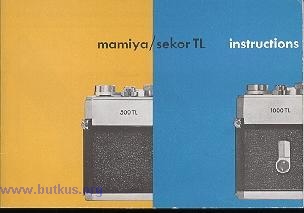
Mamiya TL
Camera Manual
posted 12-8-02
HTML Translations - German
- Italian
- French
- Spanish
- Others
These links will not translate any PDF
files
This is the full text and images from the manual. This may take 3 full minutes for all images to appear. If they do not all appear. Try clicking the browser "refresh" or "reload button".
This camera manual library is for reference and historical purposes, all
rights reserved.
This page is copyright by
, M. Butkus, N.J.
This page may not be sold or distributed without the expressed
permission of the producer
I have no connection with any camera company
If you find this manual useful, how about a donation of $3 to: M. Butkus,
29 Lake Ave., High Bridge, NJ 08829-1701
and send your E-mail address too so I
can thank you.
Most other places would charge you $7.50 for a electronic copy or $18.00 for
a hard to read Xerox copy.
This will allow me to continue to buy new manuals and maintain these pages.
It'll make you feel better, won't it?
If you use Pay Pal, use the link below. Use the above address for a check, M.O. or cash.

You are now the proud owner
of one of the worlds finest
cameras, the Mamiya/Sekor TL Single Lens Reflex
Camera. In order to get
excellent results with your
first roll of film, we suggest
that you familiarize yourself
with the camera and its
working parts. Read this
instruction book before you
load the camera.
CONTENTS
Nomenclature of Functional Parts
Construction Features and Specifications
How to Insert the Silver Battery 3
Loading the film 4
Set the film speed 5
![]() |
1.Rapid Film Advance
2.Shutter Release With cable release socket 3.Shutter Speed Dial 4.Meter Off Button 5.Automatic Reset Exposure Counter 6.Viewfinder4www.butkus.org 7.Focusing Ring 8.Diaphragm Ring 9.Preview Lever 10.Self-Timer Cocking Lever (only on 1000 TL) |
![]() |
11.Self-Timer Actuating Button 12.Distance Scale 13.Depth of Field Scale 14.Back Cover Lock 15.Rewind Crank 16.Film Chamber 17.Film Sprockets
18.Film Take-up Spool 19.Film Rewind Release
Button
|
![]() |
20.Mirror-Matic Spot Meter 21.FP & X Flash Terminals 22.ASA Film Speed Setting 23.Neck Strap Eyelets 24.Tripod Socket 25.Battery Cover4www.butkus.org
26.Back Cover |
SPECIFICATIONS
| TYPE: | 35mm Single Lens Reflex with Built-in behind the lens Light Meter |
| FILM & THREADING SIZE: | 35mm (20 or 36 exposures); 24x36mm. |
| STANDARD LENS----1000 TL | Mamiya/Sekor : f/l.4 - 55mm, 7 elements in 5 groups, angle 43 degrees
Mamiya/Sekor : f/1.8--55mm, 6 elements in 4
groups, angle 43 degrees
|
| STANDARD LENS----500 TL | Mamiya/Sekor : f/2.0----5Omm, 6 elements in 4 groups, angle 47 degrees
|
| LENS MOUNT | Threaded Praktica/Pentax type mount, 42mm |
| SHUTTER | Focal plane shutter |
| SPEEDS | 1000 TL- B to 1--1/1000th second, with Self-timer 500TL- B to 1 1/500th second, without Self-timer |
| EXPOSURE CONTROL | Highly sensitive CdS Meter positioned on the back of the mirror. Internally coupled
to both shutter speed and lens diaphragm of all Mamiya/Sekor Lenses and
Praktica-Pentax type lenses. Needle point indicator visible in
viewfinder. Operating range EV-2 to EV-18, with an ASA 100
film, and f/1.4 lens; EV-2.7 to EV-18, with an ASA 100 film, and f 1.8
lens; EV.3 to EV-17, with an ASA 100 film, and f/2.0 lens.4www.butkus.org
|
| ASA RANGE | 25 to 800 : DIN 15 to 30 |
| FINDER | Penta-Prism finder with micro diaprism fresnel lens for instant focusing. Finder ratio: 0.95 magnification for f/1.4 and f/1.8 lens at infinity. 0.86 magnification for f/2.O at infinity. Brackets visible in the viewfinder indicate location of meter and facilitate use as a true spot meter. |
| REFLEX MIRROR | Instant return type. |
| FILM ADVANCE: | 160 degrees, single-stroke, advances film, winds shutter mechanism as well as advancing exposure counter. Built-in On/Off switch for the exposure meter. |
| EXPOSURE COUNTER | Automatically returns to pre-zero position when camera back cover is opened. |
| DIMENSIONS | Width: 5.8 inches (148mm)
Height: 3.7 inches (95mm) Thickness: 2 inches (51mm) (without lens) |
| WEIGHT | Body only: 1 lb. .5 ozs. (600 grams) Lens: 1000 TL with f/b.8 lens: 2 lbs.-2-1/2 ozs. (980 grams) |
Before using the camera, be sure that the silver battery is installed in compartment on the bottom of the camera.
|
1. HOW TO INSERT THE SILVER BATTERY To open the battery cover 25) use a coin in slot on base of camera body, turning the cover counter-clockwise. Then insert the battery, with its negative ( -- ) side down. The battery will last approximately one year, depending upon the frequency of use. For replacement, use one of the following: Eveready 76, Mallory MS-675, Ray-O-Vac RS-76.4www.butkus.org
|
![]() |
|
2. FILM LOADING Do not load in bright light. Open back cover of camera by pulling out the slide lock (14). Pull up the rewind crank knob (15) and place the film cassette into the cassette chamber (16). Return the rewind crank to its former
position. Draw out the film leader and insert it in the slit of the take-up spool. If the slit is not in the proper position to
insert the film leader, turn the take-up spool.
|
![]() |
|
|
3. SET FILM SPEED Lift the outer ring of the shutter speed dial, and set the ASA number of the film to correspond to the small white index which appears above the letter "S" on the ASA window (22). Dots in-between stipulated numbers represent the following ASA Speeds: |
|
4. SELECT THE SHUTTER SPEED At shutter speeds slower than 1/30th of a second support your camera rigidly or use a tripod to prevent movement. With the shutter speed dial set on B (bulb), the shutter will stay open as long as you depress the shutter button. When you release the shutter button, the shutter closes. When a long exposure is desired use the "B" setting and attach a shutter release cable with a locking device to the shutter button. This will permit a time exposure.4www.butkus.org To protect the shutter mechanism, trip the shutter release before storing the camera for an extended period. 5. ADJUST EXPOSURE METER |
![]() |
|
6. THE EXPOSURE METER One of the most advanced features of your mamiya/sekor TL Camera is the Mirror-Matic behind the lens meter system. With the CdS cell (positioned on the
back of the mirror) you may take a spot meter reading (covering about 10% of your picture area). The meter is clearly
outlined by the two engraved brackets located in the bottom of the viewfinder. Meter readings can be taken from the
camera position and will work with any lens. In using the Mirror-Matic system, it is not necessary to figure exposure
factors, regardless of lenses or filters used.
|
![]() |
| 7. FOCUSING AND VIEWING
The Mamiya/Sekor TL Camera is a Single Lens Reflex. You view and take the picture through the same
lens.
|
![]() |
![]() |
|
8. FOCUSING The Focusing Ring (7) is turned in either direction until the image in the small circle of the viewfinder becomes sharp. The microdiaprism then disappears, indicating the sharpest point of focus. It reappears when out of focus. |
|
9. DEPTH OF FIELD The Depth of field of a lens is the area between the farthest and nearest point in focus. The shorter the focusing length of the lens and the smaller the lens opening, the more depth of field. To see the depth of field push
the lens preview lever (9 to the right. Due to the unique Mirror
Matic behind the lens meter system, you can even more conveniently check Depth of field by pushing in
fully the film
advance lever. This action automatically closes down the lens aperture to the pre-selected setting.
|
![]() |
|
10. HOLDING THE CAMERA Lightly support the bottom of the camera with the palm of the left
hand; adjust the position of the camera so that the thumb and
forefinger of the left hand can reach the focusing ring (7). Place the palm of the right hand against the end of the
camera body. Then the forefinger of the right hand will automatically be
near the shutter release button (2) and the thumb will be on the film
advance lever (1). Bring the finder window (6) to the level of the eyes and
rest against the forehead. This will help steady the camera.
|
11. CHANGING LENSES To remove the lens, turn the barrel counter clock-wise.
|
| 12. SELF--TIMER
Mamiya/Sekor 1000 TL Cameras have a built-in adjustable self-timer (10). This feature makes it possible for the photographer to be in his own picture. It is also good practice 'to use the self-timer for slow speed shutter
release to avoid vibration even if the camera is mounted on a tripod.
|
![]() |
|
13. FLASH PHOTOGRAPHY The Mamiya/Sekor TL has two sets of terminals FP and X (21). The table below shows flash contact, shutter speed, and flash bulb to be combined for maximum lamp efficiency. Unless these combinations are rigidly followed, there will be a failure in flash synchronization. Note that 160th of a second is marked in red on the shutter speed dial. This indicates the highest shutter speed at which electronic flash units may be used. |
![]() |
|
14. INFRA RED PHOTOGRAPHY When infra-red film is used, a red dot on the depth of field scale ring(13) should be used as an index for the distance. Adjust the distance indicator to match the red dot by turning the distance scale ring (12 after focusing through the viewfinder. This is necessary because the film is only sensitive to infra-red rays which focus slightly behind the film plane for ordinary light rays. 15. REWIND THE FILM After you shoot 20 or 36 exposures, rewind the film into its original cartridge as follows:
|
![]() |
|
16. PLACING THE CAMERA INTO CASE When placing the camera into the leather case or when you are through using the camera, push the film
advance housing button (4) so that the rapid film advance lever returns automatically to its original position flush to the camera body.
|
|
17. HELPFUL HINTS Storage (When camera will not be used for a long period of time
|
|
18. CARE AND CLEANING · Never expose the camera to direct sunlight for an extended period of time.
|
|
1 SET FILM SPEED. Lift the outer ring of the shutter
speed dial, turn it around and set the same number as the ASA number of the
loaded film to the small white index which appears alongside the ASA window.
Then cock the rapid wind lever.
2 SET SHUTTER
SPEED.
|
![]() |
| 4 TURN ON LIGHT METER SWITCH. Push the rapid film advance lever (1) toward the camera body with your thumb. Thought the viewfinder, you will observe the movement of the right side of the ground. 5 ROTATE DIAPHRAGM RING. The needle moves up and down with the turn of the diaphragm ring. When the needle rests at the centre, you will get correct exposure. If the needle does not come to the centre no matter how far you turn the diaphragm ring, change the shutter speed When the needle is off centre and close to the (+) mark, you will get over-exposure: change the shutter speed to a faster setting. If the needle is closer to the (--) mark, you will get under-exposure change the shutter speed to a slower setting. 6 RELEASE SHUTTER. Hold your camera firmly and trip the shutter. Cock the rapid wind lever for the next picture. (When taking a series of pictures under the same lighting conditions, it is not necessary to repeat instructions 4 and 5). |
![]() |