This camera manual library is for reference and historical purposes, all
rights reserved.
This page is copyright© by
,
M. Butkus, NJ.
This page may not be sold or distributed without the expressed
permission of the producer
I have no connection with Chinon Co., Japan
On-line camera manual library
This is the full text and images from the manual. This
may take 3 full minutes for all images to appear.
If they do not all appear. Try clicking the
browser "refresh" or "reload button" or right click on the
image, choose "view image" then go back. It should now appear.
To print, try printing only 3 or 4 pages at a time.
If you find this manual useful, how about a donation of $3 to: M. Butkus,
29 Lake Ave., High Bridge, NJ 08829-1701
and send your e-mail address so I can
thank you.
Most other places would charge you $7.50 for a electronic copy or $18.00 for
a hard to read Xerox copy.
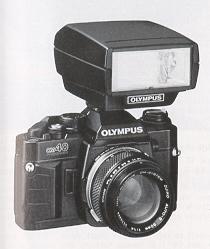
Thank you for choosing the Olympus OM-40 PROGRAM. This camera is equipped with a unique ESP
(Electro-Selective Pattern) metering
system. By combining this metering mode with the automatic film speed setting mode and programmed exposure mode, anyone can take
perfectly exposed pictures with ease. Before using the camera, please read this operation manual carefully through while checking with your
camera to become familiar with this versatile SLR.
Note: All the components of the Olympus OM-40 PROGRAM are carefully designed and their production and assembly is strictly controlled to
enhance the unmatched performance of the system. If any interchangeable lenses, flashes, or accessories other than Olympus
products are used, Olympus cannot be responsible for poor results or damage of the OM-40 PROGRAM.
TABLE OF CONTENTS
|
< Preparations before Taking Pictures > ·Setting the Camera for Automatic Film Speed Setting 15 < Taking photographs (I) > Pictures with ESP Metering 204www.butkus.org |
·
< Taking Photographs (II) > · How to Take Aperture-Preferred Automatic Exposure Pictures 26 · Manual Film Speed Setting 31 < Other Operations > · Using the Self-Timer 35 · Bulb Exposure 37
|
|
< Advanced Techniques > · Selecting the Metering Mode (A Choice of Two Metering Modes) 39 · Selecting the Metering Mode (How to Use ESP Metering) 41 · Guide to Selection of Exposure Mode 46 · Selecting the Exposure Mode --PROGRAM-- ..47 · Program Diagrams ..48 --AUTO (Aperture Preferred) - 52 ·Viewfinder Display for Automatic Exposure 54 · Selecting the Exposure Mode--MANUAL-- 55 · Combinations of Metering Mode and Exposure Mode 56 |
< OM SYSTEM > · T-Series Flashes / Mounting the Flash 63 · How to Use T-Series Flashes 64 · Bounce Flash / Close-up Flash 65 · Using Electronic Flashes Other Than Olympus T-Series Units 66 · Shooting with Motor Drive 67 · Motor Drive Group Units 68 · Macrophoto Group Units 70 < For Longer Service of Your Camera > · Handling Care 73 · Storage Care 73 |
<Preparations before Taking Pictures>
The Olympus OM-40 PROGRAM is basically designed for automatic film speed setting with
DX coded film.
![]() |
Remove the rear lens cap.
Remove the body cap.
|
![]() |
Align the red dots and rotate the lens clock wise until it locks.
Remove the front lens cap.4www.butkus.org
Removing the Lens:
|
![]() |
Remove the battery cover. .
Wipe battery surfaces clean. Make sure that + signs are facing upwards. (battery type - SR44 / LR44, very common type batteries. About $2 each) |
Checking the Batteries
After inserting the batteries, always check as follows:
![]() |
Rotate the mode selector dial to the "BATTERY CHECK" position
If the sound becomes intermittent or the LED blinks, replace batteries.
|
Setting the Camera for Automatic Film Speed Setting
![]() |
Make sure the film you are using is marked ""DX"". If the film you are using is not marked ""DX"" refer to page 31.4www.butkus.org
Set the film speed dial to
|
![]() |
Pull up on the rewind knob to open the camera back.
Place the film cartridge in the film chamber. (Always load film in the shade.}
|
![]() |
Insert the film leader into the take-up spool.
Wind the film and make sure the sprocket teeth catch both the upper and lower film perforations.
Take up the slack by turning the rewind crank clockwise4www.butkus.org
|
![]() |
|
This chapter explains how to take programmed automatic exposure pictures with ESP metering.
In this mode, anyone can enjoy taking pictures with ease, even in difficult lighting conditions such as backlight.
How to Take Programmed Automatic Exposure Pictures with ESP Metering
![]() |
Make sure the camera is set for the ESP meter
Set the mode selector dial to the "PROGRAM" position.
|
![]() |
Set the lens to its minimum aperture.
Press the shatter release lightly to activate the viewfinder display.4www.butkus.org (A built-in battery conserves turns off the viewfinder display after 60 seconds.) |
![]() |
Focus on your subject.
The
Press the shutter release to take the picture.
|
![]() |
When the exposure counter indicates the end of your roll of film
Push the ""R"" button. |
![]() |
Fold out the rewind crank and wind it until the film tension is released.
Open the camera back by pulling up on the rewind knob and remove the film.4www.butkus.org
|
< Taking Photographs (II) >
This mode a; you to respond creatively to the photo situation l free selection the lens aperture, shutter speed and exposure compensation settings.
How to Take Aperture-Preferred Automatic Exposure Pictures
![]() |
Set the mode selector dial to the "AUTO" position.
Select the light metering mode.
|
![]() |
Set the aperture.
Basic aperture setting
Press the shutter release lightly to activate the viewfinder display.
Focus on your subject
|
![]() |
Press the shutter release to take the photograph.
If you see an overexposure warning signal (the number "1000" blinks), set the aperture to a larger number.4www.butkus.org
If the shutter speed is too slow, set the aperture to smaller number to prevent camera shake. |
![]() |
Set the mode selector dial to the "MANUAL" position
Set the aperture
|
![]() |
Select the shutter speed.
Focus, then press the shutter release. To Obtain the Proper Exposure: Set the shutter speed ring to the setting indicated in the viewfinder.
|
![]() |
Release the DX ISO AUTO SET mode.
Lift up the outer collar and rotate until the desired ISO speed appears in the window.4www.butkus.org |
![]() |
Readjust the index line.
If the film speed dial (exposure compensation dial) cannot be turned to the ISO number of the film used set it once at an intermediate value then repeat steps 2 to 3 until the desired ISO number is set.
|
![]() |
For exposure compensation, set the dial anywhere except at "DX ISO AUTO SET".
When an exposure compensation is set, the indicator lights in the
viewfinder.
· After shooting, return the dial to its original position. |