Pentax Spotmatic / Spotmatic F
On line manual
11-26-'02
This manual can be used as a reference for many "needle
metered"
cameras
This is the full text and images from the manual.
This may take 3 full minutes for all images to appear. If
they do not all appear,
try clicking the browser "refresh" or "reload button".
This camera manual library is for reference and historical purposes, all
rights reserved.
This page is copyright by
,
M.
Butkus, N.J.
This page may not be sold or distributed without the expressed
permission of the producer
I have no connection with Chinon Co., Japan
If you find this manual useful, how about a donation of $3 to: M. Butkus,
29 Lake Ave., High Bridge, NJ 08829-1701
and send me your e-mail address so I
can thank you.
Most other places would charge you $7.50 for a electronic copy or $18.00 for
a hard to read Xerox copy.

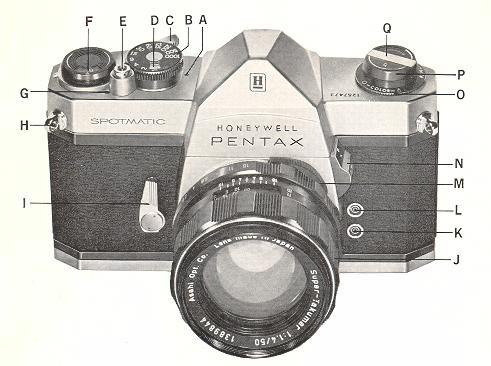
A-Shutter speed index B-Shutter speed dial C-Rapid wind lever
D-ASA film speed setting
H-D ring lug I -Self-timer cocking lever J-Focusing ring4www.butkus.org |
![]() K-X flash terminal L-FP flash terminal M-Preview lever N-Exposure meter switch 0--Film type reminder dial P--Rewind knob Q-Rewind crank R-Film type index mark S-Diaphragm ring T-Diaphragm and distance index mark U-Distance scale V-Exposure counter index mark W - Depth-of- field guide |
|
| Honeywell Pentax Spotmatic
When the Pentax Spotmatic was introduced to the public at the 1960 Photokina, the photographic world's fair in Cologne, Germany, it attracted immediate and keen attention. Not available for purchase at that time, it was a model of the advanced features and design would be incorporated into cameras of the future. Four years of extensive research, exhaustive experiments and intensive testing followed before it became available to serious amateur and professional photographers in late 1964. With its unique behind-the-lens exposure meter of entirely new design, the Honeywell Pentax Spotmatic is now more than just another camera . . . it is a new concept in photography.4www.butkus.org Hidden within the camera body, its through-the-lens meter utilizes two highly sensitive Cadmium Sulfide sensors to accurately measure light seen by the camera's lens as it is reflected from the subject being photographed. Therefore, by measuring the light as it passes through the lens and matching the exposure needle as seen through the viewfinder, you can be assured of properly exposed pictures under all but the most impossible lighting conditions. Macro or microphotography, pictures with telephoto lenses or with filters . . . the Honeywell Pentax
|
|
Spotmatic will give you correctly exposed photographs without the use of external meters or the need for cumbersome, time-consuming calculations!
The Spotmatic may also be set manually the same as any other quality 35mm camera if special lighting or selective focus effects are desired. Just leave the exposure meter switch in its OFF position and select the f/stop and speed settings for the required effect.
The traditional classic design and simple elegance associated with earlier models of the famous Pentax have been retained in the Spotmatic despite the incorporation of many highly advanced features. Meticulously constructed by master craftsmen, the Pentax cameras remain the standard of excellence and precision in the world of 35mm single-lens reflex cameras.
You will find the Honeywell Pentax Spotmatic even more versatile than the famous Pentax H3v. Its new 50mm f/1.4 and 55mm f/1.8 Super Takumar lenses with completely automatic diaphragm will satisfy the demands of even the most critical professional. Like the H1a and H3v, the Honeywell Pentax Spotmatic has a 42mm threaded lens mount that accepts any of the superb Takumar lenses from the ultra-wide-angle 18mm Takumar to the super-telephoto 1000mm Takumar.
Specifications
| Type 35mm single-lens reflex with built-in light meter. Film and Picture Size Standard Lenses Shutter Warning Signal |
|
Finder
Pentaprism finder with microprism Fresnel lens for instant focusing; 0.88x
magnification with 50mm lens and approximately life-size with 55mm lens4www.butkus.org
Focusing
Turn the distance scale ring until the subject image on the ground glass comes into focus.
Reflex Mirror
Instant return type with special shock absorbers for minimum vibration.
| Film Advance Ratchet-type rapid wind lever (for film advance and shutter cocking). 10° pre-advancing and 160 degrees advancing angle. "Cocked" Indicator Film Exposure Counter Lens Mount Flash Synchronization
|
|
Exposure Meter
Built-in meter measures the brightness of the ground glass, and couples directly to shutter and film speed settings. Film speed (ASA) setting ranges from 20 to 1600
(LV1-18 for ASA-100 film with standard lens.) Meter is powered with a mercury battery.
Film Rewind
Rapid rewind crank for speedy film take-up. Film rewind release button on
bottom of camera body rotates while film is being rewound.
Loaded
Film Indicator
Loaded film reminder dial underneath film rewind knob is marked "PANCHRO"
(black and-white), "COLOR" and "EMPTY."
Dimension
Width 5.6" (143mm) x height 3.6" (92mm) x thickness 3.4" 88mm).
Weight
868 grams (1 lb. 14 oz.) with standard lens, Body alone: 621 grams (1 lb. 6 oz.)
| Short-course operating manual
1 SET FILM SPEED.
which appears alongside the figure 1. Then cock the rapid wind lever. 2 SET SHUTTER SPEED. 3 COMPOSE AND FOCUS.
|
|
|
|
4 TURN ON LIGHT METER SWITCH.
Push up the switch button with your thumb, and the small window on the switch button will turn to red indicating that the meter is switched on. Through the viewfinder, you will observe the
movement of the meters needle on the right side of the ground glass. Be sure to turn off the meters switch when not actually taking readings.
The needle moves up and down with the turn of the diaphragm ring. When the needle rests at the center, you will get correct exposure, If the needle does not come to the center no matter how far you turn the diaphragm ring, change the shutter speed. When the needle is off center and close to the (+) mark, you will get over-exposure: change the shutter speed to a faster setting. If the needle is closer to the (-- mark, you will get under-exposure: change the shutter speed to a slower setting.
|
6 RELEASE SHUTTER.
Hold your camera firmly and trip the shutter. When the shutter is released, the meter switch will automatically turn off, and the needle will remain fixed off and underneath the center. The diaphragm will reopen to its full aperture and the overall image will look brighter. Cock the rapid wind lever for the next picture. (When taking a series of pictures under the same lighting conditions, it is not necessary to repeat instructions 4 and 5.)4www.butkus.org
How to hold your camera

| In horizontal position A. Hold the camera firmly with your left hand, and draw your arm close to your body. | In vertical position B. Hold your camera tightly to your forehead with your left hand, and draw your right arm close to your body. | In vertical position C. Hold your camera tightly to your forehead with your left hand, raise your arm and draw your left arm to your body. |
![]() |
As a general rule, your camera should be held more firmly by the left hand which does not release the shutter. If you hold your camera with the right hand--the hand which releases the shutter--it may cause camera movement. Very often, pictures which are not sharp are due to movement of the camera. When you focus with the camera held horizontally (Position A), hold the lens barrel as illustrated in photograph. |
| Put the camera on your left hand thumb and little finger. Turn the distance scale ring with your thumb and index finger. When holding the camera vertically, some people release the shutter with the thumb (Position B), while others release it with the index finger (Position C). Position C is more desirable for fast focusing and shooting. With the Honeywell Pentax, whether held vertically or horizontally, you see your subject image through the taking lens, enabling you to compose, focus and shoot with a minimum of time and effort. | |
Film loading
|
|
|
| Avoid direct sunlight when loading
your film.
1. Open the back by pulling out the rewind knob until back cover snaps open. 2. Place the film cassette into the cassette chamber, and push back the rewind knob. Draw out the film leader and crease across one or two perforations back from the end of the leader. Insert the creased portion into slot of the take-up spool. 3. Advance the film by alternately turning the rapid wind lever and releasing the shutter until both sprockets have properly engaged the film perforations. Close the back by pressing it firmly. 4. If the film is properly loaded, the rewind knob will turn counter-clockwise when you advance the film by turning the rapid wind lever.4www.butkus.org |
| Film Type Reminder dial | Setting ASA film speed | ||
|
|
|
![]() |
Film wind and rewind 1. Before turning the rapid wind lever, slowly turn the film rewind knob clockwise until a slight resistance is felt. This prevents loosening or warping of the film. 2. The first portions of the film cannot be used for picture taking as t hey have already been exposed to light. Generally, two blank exposures should be made before taking your first picture. Cock the rapid wind lover until it stops. Watch to see that the film rewind knob turns counterclockwise, indicating that the film is moving from cassette to take-up spool. Trip the shutter. Cock the rapid wind lever for the first picture; the exposure counter automatically turns to '1', indicating that the first picture is ready to be taken. |
3. After the final picture on the roll (20 or 36 exposures) has been taken, the rapid wind- lever will not turn all the way as you stroke it. This indicates that the final picture has been taken on your film, and that the film must be rewound. DON'T open the back of the camera, or all exposed frames will be ruined.
4. Unfold the film rewind crank.
5. Depress the film rewind release button. Turn the rewind crank to rewind the film into the film cassette. The film rewind crank permits rewinding at a smooth, even rate. (Under some atmospheric conditions, erratic or too rapid rewinding will cause static electricity marks on the film.) You will feel the tension on the rewind crank lessen as the leader end of the film slips off the take-up spool.
Stop rewinding when you feel this happen. AVOID DIRECT SUNLIGHT WHEN UNLOADING YOUR FILM. (The rewind release button will return to normal position as you lead your next film and turn the rapid wind lever.)
6. Pull out the film rewind knob (the back will open automatically), and remove the film cassette.
.
| Bright field focusing
1. You can start viewing and focusing before and after cocking the rapid wind lever. When the preview lever is in "A" (automatic) position, and the meter is at "OFF the diaphragm is fully open except for the moment of exposure. 2. Turn the distance scale ring until your subject image is clearly in focus. It is not always necessary for you to view and focus with the diaphragm fully open. In bright sunlight, you can easily focus with diaphragm closed to f/5.6 or f/8, and still observe the depth of field. It is easier, however, to focus with the diaphragm fully open as your subject image is much brighter. When the letter "M" appears beside the lever, the lens is in manual position; when "A" appears, it is in automatic position. |
|
|
|
Microprism Honeywell Pentax cameras have a Fresnel lens with a microprism center underneath the ground glass. As you look through the finder, you will see that the Fresnel lens consists of many concentric rings which provide the brightest possible image on the ground glass. The microprism is the center portion of this diagram. When your subject is in focus, the image in the microprism will be sharp and perfectly clear. If your subject is not in focus, the microprism will break the image up into many small dots, much like an engravers screen. You can focus your subject on any portion of the ground glass.4www.butkus.org
|
| Automatic diaphragm
When the preview lever is in "A" (automatic) position, and the exposure meter is turned to "OFF", the fully automatic diaphragm is at its largest aperture at all times, except for the instant of exposure, no matter what aperture is set on the diaphragm ring. When you release the shutter, the diaphragm automatically stops down to the predetermined aperture and the shutter curtains start traveling instantly. When the exposure is completed, the diaphragm reopens to maximum aperture completely automatically and you are ready to compose, focus, and shoot your next pictures. If you wish to visually check exact depth-of-field before making the exposure, move the preview lever to "M" Manual) position. This stops the diaphragm to the aperture selected and shows you exactly how much depth-of-field will appear in your picture. The preview lever may be moved back to "A" (automatic) position before or after making your exposure, or, if you are making pictures in bright sunlight, it may be left in manual position, which permits a constant ('heck of depth-of-field.
|
|
* When the exposure meter switch is turned to the "on position, the lens diaphragm changes from the automatic to manual position even though the preview lever is in the "A" (automatic) position. When the shutter is released, the lens diaphragm will automatically return to its automatic position if the lever is set on "A". |
|
Shutter
| Turn the shutter speed dial clock. wise or
counter-clockwise to the shutter speed desired. The shutter speed may be set either before or after cocking the rapid wind lever. As you cock the shutter by turning the rapid wind lever, the "cocked" indicator turns to red showing that the
shutter is cocked.
The indicator window blacks out as you trip the shutter button. For use of the X setting on the shutter speed dial, refer to page 17. With the shutter speed dial set on B (bulb), the shutter will stay open as long as you depress the shutter button. As you release your finger from the shutter button, the shutter closes. When a long exposure is desired while using the B setting, attach a shutter release cable with a locking device to the shutter button. This will permit a "Time" exposure. |
![]() |
Cautions
1. At slow speeds-slower than 1/30 - support your camera rigidly or use a tripod
to prevent movement of your camera.
2. To protect the shutter mechanism, trip the shutter release before putting the camera out of use for any extended period.
![]() |
For example, if the lens opening of f/8 is to be used, the range on the distance scale ring covered within the figure 8 on the depth-of-field guide indicates the area in focus at the lens opening. You will note from the depth-of-field guide in the photograph that the range from approximately 10 to 25 feet is in focus. Note that as the lens apertures change, the effective depth of field also changes. For the depth of fields at different apertures and distances. refer to page 14. Depth of field is the range between the nearest and farthest distances which are in focus at different lens apertures. |
| Depth of field
If you want to know how great the depth of field is at a certain aperture, look at the depth-of-field guide. In the above photograph, the distance scale is set at 15 feet . . . the lens is focused on a subject 15 feet away. The calibrations on each side of the distance index correspond to the diaphragm setting and indicate the range of in-focus distance for different lens apertures. |
| Depth of field Guide Super-Takumar 55mm | Depth of field Guide Super-Takumar 50mm |
| Range of light
measurement -
Range of light meter chart -
The exposure meter of the Spotmatic measures the brightness of the ground glass. Therefore, the meter should be turned on after you have focused your subject on the ground glass. The following table shows the range of the meter's light measurement, and should not be interpreted as the camera's total range of f/stop-shutter speed combinations. As you will note from the table below, with an ASA100 film, you may use any shutter speed from 1 sec. to 1/1000 sec. in combination with any aperture that will bring the meter needle to the midpoint in the viewfinder. The total range of the aperture settings is, of course, determined by the minimum and maximum apertures of the lens being used. For example, with the 50mm f/1.4 lens and ASA100 film, an aperture from f/1.4 (the maximum aperture of this lens) to f/16 (the minimum aperture) may be used with any shutter speed from 1 sec. to 1/1000 sec. that will bring the meter needle to midpoint. |