Praktica LLC
HTML Translations - German
- Italian
- French
- Spanish
- Others
These links will not translate any PDF
files
This camera manual library is for reference and historical purposes, all rights
reserved.
This page is copyright by
, M. Butkus, NJ.
This page may not be sold or distributed without the expressed
permission of the producer
I have no connection with Chinon Co., Japan
On-line camera manual library
This is the full text and images from the manual. This
may take 3 full minutes for all images to appear.
If they do not all appear. Try clicking the
browser "refresh" or "reload button" or right click on the
image, choose "view image" then go back. It should now appear.
To print, try printing only 3 or 4 pages at a time.
If you find this manual useful, how about a donation of $3 to: M. Butkus,
29 Lake Ave., High Bridge, NJ 08829-1701
and send your e-mail address so I can
thank you. Most other places would charge you $7.50 for a electronic copy
or $18.00 for a hard to read Xerox copy.
(posted 3-02)
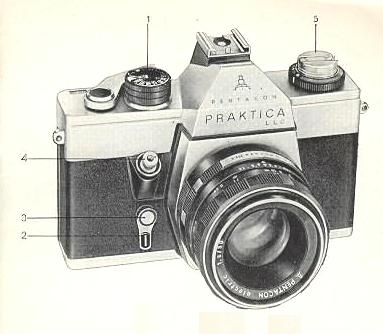
1. Knob for setting the shutter speeds
2. Cocking lever for delayed-action release
3. Delayed-action release knob ;
4. Shutter release -A
5. Rewind knob
6. Rewind crank
7. Accessory shoe 2
8. Center flash contact
9. Exposure speed index
10. Film speed scales
11. Film speed index
12. Rapid cocking lever
13. Exposure counter4www.butkus.org
14. Distance setting ring
15. Diaphragm setting ring
16. Selector ring for automatic exposure control
17. Symbols for measuring at full aperture or taking aperture
18. Rewind catch
19. Cartridge chamber
20. Supporting piece
21. Marking point for inserting the film
22. Film transport sprocket
23. Wire bracket
24. Metal-blade focal - plane shutter
25. Ocular mount with fitting for accessories
26. Rewind release knob
27. Battery compartment with PX 21 battery
28. Tripod socket
29. Take-up spool
30. Manual stop down key
31. Depth-of-field scale
We are very pleased that you have chosen the high quality PRAKTICA LLC, and we wish you every success in working with this modern reflex
camera. Before using your camera, however, we would request you to read these Instructions for Use very carefully. This will help you to avoid
errors or trouble caused by wrong handling.
The PRAKTICA LLC is o miniature single-lens reflex camera for the 24x36 mm picture format. Its novel type of steel-blade focal-plane shutter,
which travels across the shorter side of the frame, has a range of speeds from 1 sec.
to 1/1000 sec. and B.
It is synchronized for the use of flash bulbs and electronic flash units. As a result of the rapidly moving steel curtains, the electronic flash can be
synchronized at 1/125 sec. The center contact in the accessory shoe makes it possible to connect camera and flash unit without using a cable.4www.butkus.org
The pentaprism is firmly built in, and the focusing system, due to its Fresnel lens, reveals a finder image of maximum
corner to-corner brightness.
The microprism screen and a circular ground glass area assure quick and perfect sharp focusing.
For use as interchangeable lens systems, the well-known PRAKTICA lenses are available. Up to a focal length of 180 mm they have automatic
diaphragm control. In connection with the automatic mechanism in the camera they function as spring-diaphragm lenses, which means that the
diaphragm closes within the shortest time and opens again immediately after the shutter has run down. Through the instant return
mirror the image is visible practically all the time, except for the short moment of the exposure.
The distinctive feature of the PRAKTICA LLC is the novel type of automatic exposure control with through-the-lens metering.
The method of light metering is partially integral. The principal metering point is concentrated within an area of approximately 20 mm in diameter
in the center of the viewfinder field. The readings are thus true to reality, since this area, for the greater majority of objects, includes the
details of
uppermost importance to the picture. All subordinate parts of the object outside of this section of the image are photometrically of less value and
cannot influence the reading.
Metering is performed with the taking lens at full aperture, which means that the viewfinder image is always at its maximum brightness. In the
PRAKTICA LLC the diaphragm values are transferred from lens to camera electrically, without requiring any mechanical device. Also in connection
with intermediate rings adapted for electric transmission, this modern method of light metering at full aperture can be employed.
Due to the special type of bridge circuit, the reading is not affected by any variation in voltage of the power source.
But also all the PRAKTICA lenses without electric transmission of the diaphragm values may be used thanks to the possibility of readjusting the
light meter for measuring with the lens at taking aperture.
The PRAKTICA LLC is also equipped with a delayed-action device.
ABRIDGED INSTRUCTIONS
For further details please turn the page.
A. Opening the camera back. Pull out rewind knob (5) as far as it will go.
B.
Inserting the film
Place film cartridge into cartridge chamber (19), push in rewind knob (5). Slant the beginning of the film and push it from above as far as it will go
underneath the supporting piece (20) and over the transport sprocket (22). Bring the beginning of the film strip onto the core of the take-up spool
(29) and to its green marking point (21).
Wire bracket (23) of the take-up spool must not stand upwards.
C. Closing the camera back
D. Preparing for the exposure
Actuate rapid cocking lever (12) and shutter release (4) until exposure counter (13) stands on number "1".
E. Setting the film speed
Lift the knurled ring of speed setting knob (1) and rotate it until the speed value of the film in the camera stands opposite the film speed index (11).
E. Setting the exposure speed
Rotate speed setting knob (1) until the desired speed numeral stands opposite the
orange-colored triangle (9) on the cover plate of the camera.
G. Setting the diaphragm numeral
Rotate diaphragm setting ring (15) on the lens mount to bring the desired diaphragm numeral against the red index mark.4www.butkus.org
H. Automatic exposure control
When using lenses permitting electric transmission of the diaphragm values, set the selector ring (16) to the
OPEN CIRCLE symbol = measuring at full aperture. For lenses without electric
transmission set the selector ring to the CLOSED CIRCLE symbol = measuring with the lens at taking aperture!
Preselect either the shutter speed or the aperture. Depress shutter release (4) till you feel the pressure point, At the same time rotate either the diaphragm setting ring (15) or the speed
setting knob (1) till the meter needle is centered in the circular mark in the viewfinder field. In connection with the taking aperture of lenses with automatic diaphragm control, the stop
down key (30) has to be depressed when meter reading is taken or the engaging kind selection lever of the 50 mm f/1.8 Pancolar lens, which is designed for electric transmission of
diaphragm values, has to be actuated downwards to the camera battery.
I. Focusing
Rotate distance setting ring (14) until the image in the microprism screen or in the
ground glass field appears perfectly sharp.
K. Releasing and cocking the shutter
Depress shutter release (4) to beyond the pressure point. After the shutter has run down a signal appears in the left-hand side of the viewfinder.
Swing cocking lever (12) around as far as it will go and return it into its initial position.
L. Delayed action release
Swing delayed-action cocking lever (2) upwards either before or after cocking the shutter. Depress knob (3) to release the delayed-action
mechanism.
M. Changing the film
After the last exposure, depress rewind release knob (26), swing out rewind crank (6) and turn it in direction of arrow to rewind the film. Open the
camera back and remove the cartridge.
N. Exchanging lenses
O. Flash exposures
P. Exchanging the power source
Q. Maintenance of the camera
R. Accessories
The Abridged Instructions are a short summary of the most important items. A detailed description is given in the main section on the following
pages.4www.butkus.org
A. Opening the camera.
Pull rewind knob (5) upwards until you feel hard resistance. The camera back is thus unlocked and can be opened. The exposure counter (13) will
automatically jump to zero position.
Any type of perforated 35 mm film in commercially available standard cartridges may be used. The cartridges contain film lengths for 36, 20 or 12
exposures in the 24 x 36 mm format. To make sure that no light enters the slit of the cartridge the film should not be loaded in direct sunlight. The
shade of your own body will suffice.
By having pulled out the rewind knob (5) to open the camera back you have withdrawn the rewind-catch (18) from the cartridge chamber (19), so
that you can now place the cartridge into the cartridge chamber.
![]() |
![]() |
Push the rewind knob, with slight backward and forward movements, right back into the camera. The rewind catch will engage In the core of the
cartridge.
Push the beginning of the film projecting out of the cartridge slit from above as far as it will go underneath the supporting piece (23) arranged
above the transport sprocket (22). The beginning of the film strip must now lie on the core of the
take-up spool (29) and meet the green marking
point (25).
The wire bracket (23) of the take-up spool must not stand upwards. Should this happen to be the case the knurled flange of the spool has to be
turned to bring the bracket wires to their lateral position.4www.butkus.org
Press the camera back firmly on to the camera body. It locks automatically.
The rapid wind lever (12) has an idle stroke of about 15°, so that it can be moved from its rest position into that of readiness for action, and can thus
be easily grasped - a great advantage especially in serial shots.
Swing the cocking lever around as far as it will go, return it, and depress shutter release knob (4). Repeat these operations and then cock the
shutter once more. The automatic exposure counter (13) now stands on number "1". Special setting of the exposure counter is not necessary since
it starts working automatically when the camera back is closed.
To avoid inadvertent tripping, the shutter release (4) is provided with a locking device. The release mechanism is locked when the red dots on the
knob and on the outer ring meet. The mechanism is unlocked by rotation of the knob through 90°.

E. Setting the film speed
To set the film speed value for the automatic exposure control, the knurled ring of the speed setting knob (1) has to be lifted and rotated until the
speed value of the film loaded (DIN or ASA) stands opposite the white index (11). When lowered, the knurled ring clicks in at the selected film
speed numeral.4www.butkus.org

F. Setting
the exposure speed
The metal-blade focal-plane shutter can be set for exposure speeds range from 1 sec. to 1/1000 sec.
When set on "B" the shutter remains open as long as the release knob (4) is being depressed. For exposures of a longer duration a cable release
with locking device should be used which can be screwed into the thread in the body release knob. Regarding exposure speeds in connection with
flash units please refer to Section O.
The orange-colored numerals on the shutter-speed setting knob (1) stand for slow speed exposures from 1 sec. to 1/15 sec. which require the
use of a tripod. The white numerals indicate the values for instantaneous shots from 1/30 sec. to 1/1000 sec.
The exposure speeds are set by rotating knob (1) until the desired numeral coincides with the
orange-colored triangle (9) on the cover plate of the
camera. Please note that the knurled ring of the setting knob must not be lifted up since this would alter the film speed setting and cause the
automatic exposure system in the PRAKTICA LLC to give incorrect results.4www.butkus.org
The exposure speeds can be set either before or after the shutter has been cocked. The setting knob clicks in at every numeral. Intermediate
values are not adjustable.
G. Setting the diaphagrm numeral
On the lenses with automatic pressure diaphragm (APD) only the desired aperture numeral on the diaphragm setting ring (15) has to be brought to
meet the appropriate index on the lens mount. The diaphragm thus remains fully open at first and closes down to the preselected value when the
shutter release is depressed.

The automatic diaphragm control mechanism in the PRAKTICA LLC causes the pressure diaphragm to function as an automatic spring
diaphragm. Regardless of the speed with which the shutter release (4) is depressed, the
diaphragm will spring to the preselected value and then
open again immediately after the shutter has run down.
For checking the depth of field in the viewfinder image, most lenses con be stopped down, before the exposure is made, to the preselected value
or to the value determined by the exposure meter by means of a manually operable key (30) on the lens mount.

The 50 mm f/1.8 Pancolar lens with electric transmission of diaphragm values has a kind selection lever opposite the lens mount instead of the
stop down key. With the lever in the upper position the diaphragm operates as an automatic spring diaphragm whereas in its lower position,
depressed towards the camera bottom, the automatic diaphragm control mechanism is disengaged. The diaphragm acts as a click stop and closes
according to the value preset on the diaphragm ring.
H. Automatic Exposure Control
The newly devised automatic exposure system in the PRAKTICA LLC makes it possible, by means of the electric transmission of the diaphragm
values, to take the meter readings with the photographic lens at full aperture, so that the viewfinder image remains at its maximum brightness. The
lenses arranged for metering at full aperture are recognizable by three resilient contact pins visible at the rear end of the barrels, which join the
contact paths on the camera.4www.butkus.org

But it is also possible to use the well-known lenses of the PRAKTICA family without automatic diaphragm control. In this case, metering is
performed with the lens stopped down to taking aperture. The finder image will thus be somewhat darker, according to the aperture selected, or
determined by the exposure meter.

Whether your lens is at full aperture or stopped down, you have in either case, two methods of metering from which to choose:
a) You preselect the shutter speed and adjust the aperture to center the meter needle, or
b) You preselect a certain aperture and adjust the shutter speed to center the meter needle.
The first method is applied, e.g., if movement of the object requires a certain exposure speed, whereas the second method will be preferred if a
specific aperture has to be preselected to achieve the necessary depth of field.4www.butkus.org
Metering at full aperture with shutter speed preselected
Set the index of selector (16) which, as a knurled ring, encircles the rewind knob, to coincide with the E, symbol. Preselect the exposure speed by
actuating knob (1). Depress shutter release (4) till you feel the pressure point and rotate diaphragm setting ring (15) on the lens mount till the
meter needle visible in the viewfinder field is centered in the circular mark.
If on the rotation of the diaphragm setting ring or the exposure speed setting knob the meter needle deflects no more, replace the power source
(please cp. section P).
Metering at full aperture with diaphragm stop preselected
Set selector ring (16) to the E] symbol. Move the diaphragm setting ring (15) on the lens mount to a stop
corresponding to the taking conditions.
Depress shutter release (4) till you feel the pressure point and rotate the exposure-speed setting knob (1) till the meter needle is
centered in the
circular mark. The exposure speed knob must always be set to click-stops and not to intermediate values. Should this not bring the meter needle
precisely to the center of the circular mark, the diaphragm ring has to be moved for fine adjustment. The diaphragm ring can be set to intermediate
values between the click-stops.

Metering at taking aperture with shutter speed preselected
This method is employed in connection with lenses not permitting electric transmission of the diaphragm values. Move selector ring (16) to the El
symbol. Preselect the shutter speed adjust the diaphragm ring to center the meter needle as described above. On lenses with automatic pressure
diaphragm the stop down key (30) on the lens mount has to be depressed while the meter reading is taken.
The 50 mm f/1.8 Pancolar without electric transmission of the diaphragm values is provided with a kind selection lever by which you can change
over from automatic diaphragm control to manual operating (please cp. section G). For meter reading this lever must be in its lowermost position
so that the diaphragm acts as click stop. As soon as the lever is returned into its upper position, metering is performed automatically again.
Metering at taking aperture with pre-set diaphragm
To be employed with lenses not permitting electric transmission of the diaphragm values. Selector ring (16) stands on the E] symbol. Preselect
aperture on diaphragm ring of lens mount and adjust shutter speed setting knob to
center meter needle. Pay attention to click-stops and fine
adjustment by means of diaphragm ring. Here, too, the shutter release has to be actuated up to the perceptible pressure point.
If lenses without automatic diaphragm, i.e. lenses with pre-set or plain diaphragm, are being used for metering at taking aperture, the lens
remains stopped down until the shutter is released, It is, therefore, advisable to focus with the lens wide open before taking the meter reading.
Owing to the construction of their barrels, some of the older types of lenses protrude so far into the interior of the camera body as to impede the
functioning of the swing mechanism for the automatic diaphragm. Thus, mirror and shutter cannot work These lenses cannot be used in the
PRAKTICA LLC. They are recognizable by the structure of their barrels, as may be seen from the illustration below.
Measuring range of the PRAKTICA LLC
If the luminous density of the object to be photographed is very low, the meter needle, even at the smallest diaphragm numeral -- e.g. 1.4 -- and a slower
shutter speed, cannot be centered within the circular mark. In fact, the selection of yet longer exposure periods will disconnect the automatic exposure
system, so that the meter needle will swing downwards to its stop point. When lighting conditions become more
favorable again, a shorter exposure time
has to be set before the automatic exposure system will recommence functioning.
The table shows within which range of speeds the automatic system works in connection with the various film speed settings.
| DIN | Speed of film ASA |
Exposure-speed |
| 12 | 12 |
1 sec. to 1/1000 sec. |
| 15 | 25 |
1 sec. to 1/1000 sec. |
| 18 | 50 |
1 sec. to 1/1000 sec. |
| 21 | 100 |
1/2 sec. to 1/1000 sec. |
| 24 | 200 |
1/4 sec. to 1/1000 sec. |
| 27 | 400 |
1/8 sec. to 1/1000 sec. |
| 30 | 800 |
1/15 sec. to 1/1000 sec. |
| 33 | 1600 |
1/30 sec. to 1/1000 sec. |
I. FOCUSING
To brighten up the image, the prism viewfinder of the PRAKTICA LLC is fitted with a Fresnel lens, in the
center of which are the two focusing systems:
- the microprism screen right in the middle and --the circular ground glass area surrounding it.
Focusing is performed by rotating the distance setting ring (14) on the taking lens. To achieve utmost definition when using lenses with pre-set diaphragm
or simple diaphragm adjustment, it is advisable to focus with the lens set to the smallest diaphragm numeral (full aperture).4www.butkus.org
Focusing on the microprism screen
The image in the microprism screen is in correct focus as soon as it appears clear and free from fuzziness. It is out of focus if it looks fuzzy and crumbles
into screen elements. The microprism screen is usually employed for focusing if the subject to be photographed is in resting position or only slightly
moving.
Focusing on the circular ground glass Oreo
The ground glass area is used for focusing if there is more movement in the scene. Also this kind of setting is often most appropriate in macrophotography
or photomicrography as well as on lenses with a small relative aperture (diaphragm numeral higher than 4).
The ground Fresnel section of the viewfinder is not meant to be used for focusing.
Depth-of-field indication
The depth of field is determined by means of the depth-of field scale (31)
arranged on the right and left of the red index on the lens mount.

While the value of the camera-to-subject distance figure stands opposite the distance mark, the limits of the range of definition can be read from the
distance scale above the numerals on the depth-of-field scale, which latter are equivalent to the diaphragm numerals of the lens. As an example, the
illustration shows a zone of sharpness from 2 m to 5 m (7 ft. to 16 ft.) for a distance setting of 3 m (10 ft.) and an
f/8 aperture.
When the manual stop down key is depressed or the diaphragm selection lever of the 50 mm f/1.8 Pancolar is in its lowermost position, you will be able to
judge depth of definition in the finder image.
Persons with defective eyesight may work without their spectacles on by having a corrective lens corresponding to their long-distance glasses fitted into
the eye cup which is then attached to the ocular mount (see Section "Accessories").
For infrared exposures the focusing point has to be slightly modified. By rotation of distance setting ring (14), the distance reading which, after focusing,
stands opposite the distance mark, has to be moved to meet the infrared dot next to that mark. Thus, the image produced by the infrared rays is brought
into correct in relation to the film

K. Releasing and cocking the shutter.
Before releasing the shutter, please note the following:
1. Make sure that the shutter release is unlocked (see Section D)
2. If the signal is visible in the left side of the viewfinder, the camera is not ready for exposing. The shutter has to be cocked!
3. For exposure speeds slower than 1/30 sec. a tripod and a cable release should be used.
![]() |
We advise you to hold your PRAKTICA LLC so that it lies firmly in both hands and you are able to actuate the shutter release (4) comfortably.
|
L. Delayed-action release
The delayed-action mechanism is cocked by moving lever (2) upwards as far as it will go. By means of pressure on knob (3) it will start and after about 10
seconds the shutter is released. The delayed-action mechanism may be tensioned either before or after the shutter is cocked. Also, the shutter can be
released in the usual manner by means of release knob (4), even if the delayed-action device is tensioned.
![]() |
![]() |
M. Changing the film
When the exposure counter (13) indicates the maximum number of frames obtainable with the film in the camera (12, 20 or 36 exposures) the film has to
be rewound and taken out of the camera.
Depress rewind release knob (26) in the base plate of the camera It will remain locked in this position. Unfold rewind crank (6) out of rewind knob (5) and
rotate it, not too quickly, in the direction of the arrow. Rewinding at too great a speed may cause electrostatic charge and
static on the film.
As rewinding is completed, greater resistance becomes noticeable until the film is disengaged from the take-up spool. After this, the crank turns quite
easily.
Fold the rewind crank back into the knob and pull the knob upwards as far as it will go. The camera back is thus unlocked and can be opened. Remove the
cartridge with the exposed film from the cartridge chamber. Loading a new film, and subsequent cocking of the shutter, cause the rewind knob (26) to
spring back automatically out of its click-stop position.
Should you have attempted to expose more frames than the number marked on your film packet, the cocking lever might, at the end of the film, get jammed
so that it cannot be swung around completely. Do not, in such a case, use force, as this might cause damage to the perforation of the film, or the end of
the film might slip off the spool inside the cartridge. Rewinding would then be impossible.
If the cocking lever--as described above--has not been fully tensioned, this must be completed, and the shutter released, after rewinding and removing
the exposed film and before inserting a new one.
![]() |
![]() |
N. Exchanging lenses
The standard lens of the PRAKTICA LLC can easily be replaced by lenses of other focal lengths. You take hold of the lens body, as shown
in the illustration below, and turn it in an anti-clockwise direction. The exchange lens is inserted accordingly and screwed tight.
For exposure measurement at the widest lens aperture in the PRAKTICA LLC, lenses permitting electric transmission of the diaphragm
values are employed. The name of the lens is added by "electric". Furthermore, these lenses are recognizable by three contact pins visible at
the rear end of the barrels. But you may also use the ordinary PRAKTICA lenses with this camera, in which case metering has to be
performed with the lens stopped down to taking aperture.
Because of their structural design, some of the older types of lenses cannot be used with the PRAKTICA LLC. (For details please refer to
Section H).
List of interchangeable lenses:
1. Lenses permitting electric transmission of diaphragm values
ous Jena Pancolar
50 mm f/1.8 APD
PENTAGON electric 50 mm f/1.8 APD
PENTAGON electric 29 mm f/2.8 APD
PENTAGON electric 100 mm fl2.8 APD
PENTAGON electric 135 mm f/2.8
APD
2. Lenses not permitting electric transmission of diaphragm values
aus Jena Flektogon 20 mm f/4
APD
aus Jena Flektogon 35 mm f/2.8 APD
PENTAGON auto 50 mm f/1.8 APD
aus Jena Pancolar 50 mm f/1.8 APD
aus Jena T 50 mm f/2.8 APD
PENTAGON 135 mm f/2.8 PD
aus Jena S 180 mm f/2.8 APD
PENTAGON 200 mm f/4 PD
PENTAGON 300 mm f/4 PD
PENTAGON 500 mm f/5.6 PD
aus Jena catoptric lens 1000 mm f/5.6 without diaphragm
APD = automatic pressure
PD = pre-set diaphragm
O. Flash exposures
The shutter of the PRAKTICA LLC is designed for synchronization wit flash bulbs and electronic flash units.
When the flash unit is attached to the camera, the electric connection between camera and unit is automatically effected by means of the
center contact (8) in accessory shoe (7). No synchronization cable is required. Modern flashbulb and electronic units are equipped for this
purpose with a suitable co-operation contact.
For the use of flash units fitted with a synchronizing cable, an adapter piece with flash socket to accept the cable plug has to be pushed on
to the accessory shoe of the PRAKTICA LLC.
Flash bulb exposures
In connection with bulbs for short flash duration, the shutter has to be set for a speed of 1/30 sec. -- marked by the lamp symbol -- or
slower. The ignition circuit is closed only as long as the shutter runs down and is open after the shutter has terminated running-down and
during the tensioning procedure, so that flash bulbs can be exchanged also before the shutter is cocked.
Electronic flash exposures
Owing to the extremely rapid travel of the curtains in the metal-blade focal-plane shutter, synchronization up to a shutter speed of about
1/125 sec. is made possible. The knob for setting the shutter speed has to be moved to the flash symbol setting next to "B".
The guide number
The diaphragm numeral to be set on the lens mount for flash exposures can be found with the aid of the "guide number". Manufacturers of
bulbs and electronic flash units give these guide numbers on the wrappings or in the instructions for use as required for the various
sensitivity grades of the negative material. The correct aperture is determined by dividing the guide number for the flash in use by the flash-to-subject distance figure (in metros). Formula for the flash unit attached to the accessory shoe of the camera:
P. Exchanging the power source
The exposure meter system is powered by a Mallory battery of the PX 21 type.
![]() |
The battery compartment (27) is on the under side of the camera. It is opened by lifting the plastic lid by means of its handle piece.
|
Owing to the low consumption of current during the period of reading, with normal use of the camera, the battery should be exchanged
after about two years, only.
![]() |
![]() |
Q. Maintenance and care
The PRAKTICA LLC is a high quality precision instrument. Perfect functioning of the camera depends very largely on proper handling and
careful maintenance.
The camera must, above all, be protected against shock and impact, dust and moisture. That is why the
Eveready case should be used
wherever possible.
![]() |
From time to time the cartridge chamber and spool chamber, also the film track and camera back with film pressure plate must be cleaned with
a soft brush. But be careful not to exert pressure on the steel blades of the shutter nor to touch them with your fingers.
|
If due to the battery in the battery chamber a thin white layer has deposited, the latter can be removed with a soft cloth.
Do not interfere with the mechanism of the camera. Repair work should be carried out only by one of our special Repair
Workshops.