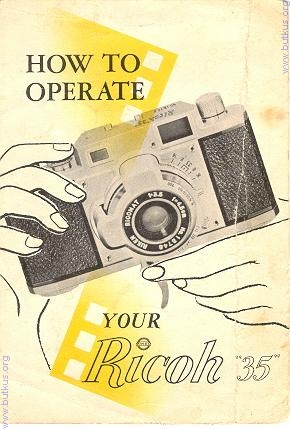
For reference use on many Chinon, Ricoh and metering cameras
This is the full text and images from the manual. This may take 3 full minutes for all images to appear. If they do not all appear. Try clicking the browser "refresh" or "reload button".
This camera manual library is for reference and historical purposes,
all rights reserved.
This page is copyright by
, M. Butkus,
N.J.
This page may not be sold or distributed without the
expressed permission of the producer
I have no connection with Chinon Co., Japan
If you find this manual useful, how about a donation of $3 to: M.
Butkus, 29 Lake Ave., High Bridge, NJ 08829-1701
and send your E-mail address
too so I can thank you.
Most other places would charge you $7.50 for a electronic copy or
$18.00 for a hard to read Xerox copy.
This will allow me to continue to buy new manuals and maintain these
pages. It'll make you feel better, won't it?

Location of Parts:
1. Film counter dial
2. Film loading winding knob
3. Film release button
4. Shutter release
5. Range finder lens
6. Accessory shoe
7. Viewfinder lens
8. Film rewind know
9. Focusing lever
10. Flash terminal
11. Camera lens
12. Locking discs
13. Rapid winding trigger 4www.butkus.org
14. Locking discs
15.
16. Range finder-viewfinder
The shutter speed dial (on lens) and aperture ring (on lens) are not pointed
out.
LOADING YOUR FILM
1. Turn locking discs (12 & 14) on bottom of camera so that "O" position lines up with triangle. This
unlocks camera back, which you gently slide down to expose rear of camera face.
2. Insert standard 35mm cartridge in left chamber, letting out 4 inches of film leader, which is inserted into slit in right take-up spool. (Fig. B) Be
sure film's dull emulsion side faces the lens.4www.butkus.org
3. Turn film winding knob (2 ) so that film perforations engage sprocket gears.
4. Replace camera back by placing over front (Fig. A). Lock camera back by turning locking discs to
original position "C".
5. Turn film winding knob (2) completely around twice, release automatic stop after first turn by
depressing shutter release button (4). Line up "O" of film counter dial (1) with triangle mark. Rotate
film winding knob one more complete turn. You're now ready to shoot!4www.butkus.org
After you have completed the roll, pull out film-rewinding knob (8), push film release button (3), and rewind the entire film into the original cartridge.
NOTE: Do not
press shutter release button after you finish last exposure. Merely rewind and remove film cartridge from
camera.
HOW TO TAKE PICTURES
Through the eyepiece of the range finder-viewfinder (16), you compose and focus your picture. In a contrasting colored section at the center of
the image, a double image appears. When you turn the focusing lever (9), and the images coincide, your picture is in focus.4www.butkus.org
Set your lens opening and shutter speed, according to the film manufacturer's recommendations. When
ready to shoot, depress release button (4).
TO USE FLASH GUN
Slip flash gun into accessory shoe (6) and attach cable to terminal
(10) Shutter synchronizes to SF or SM
flashbulbs at speeds to 1/50th second; or "O" delay electronic flash at all speeds.
RAPID SEQUENCE SHOOTING
When you pull rapid winding trigger (13) with left finger until it stops, film is wound and the shutter is
cocked, simultaneously. Compose picture in view-rangefinder and gently depress shutter release button
(4). You can now shoot pictures as rapidly as you pull the lever and click the shutter!
YOUR DEPTH OF FOCUS SCALE
For normal snapshots, it is advisable to use the red line at the distance scale, and the red dot at the stop
diaphragm. That gives you the so-called Fixed Focus (any objects between °° (infinity) and 10 feet are
critically sharp).
Also use the Depth of Focus Scale (Fig. 4), to determine the held of sharpness. For
example, when distance is set at 10 feet, you will note that at f :16, all objects between 5 feet and infinity
are sharp. At the same time, if diaphragm is set at f:8, objects between 7 feet and about 25 feet are
share.4www.butkus.org
HOW TO HOLD YOUR CAMERA
Pull both elbows against your body to hold the camera steady (as illustrated).
For vertical camera position, release the shutter with your forefingers..
NOTE:
1: When using slow speeds, such as 1/10th sec., be certain to permit full shutter action before
winding for next exposure.
2: Always be certain to wind fully before making exposure.
RIKEN Optical Industries, Ltd. · New York · Tokyo