posted 8-10-2003
This camera manual library is for reference
and historical purposes, all rights reserved.
This page is copyright© by
 , M. Butkus, NJ.
This page may not be sold or distributed without
the expressed permission of the producer.
I have no connection with Ricoh cameras, Japan.
On-line camera manual library.
Back to main on-line
manual page
If you find this manual
useful,
how about a donation of $3 to:
M. Butkus, 29 Lake Ave.,
High Bridge, NJ 08829-1701
and send your
e-mail address
so I can thank you.
Most other places would charge
you $7.50 for a electronic copy
or $18.00 for a hard to read Xerox copy.
buy new manuals,
and pay their shipping costs.
It'll make you feel better, won't
it ?
If you use Pay Pal, use the link below.
Use the above address for a check, M.O. or cash.
CLICK HERE FOR A Ricoh L-20 PDF
VERSION OF THIS HTML PAGE
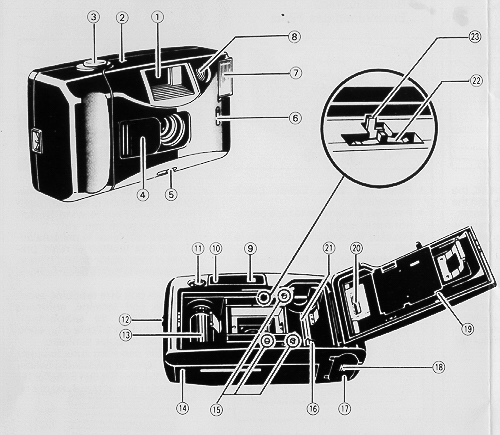 |
(1) Viewfinder |
1. Inserting the batteries
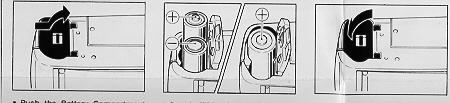 |
· Push the Battery Compartment Latch to pull open Battery Compartment Cover |
· Close the Cover by pushing it shut
Notes: Do not use Nickel Cadmium batteries.
Remove AA batteries from the camera when you do not expect to use it for a long period time.
Replace batteries with new ones when the Flash Ready Lamp takes more than 30 seconds to light up.
In cold conditions the capacity of the battery decreases, and the camera may not operate correctly. In that case, you should warm the battery (carry them in your pocket for exam pie) before using the camera.
2. Opening the Lens Cover
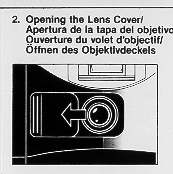 |
· Slide the Lens Cover in the direction of the arrow. · The Lens Cover is interlocked with the safety mechanism of the camera You can fire the camera only when the Lens Cover is open. |
3. Checking the Battery
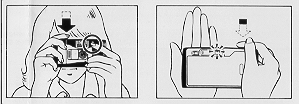 |
· Cover the Photocell with your finger,
and press the Shutter Release Button down halfway
· Make sure that the Low Light Warning LED in the Viewfinder lights up. |
Note: Some clear plastic surfaces may be covered with a protective plastic
film. Gently remove this material before using camera.
4. Setting the film speed
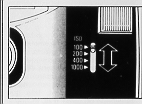 |
· Slide the Film Speed Selector to the closest ISO number according to the film speed indicated on the outside of the film. · Applicable Films: ISO 100 ISO 1000 It's recommended you use color negative films. Color slide films may be improperly exposed under varying lighting conditions. |
(webmaster: Color slide film is very sensitive to the kinds of light it is
shot under. Fluorescent lights, indoor lights, etc. The colors may be off
and slide film cannot be "corrected" like print film can when being printed.
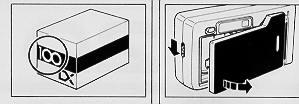 |
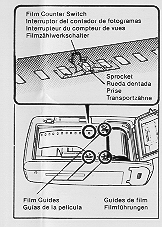
· Push the Back Cover Latch down · Load the film into the Film Chamber, pull out the film leader, press the film container's outlet so that the surface becomes level with the rail surface and place the film |
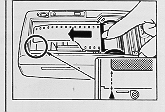 |
· Line up the film within the Film Guides. Make sure that there is no slack in the film and that the edge of the film stays over the Film Counter Switch. Then press the Back Cover shut. |
 |
· Press the Shutter Release Button once
The film will be automatically advanced until number"1" appears in the Film
Counter Window. If number "1" does not appear, or the film transport motor
does not stop, the film has not advanced correctly. Open the camera back
· The Film Loaded Window confirms whether film is in the camera or not, and shows you what type of film is being used. |
6. Taking a picture
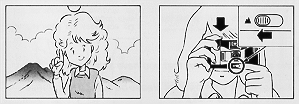 |
· Be sure your subject is at least 1 m 3 ft. ) A away from the camera
· Take pictures with sunlight behind you. |
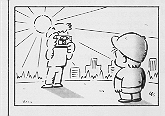 |
· The camera takes beautiful pictures
outdoors at any focusing distance greater than 1 m (3 ft.) by simply
pressing the shutter For distant subjects, the image will be clearer if the
Infinity Switch is held while the shutter is pressed. The Infinity Switch is
the small gray lever on the front of the camera.
· Push the Back Cover Latch downward. |
7. Using the Flash/
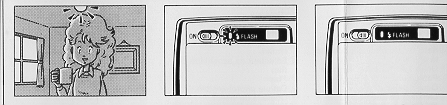 |
· Use the flash whenever the Low Light Warning LED lights up. · Slide the Flash Switch to the ON |
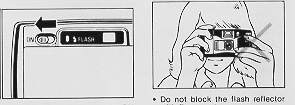 |
· Wait until the Flash Ready Lamp is lit
before shooting.
· Do not block the flash reflector · Always turn off Flash Switch when not in use. · Flash shooting Range 1.2-3.1 m (3.9-1 0.2 ft.) (ISO 100 color negative film) |
8. Rewinding the Film.
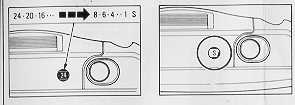 |
· After the end of the film has been reached, the film will I be automatically rewound. · After the film is fully rewound and the motor stops automatically and the "S" is seen in the film counter. |
9. Unloading the Film
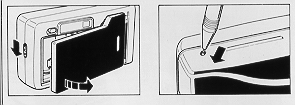 |
· Push the Back Cover Latch downwards · If you wish to rewind the film before the end of roll is reached, push the Manual Film Rewind Switch |
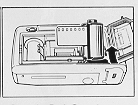 |
· Open the Back Cover to remove the film cassette. |
Proper care of your camera
*If there is dirt on the lens, do not touch with fingers. Use a blower to
blow the dust away, or wipe the surface gently with a soft cloth.
Major Specifications
Type: 35 mm lens shutter type
Lens: 35 mm Ricoh f4.5 lens, 3 elements, 3 groups
Focusing: Fixed Focus with Infinity Switch
Distance 1 m (3.3 ft) - 00
Shutter: Mechanical shutter, 1/125 sec.
Viewfinder: Reverse Galilean viewfinder
Magnification: 0.52X
Field of view: 80%
Low light warning: CdS photocell activates Red LED in viewfinder
Film speeds: ISO 100 200 400, 1000
Film loading: Ricoh auto load system
Film advance: Automatic advance
Film rewind: Automatic rewind at the end of roll
Exposure counter: Additive, automatic resets to "S" when the camera back is opened.
Built-in flash: Electronic flash
Flash recycling time: About 6 sec. (with fresh batteries, at room temperature)
Flash shooting range: 1.2-about 3.1 m (3.9ft.-10.2ft.) with 150100 color negative film
Power source: 1 lithium battery (Panasonic CR-123A or Duracell DL-123A) or 2 AA penlight Alkaline or Manganese batteries (Nickel Cadmium batteries can not be used.)
Dimensions: 132(W)x68(H)x50(D)mm (5.2x 2.7x2.0 inches)
Weight: 220g (without batteries)
Specifications and appearance are subject to change without notice.