Zenith TTL
Handbook
posted 12-10-'02
HTML Translations - German
- Italian
- French
- Spanish
- Others
These links will not translate any PDF
files

For reference use on many Chinon manual focus and metering cameras
This is the full text and images from the manual. This may take 3 full minutes for all images to appear. If they do not all appear. Try clicking the browser "refresh" or "reload button".
This camera manual library is for reference and historical purposes, all
rights reserved.
This page is copyright by
, M. Butkus, N.J.
This page may not be sold or distributed without the expressed
permission of the producer
I have no connection with Chinon Co., Japan
If you find this manual useful, how about a donation of $3 to: M. Butkus,
29 Lake Ave., High Bridge, NJ 08829-1701
and send your E-mail address too so I
can thank you. Most other places would charge you $7.50 for a electronic copy
or $18.00 for
a hard to read Xerox copy.
This will allow me to continue to buy new manuals and maintain these pages.
It'll make you feel better, won't it?
If you use Pay Pal, use the link below. Use the above address for a check, M.O. or cash.


Introduction
You can be justly proud that you have chosen the
Zenith TTL*_ the latest and most advanced 35mm
reflex camera from the U.S.S.R. * Through-the-lens
metering offers many advantages over other
metering systems. Close range pictures with the
aid of bellows or extension tubes; using filters or
teleconverters; taking pictures with the aid of a
microscope (photomicrography) -- all become easy
and straightforward, since the meter cell
determines the amount of exposure required (and
thus automatically compensates for same) by
reading through the accessory in use. This
handbook has been systematically written and
designed to take you through all the operational
and handling features of your new camera in easy
stages.
Though many hints and tips towards better
photography have been included, this handbook
should in no way be thought of as a
comprehensive guide to general photographic techniques. There are numerous
useful books of this type available and if you are
just taking your first shaky steps in photography it
would certainly benefit you to consult your local
library or bookshop.
Your Zenith camera is sturdily built and will work happily under widely varying conditions. Do remember, though, that it is a precision-built optical instrument and should therefore be handled carefully and protected from violent shocks, damp, dust and sand and sudden changes of temperature. Take care of your camera and it will give you years of reliable service and brilliant pictures. The wide range of accessories available, particularly those from the U.S.S.R. which offer outstanding value-for-money, enable you to cope with almost any photographic situation. You can build up as complete a system as you need at your own pace.
To get the best possible results from your Zenith, study this book thoroughly to make sure that you are familiar with the essential features of the camera before you start taking pictures. Refer back to the book any time there is something you are not sure of. Many operational features of this camera are unique and probably somewhat different from other cameras you may have owned. It is therefore strongly recommended that after carefully reading the instructions you shoot a 'test roll of film, have this film processed, and examine the pictures before exposing additional rolls. This test roll will verify that you are using your new camera correctly and allow you to make any necessary changes in camera operation. Additionally, it will confirm that all the camera controls are functioning perfectly.
N. B. A policy of continual product development means that there may be minor differences in design or specification between your camera and these instructions.
The illustration/description of equipment and accessories throughout this book is for information only and should by no means be considered an offer of sale.
Contents
|
Specification p.2 Loading your camera p.3 Picture-taking technique p.7 Your TTL Meter and how to use it p.8 Exposure hints p.10 Setting camera and lens controls p.1 2 Choosing shutter speeds and apertures p.14 Viewing and focusing p.16 Depth of field p.18 |
Taking the picture
p.21 Removing exposed film p.22 Taking flash pictures p.24 Using the self-timer p.26 Changing lenses p.28 Care of camera and accessories P.30 Trouble-shooting p.32 Taking better pictures p.34 Choosing lenses and accessories p.37 |
Specification
Format - 24 x36mm; using standard 35mm cassettes of 12,20, 24 or 36 exposure color or black and white film.
Shutter Horizontal traveling Focal Plane type, speeded 1/30, 1/60, 1/125, 1/250 and 1/500th second plus B (brief time). Linked to self-timer giving approximately 7 seconds delay.
Flash Synchronization Electronic flash only at 1/30th sec. through a standard 3mm co-axial -- socket.
Viewing/Focusing system Eye-level pentaprism/instant return mirror shows upright laterally correct image. Bright Fresnel focusing screen with central ground glass/microprism spot.
Exposure meter Built- in CdS cell with needle coincidence through viewfinder, calibrated for 6-500 ASA /l 3--28 DIN. Power source Mallory or Ever Ready PX625 Battery.4www.butkus.org (Should be replaced once a year.)
Frame counter Additive 0--36 manual resetting type.4www.butkus.org
Standard Lens-Helios 44M 58mm focal length
Construction- 6 elements in 4 groups
Diaphragm type-Fully automatic instant re-open Optional manual over-ride
Aperture Range- f/2-f/16 with click stops at full and half apertures (except
between f/11 and f/16)
Distance Scale-0.55-Infinity
Angle of View - 40degrees
Filter Size - 52mm screw 54mm push-on4www.butkus.org
Lens mount -'Universal' (42mm) thread accepts standard single pin automatic
lenses and accessories
Loading your camera
Precautions:
(a) Your Zenith camera accepts any standard 35mm cassette, of color or black and white film.
(b) Always load the film in subdued lighting conditions, If
outdoors, look for a shady area or shield the camera
from direct sunlight with your body or coat.
(c) Whenever possible avoid loading in a dusty place or at
the seaside where strong salty wind is blowing.
(d) When loading take care not to touch the shutter blinds.
(e) Make sure Shutter Release has not been set in the '1 (or
Time) Lock position. (See p.12)
Procedure:
| 1.Raise the Back Lock-catch (16) and swing the Camera Back (27) open.4www.butkus.org
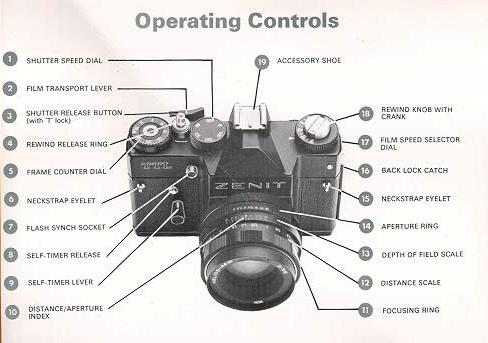
2. Before loading ensure rewind release mechanism has been cleared. The Rewind Release Ring (4) must be turned clockwise so that the three dots are fully lined up. Turn Film Transport Lever (2) through a couple of short strokes till no further movement is possible while applying light finger pressure to the back Sprocket wheel (24). The Sprocket should rotate in time with the lever action and not 'free-wheel. 3.Push up the Cassette Retaining Spindle (21) from inside the camera. Place the cassette into its chamber (22) ensuring that the cassettes projecting end faces down. Push Rewind Knob (18) back to its original position to hold the cassette in place -- you may need to turn it clockwise a little until it seats properly in the cassette spool. 4. Draw out from the cassette enough film (about 3m) to insert the leader into the Take-up Spool (26). The leader can be inserted into any one of the spools slots. Ensure that one perforation hole is caught by the Take-up Spool tooth, also see that the Sprocket wheel (24) engages in a perforation. |
|
|
|
5. Make sure film cassette lies flat, then alternately
depress Shutter Release Button (3) and turn film
Transport Lever (2) until perforations on both sides of
film are engaged by the Sprocket Wheel (24). The film
should also be taut around the Take-up Spool-- turn
bottom spool-flange with finger towards cassette position
to take up any slackness.
Note -- Film is advanced by sprocket drive, so it is most
important for sprockets to engage film perforations
properly.
6. Complete film wind, if necessary, to its limit. Press Shutter Release Button (3) then close the Camera Back (27). Firm pressure only is required as
the back has a self-locking catch.
7. Take up any slackness of film within the cassette (especially important with shorter than 36
exposure lengths) by slowly turning Rewind Knob (18) clockwise till slight resistance is felt.
8. Move Film Transport Lever (2) through two or more
short strokes (letting it return to the starting position after
each stroke) until no further movement is possible, watching to see if the Film Rewind Knob
(18) turns while doing so. If the Rewind Knob turns it
shows that the film is correctly loaded and moving
properly through the camera. If it doesn't turn, and you
have taken up the slack as described in step 7, then the
film may not be securely attached to the Take- up spool
or properly engaged by the Sprocket Wheels.
|
9. Now turn Frame Counter Dial (5) until the number '0 shows against the Frame Counter Index (29) and press the Shutter Release (3) once more.
10. If you are ready to take photographs, wind Film Transport Lever (2) fully. .. and your first film frame is in position, as shown by the Frame Counter Index (29). |
|
Notes
(a) Always make sure the Transport Lever (2) has
been fully wound. This is easiest when you move
this lever in two short strokes. When the lever stops
during the second stroke, you are assured that the
cameras film, shutter and frame-counter are all ready
for exposure. Failure to wind the Transport Lever
fully may result in a 'blank exposure.4www.butkus.org
|
(b) To maintain accuracy in use, the Frame Counter Dial (5) must be zeroed only after winding the film/shutter. After this, every time you wind on, the dial will come to rest with the next division opposite the Counter Index (29). The counter tells you how many frames (pictures) you have taken and when it reaches 12, 20, 24 or 36 (depending on film in use), you will need to rewind the film into its cassette and put in a new film. Color film especially should not be left in the camera for long periods and for the best results should be processed as soon as possible after exposure. Incidentally, do carry a spare film -- nothing is more annoying than to run out of film just before the best shot turn up! |
Rewind knob
should rotate anti-clockwise when film is
wound.
|
Picture Taking Technique:
Once the camera is loaded you have to consider three aspects of taking a picture -- exposure, focus and composition. The first two of these are purely technical; the following sections, together with a little experience, will soon enable you to handle your Zenith with sufficient enough ease to leave you free to concentrate on the third aspect, composition, which is the artistic one.
Exposure:
Though sometimes thought to be photography's
biggest problem, obtaining correct exposure is not
really
so
difficult thanks to the latitude of modern-day films.
There are three governing factors: sensitivity to light of the film (usually expressed as an
ASA speed rating); shutter speed, which controls the
amount of time the image is allowed to affect the film;
and the lens aperture, which controls the brightness of
the image falling on the film. It is recommended to use a minimum shutter speed of
1/125th second where possible, (certainly for the
majority of outdoor subjects). This speed is fast enough
to prevent most 'blur due to camera or subject movement, yet is slow enough to permit
picture-taking in a wide variety of lighting conditions
with today's sensitive films. If its necessary to shoot at
1/60th or 1/30th second, hold the camera as steady as
possible -- ideally by using a tripod, or by bracing your
arms on a nearby table or other support.4www.butkus.org
Your TTL Meter and how to use
Power Source
| The camera is supplied complete with a battery (PX
625). To check that the battery is fitted, use a small coin (half penny) to
turn the battery compartment cover anti-clockwise for removal.
|
|
|
Ensure that the battery is fitted with the + sign facing you, then re-fit the battery cover as follows. Holding the cover at an angle to the camera (see illustration), insert the lug under the rim at the top of the compartment and press the cover into position so that the two spring clips engage in the cut-outs on either side. The coin can then be used to turn the cover clockwise until it locks. |
![]() |
Meter Check
The meter needle normally zeros (comes to rest)
over the circle seen on the right-hand side of the
viewfinder. Before using the camera ensure the meter
is working by setting the Film Speed Selector (17) at
500 ASA, the Shutter Speed Dial (1)at 1/30th sec and
the Aperture Ring (14) at f/2. Point the camera at any
bright light source and, while looking through the
viewfinder, depress the Shutter Release Button (3).
Continue depressing the Release Button until it activates the meter switch which should deflect the
meter needle upwards past the + sign. If there is no
deflection of the needle this indicates the probability of
a dead battery. The meter should be checked regularly
in this way and batteries replaced at least once a year
to ensure accuracy in use.
Using the Meter
| 1. Set Film Speed. The Film Speed Dial (17) has 2 scales of figures on it, one marked for films rated at 16,32,65, 130, 250 and 500 ASA and the other marked in DIN ratings of 13, 16, 19,22,25 and 28. Turn the selector until the speed number for your film shows against the index marked on the camera top. The dial is click-stopped and so must be turned till it locks onto one of the numbered or intermediate settings. Select the number or setting nearest the speed of your film (e.g. foray 64ASA film set it to 65 on the ASA scale, for a 25 ASA film set it to the click-stop setting between 1 6 and 32 ASA. | 2. Aim the camera at your subject. Bearing in mind the subject matter of your photograph select what you consider to be a suitable shutter speed. Now, while looking through the viewfinder, depress the Shutter Release Button (3) as described in Meter Check procedure. This activates a switch in the metering system which in turn deflects the meter needle (either up or down depending on the lighting conditions). |
|
|
|
| 3.Match the Needle. While continuing to depress the Shutter Release slightly turn the Aperture Ring (14) or the Shutter Speed Dial (1) until the needle bisects the circle situated between the + and -- signs on the right-hand side of the viewfinder. When the needle bisects the circle correct exposure is indicated. If the needle is deflected towards the -- sign a slower shutter speed or wider aperture is required, if deflected towards the + sign a faster shutter speed or smaller aperture is required. Should you find it impossible to line-up the needle within the circle this indicates that lighting conditions or film speed need to be altered.4www.butkus.org |
|
|
|
Helpful hints for better exposure Remember that your exposure meter measures all the light that reaches its cell and 'averages out the brightness or contrast range before giving a reading. With subjects of average contrast (e.g. scenes lit from the front, or at an angle from the side, where there are no heavy shadows and dark and bright areas are fairly balanced) the right amount of exposure is indicated automatically. However, to obtain the best results with subjects of widely varying brightness range it is wise to take some precautions.
Shutter Speeds
Turn the Shutter Speed Dial (1) until the required
speed aligns with the index mark on the body. Shutter
speeds may be selected before or after the Film
Transport Lever (2) has been wound. However, the
following points must be observed to avoid
mechanical damage.
(a) Always turn the Shutter Speed Dial tone of the marked speeds (30, 60, etc. that indicate fractions of a second, or B, that indicates a hand-controlled time exposure) -- NEVER to a position between marked speeds; and
(b) DO NOT TURN the Shutter Speed Dial the short
distance between B and 500.
Long Exposure Times (Time Exposures)
Time exposures of one second duration or longer, enable you to take
photographs in lighting conditions that would be too poor for normal
picture-taking, e.g. city streets at night or dimly lit interiors. To take a
time exposure with your Zenith set the Shutter Speed Dial (1) to 'B. At this
setting the Shutter will remain open for as long as the Shutter Release Button (3)
is pressed down.
| A sturdy tripod is really essential for this type of work, though sometimes it is possible to find an alternative firm support (a street bollard or church pew, for example). A cable release, preferably the locking type, is also recommended for extra steadiness. If such a release is not available the shutter can be kept open for extended periods, via the "T" lock, simply by pressing the Release Button (3) down firmly and turning at the same time in an anti-clockwise direction (as seen from top of camera) until it stops. 4www.butkus.org |
|
The shutter will remain open for as long as desired and is closed on completion of exposure by pressing down the Release Button once more and returning same, clockwise, to its normal position. To reduce the risk of vibration it is recommended that a piece of black card (or even ones hat) be held in front of the lens as the Release Button is pressed and turned -- the lens is then uncovered for the required time (using a stopwatch or slow count) and then recovered to end the exposure while the Release Button is returned to its normal position. Obviously this procedure only applies to long exposures of several seconds. Note: After using the "T" or Time lock on the Release Button always make certain that the Release Button (3) is turned fully clockwise, that the Rewind Release Ring (4) is still turned fully clockwise and the three dots are properly aligned. This will ensure correct operation of shutter and exposure counter in subsequent pictures.
Your cameras Tripod Bush accepts a standard 1/4 in Whitworth screw. When fitting a tripod or other bush-mounted accessory (e.g. flash bar) care should be taken to see that this is screwed in just finger-tight only (this applies to the carrying-case retaining-screw also). If there is a safety locking -nut on the accessory, turn the main screw up to three revolutions only, then hold it in position and lock into place with the safety nut.
Apertures:
| The Hellos 44M,the standard lens supplied with the Zenith TTL camera, is designed to be used in Automatic or Manual mode. When the Auto/Manual Switch (23) is set to 'A, the aperture remains fully open for viewing and focusing and closes down automatically to a pre-selected f/number value when the Shutter Release Button (3) is pressed down. |
|
When the
Auto/Manual Switch (23) is set to 'M, the aperture
closes down immediately to whatever f/number has
been selected on the Aperture Ring (14). Thereafter
apertures are changed manually by moving the
Aperture Ring into any of its 'click-stop positions.
Normally the lens would be used in Automatic mode, in
which case the lens opening required (f/2, f/2.8, f/4,
etc.) is selected by turning Aperture Ring (14) until that f/number
(or a position mid-way between marked lens
opening if so indicated by meter needle movement in
the viewfinder) aligns with the Distance/Aperture Index
Mark (10). As soon as pressure is taken off the Shutter
Release Button, the aperture automatically returns to its
wide-open position.4www.butkus.org
Choosing shutter speeds and lens openings
Under given conditions of lighting and film sensitivity
there are various combinations of shutter speed and aperture that will produce
good results, However, you will often need to select a particular a shutter
speed or aperture to suit your subject so how do you choose? For example, the
suggested shutter speed of 1/125th second, while fast enough to stop most
normal subject movement,
(people walking etc.) would not be enough to freeze the really fast action of
subjects such as children at play, sports events or racing cars -- here,
speed of 1/250th or 1/500th second would be best.
| Again, if taking a landscape type picture, a small aperture of say f/1 1 or f/1 6 would be needed to obtain maximum sharpness (see Depth of Field). Summarizing then; with moving subjects, choice of shutter speed is of most importance, to stop the motion use the fastest speed possible that lighting conditions will allow; where you need your subject to be sharp over a long range from foreground to background, then choosing a small lens aperture is more important. |
|
Its worth knowing too the relationship between shutter speed and aperture settings. These settings are so designed that altering from one figure to another on either scale, will double or halve the amount of light reaching the film. An aperture of f/5.6 is wider than, and will transmit twice as much light as, an aperture of f/8, and at the same time is smaller than, and will transmit half as much light as, an aperture of f/4. Likewise a shutter speed of 1/1 25th second is slower than, and will transmit twice as much light as, a speed of 1/250th and is at the same time faster than, and will transmit half the amount of light as, a speed of 1/60th second. Thus if you start from a given combination, say 1/1 25th at f/8, and you decide that a shutter speed of 1/250th would be better for the subject and you want to finish up with the same amount of exposure, you will need to compensate for the fact that only half the necessary light is reaching the film by opening the aperture one division to f/5.6. If you had decided that 1/500th were the best speed you would need to open the aperture by two divisions (from f/8 to f/4) since 1/500th is two divisions up from, or four times the speed of, 1/1 25th second. Remember though that all combinations of shutter, speed and aperture are a compromise. There is really no 'correct exposure for any subject, it all depends on the effect you want.
Viewing and focusing
First make sure your lens is securely attached to the
camera by turning it clockwise until no further movement
is possible.
| Look through the viewfinder eyepiece (32) and you can feel safe in the knowledge that there'll be no parallax problems (no more cut-off heads in close-up portraits and the like) as you are viewing and focusing, by means of a ground-glass screen, through the actual lens that takes the finished picture. There is a built-in safety margin of course, in common with many other modern single lens reflex cameras, the viewfinder showing an overall area somewhat smaller than the total film area. This ensures that everything you see in the viewfinder appears in the finished picture despite the fact that slide mounts and masks in printing equipment actually cover part of the films image. |
|
Focusing should always be carried out with the
aperture wide open, unless of course you want to
preview 'depth-of-field, so follow the previous
instructions concerning aperture operation. With the
camera held to your eye turn the Focusing Ring (11)
towards the right for close distances or towards the
left for far distances, until the subject is sharp and
clear on the large ground-glass screen. The Zenith
TTL camera has in addition in the center of its screen,
two aids for speedier critical focusing, a microprism
spot which is composed of literally hundreds of tiny
prisms that distort and accentuate an out-of-focus image. Simply focus the lens until you
obtain a single undistorted image at the center and
you are at the point of sharpest focus. This
microprism works well for the majority of subjects and
conditions but for subjects lacking in contrast or color the fine ground-glass collar around the central spot is
probably more helpful -- its quite handy when using
long telephoto and wide angle lenses too. (Aim your
camera at this instruction book from about 2 feet away
and you'll see how these focusing aids work). You can
of course also use the Distance Scale (12) of your
lens, which is calibrated in meters, to set the focus.
Generally there's no need to check distance, its
almost always easier to use the viewfinder the only
time it becomes necessary is when taking flash
pictures (see p.24) or when 'depth-of-field is
important.4www.butkus.org

Depth-of-field
All photographic lenses, when focused on a given
subject, will show some objects in front of and behind
that subject more or less sharply. This 'range of extra
sharpness is called "depth-of-field" and varies with
different lenses; its greatest with wide angle lenses,
and least with telephoto lenses. With any lens, you'll find your depth-of-field is always greater (more
things in focus) at small lens apertures such as f/11 or f/16 and lesser (fewer things in focus) at larger lens
apertures such as f/3.5, f/2.8 or f/2. Depth-of-field is
also greater in cases of more distant subjects than it
is with close-up subjects and increases nearly twice
as much beyond the subject, your main point of
focus, than it does in front of the subject (towards
the camera).
If your picture is such that you want both nearby and distant objects to be in sharp focus then generally the smallest possible aperture should be used. However, the aesthetic quality of a picture can often be improved by having the principal subject in sharp focus while other objects in the scene are soft and out-of-focus. Here a larger aperture is necessary to produce the "differential focus" that de-emphasizes distracting background and/or foreground detail and thus isolates, and concentrates your viewers attention on, the principal subject.
You may want to preview depth-of-field prior to exposure. This can be done in two ways, first by pressing the Shutter Release Button (3) smoothly until it reaches the definite stopping point, just before firing the shutter. This closes the aperture down to its pre-set value and enables you to get an idea (despite the dimness) of what will or will not be sharp -- the final photograph will be at least as sharp if not sharper than the viewfinder image. The second method is to turn the Auto/Manual Switch (23) to the "M" position which has the effect of manually closing the aperture down to the selected lens opening --this is probably easier to master than the first method but you must remember to return the Switch after use to the "A" position ready for normal operation.
Using the depth-of-field scale (13)
The scale consists of the aperture numbers repeated
each side of the Distance Index (10) and shows, at
any given focus distance, the nearest limits and
furthest limits of acceptable sharpness. Taking the
Helios 44M lens as an example, if this is focused at 4 meters, the depth-of-field stretches from 3
meters to
6 meters at an aperture of f/5.6 while at an aperture of f/16 objects from 2 meters
to infinity (oo) will be
acceptably sharp in the final picture. Note: For the
sake of reading clarity some figures are omitted from the scale; however, its a simple
matter to 'fill in those missing if you remember they
follow the aperture sequence exactly, with those
proceeding left from the index (10) showing the near
limits of sharpness, and those proceeding right
showing the far limits.

Now for some practical examples
(a) You're taking a landscape view where you want
everything needle-sharp from the foreground all the way
to the background. Easy you say, close the aperture
right down to f/1 6-- the snag is that the sky has
clouded over and the light is too poor to use this aperture at a reasonable shutter speed. The
remedy -- obtain the maximum depth-of-field required
with the minimum of 'stopping-down (decreasing
aperture size). Focus through the viewfinder on the
closest object and note the distance (say 3m)
registered against the Index (10), then focus on the
most distant part of your subject and note this distance
(say 10m) also. Now look at your lens and move the
Focusing Ring (11) until both distances appear just
between an identical pair of aperture numbers (f/8, in
above example), on the Depth-of-Field scale (13). Set
the lens to the aperture thus found, use your exposure
meter to determine the correct shutter speed for an
exposure at this aperture, then set this speed on the
Shutter Speed Dial (1). Everything between the two
distances (3 to 10 meters) shown by the matching
aperture numbers (f/8) on the Depth-of- Field scale (13) will appear sharp in the final photograph.
(b) If you need absolute maximum depth-of-field at any
given aperture focus on the 'hyper focal distance. This
is found by aligning the infinity mark (00) against the
Distance Index (10). The distance then found to be
aligning with the near limit of depth-of-field for the aperture
required will be the 'hyper focal distance. If the lens is now
refocused so that this distance aligns with the Index (10) everything will be sharp from half the distance to infinity.
(c) To obtain a "differential focus" effect, determine the
closest and most distant parts of your subject as described
in example (a) above, then refocus the lens so that the
distance of the important part of your subject aligns with, or
is near to, either the near or far limits (according to whether
you want foreground or background out-of-focus) on the
Depth-of-field scale (13) when using a largish aperture,
say f/4. Set lens and camera controls as necessary and you'll be assured of obtaining a picture of high subject
impact.
| Here we can see that the 10 meter focus setting is in fact the hyper focal distance for an aperture of f/8 which gives us the maximum depth- of-field possible from that lens, extending from half that distance (5 meters) to infinity.4www.butkus.org |
|
Taking the picture
Poor first-time results are largely attributable to camera
shake, so its very important to hold the camera steady
using both hands. You will probably find it most
convenient to grip the camera firmly with your right hand
and fire the Shutter Release Button with your right fore-finger. This way your left hand can easily turn the
Focusing Ring and give extra support at the same time.
Always press the Shutter Release Button downwards
smoothly and firmly-- NEVER jab at it.
|
|
|
|
Note the extra support the left hand gives and the "correct" finger position for smooth release of shutter. |
|
For each Successive Exposure. . . just move the Transport Lever until fully wound and you're ready for your next shot. If lighting conditions have not changed it is only necessary to frame the subject, focus and fire the shutter. If taking a photograph in a slightly different direction or if the sun clouds over, take a further meter reading and make any adjustments to camera and lens controls that might become necessary before firing the shutter.
Note: Keep an eye on the Frame Counter (5). When this registers a figure indicating that the entire length of film has been exposed, or if the Film Transport Lever cannot be turned, it is time to rewind the film into its cassette ready for processing. DO NOT try to get an extra exposure -- if the Transport Lever is wound forcibly the film may be damaged and disengage from the cassette making it impossible to rewind.
Removing exposed film
(1)
Before attempting to rewind a film put the cap,
supplied with your camera, back on the lens. This is
simply a precautionary measure to prevent any portion
of the last frame being exposed to light, since the
Rewind Release has the effect of firing the shutter even
if, as sometimes happens, the Transport Lever is only
partly wound when the end of the film has been
reached.
(2) Releasing the film for rewinding. The Zenith TTL
has a locking device which permits rewinding without
constant application of pressure.
To engage it first press the Shutter Release Button (3)
then turn the Rewind Release Ring (4) fully anti-clockwise. Make sure the Ring is turned until no further
movement is possible and you'll then be able to rewind
the whole film quite freely.
(3) Rewinding. To rewind the film it is necessary to lift
the crank handle out of its recess and into the position
as indicated below. The Rewind Knob (18) should be
gripped firmly by the crank and rotated in a clockwise
direction (as indicated by the engraved arrow). While
resistance is felt you are rewinding the film back into
the cassette (the knob will turn freely without resistance
when the film has been fully rewound).4www.butkus.org
(4)
Having rewound the film, remove the camera from
its case, raise the Back Catch (16) and swing the
Camera Back (27) open. Pull the Rewind Knob (18)
upwards fully and take the cassette of exposed film out
of its Chamber (22). Your film is now ready for
processing.
(5) The camera can now be reloaded (after observing
precautions on p.3). If you don't want to reload till a
later date return the Rewind Knob to its 'closed
position.

Taking flash pictures
When the light is poor some form of auxiliary lighting
will be required. This is why your Zenith has a built- in synchronizer which enables you to use an electronic
flashgun. This can be one of the simpler battery
powered, medium-range guns like the Helios 32
(detailed on p.44) or the more advanced type which can
be powered by mains supply or batteries and often have
a built-in minicomputer which automatically regulates
the duration of the flash according to the subject
distance. We recommend you to consult your Zenith
camera dealer for advice on the best type of gun to suit
your needs -- here we can only give guidance on the
procedure and technique of flash photography.
|
1. The Shutter Speed Dial (1) must be set at 1/30th second when using electronic flash.
2. Small light weight flash guns may be safely clipped into the Accessory Shoe (19) on top of the camera. Some electronic guns being heavier may need a separate mounting bracket or 'flash bar which screws into the Tripod Bush (25) at the bottom of the camera. |
![]() |
3.Plug your flash gun lead into the Flash Synchronization Socket (7) making sure its tip is pushed in firmly.
Obviously the type of calculator dial or scale will vary with each make of gun, so consult the instruction book supplied with your unit, or your dealer for exact information -- the general operating rule however is.,.
4. Look through the viewfinder and focus on your subject. You can then find from the calculator dial! scale the correct lens opening for the actual camera-to-subject distance that is shown by your lens' Distance Scale (12).The Aperture Ring (14) must then be set accordingly.
If the flash unit does not fire when you press the Shutter Release Button (3) make sure that the lead is securely plugged into the Flash Synchronization Socket (7) and check that unit is switched on.