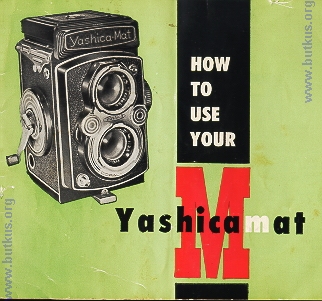
Yashicamat M
Posted 9-20-03

HTML Translations - German - Italian - French - Spanish - Others
These links will not translate any PDF files


This camera manual library is for reference and historical purposes, all rights reserved.
This page is copyright © by , M. Butkus, NJ.
This page may not be sold or distributed without the expressed permission of the producer
I have no connection with Chinon Co., Japan

On-line camera manual library
This is the full text and images from the manual.  This may take 3 full minutes for all images to appear.
If they do not all appear.  Try clicking the browser "refresh" or "reload button" or right click on the image, choose "view image" then go back.  It should now appear.
To print, try printing only 3 or 4 pages at a time.

Back to main on-line manual page

If you find this manual useful, how about a donation of $3 to: M. Butkus, 29 Lake Ave., High Bridge, NJ 08829-1701 
and send your e-mail address so I can thank you.

Most other places would charge you $7.50 for a electronic copy or $18.00 for a hard to read Xerox copy.  


This will allow me to continue to buy new manuals and pay their shipping costs.  
It'll make you feel better, won't it?
 
If you use Pay Pal, use the link below. Use the above address for a check, M.O. or cash.

Click here to PDF manual created from this file - Better Printing

TO SECOND SECTION

Description of Yashica

THIS IS YOUR YASHICAMAT

A precision instrument capable of bringing you some of the finest photographs you've ever taken. Please read the following pages carefully. Follow the easy, step-by-step recommendations.

To fully exploit all the advantages of your Yashicamat

To take better pictures with more confidence

To maintain the flawless operate the camera4www.butkus.org

Yashica parts - front  Side Back

REMOVING THE CAMERA FROM THE CASE
Just snap off the bottom when removing the entire front element of the carrying case.  To remove the camera for film loading raise the two metal Lock Slides.  Spread the sides of the cave apart and lift the camera free.

Your Yashica camera comes complete with a deluxe, leather eveready case. While the camera is in the case, all working parts are visible and ready to use. All you need to do is open the back-snap and lift the : top at the case forward.4www.butkus.org


LOADING THE FILM

120 size film, 12 pictures per roll, in the popular 2 1/4 X 2 1/4 size. Black-and-White or Color

(1) To unlock back cover, turn the tripod socket in the direction marked 'O'. Then open the Bock Cover by swinging it out.

(2) Remove the Take-Up Spool in the Lower Film Chamber by pulling out the lower Film Spool Locking Spring.4www.butkus.org


(3) Place the Take-Up Spool in the Upper Film Chamber by pulling out the Upper Film Spool Locking Spring.

(4) Place a new roll of size 120 film in the Lower Film Camber.


(5) Flip up the Film Transport Crank and slowly wind it clockwise so that the wider slot of the Take-up Spool in the Upper Film Chamber faces upward. Then gently draw out the film leader and thread it firmly and evenly into the slot.

(6) Gently wind the Crank clockwise.


(7) Advance the film by slowly winding the Crank until the arrow on the film points to the triangles on either side of the camera body.

(8) Close the camera back cover and lock it by turning the Tripod-Socket in the direction marked 'C'. The letter S' will appear in the Film Counter Window.4www.butkus.org


The Yashicamat transport employs a fine, precision mechanism, constructed to provide years of trouble-free performance Like any fine instrument it should be treated with care and respect.

The following are recommended:

a. Operate the film transport crank gently. It is important that the clockwise, film-advancing stroke of the crank be first completed before it is brought bock.

b. In loading the film, be sure that the paper leader is inserted in the take-up spool so that the film will crow evenly.

(1 ) Wind the crank clockwise until it comes to a stop. The letter 'S' will have disappeared and No. 1 will appear in the Film Counter Window.

(2) Then wind the Crank counter-clockwise until it stops. You are ready to Snap your first picture.

For subsequent exposures a smooth pendulum swing, first downward to stop and then upward to stop, advance the film and cocks the shutter simultaneously.4www.butkus.org


(A) The downward wind advances the film and moves up the number of the next film in the Film Counter Window.

(B) The upward-wind cocks the shutter. 

(C) The position of the Crank when it is flipped back into its rest after your pictures have been taken.


The shutter should not be kept cocked when not in use because it weakens the shutter spring, and there is the possibility you may unknowingly press the shutter button and waste a film.

TO REMOVE THE LENS CAP
Raise the lower cap and fold back on its hinge. 


Turn the upper cap counter clockwise and remove.4www.butkus.org


LENS OPENING AND SHUTTER SPEED

(A) The arrow points to the Lens Opening and Shutter Speed Scale Window. The letter 'f' on the left of the window indicates lens opening and 'see' indicates shutter speed.

(B) The shutter speed is set by turning the Control Wheel with your right-hoed thumb either up or down as indicated by the arrow. The red shutter speed figures should be set so that the red line in the window runs exactly through the center of the figures.

(C) The lens opening is set by turning the Control Wheel with your left-hand thumb either up or down as indicated by the arrow. The block lens opening figures should be set so that the red line in the window runs exactly through the center of the figures.4www.butkus.org

The correct combination of lens opening (aperture) and shutter speed (exposure) is imperative to obtain a good picture For details see Pages 10 and 11.


SIGHTING THE SUBJECT AND FOCUSING

Your Yashicomat is a twin-lens reflex camera. The lower lens takes the picture. The upper lens is for focusing and composing on the ground glass viewing screen.

(1) Open the focusing hood by lifting it at the back.


(2) Rotate the Focusing Knob until your subject on the ground glass screen is sharp. The bright round lens in the center of the ground glass viewing screen enables you to obtain a sharp focus and should be the center of the picture you are composing on the screen. The red lines on the screen help you to judge proportion and proper composition. Compose your subject on the ground gloss as you would like to see it in the final picture.

TO SECOND SECTION